





Compare SNAP-8 peptide with Argireline, Matrixyl and GHK-Cu for wrinkle reduction, mechanisms, formulation applications and cosmetic peptide sourcing.
How Does SNAP-8 Peptide Compare with Other Cosmetic Peptides for Wrinkle Reduction?
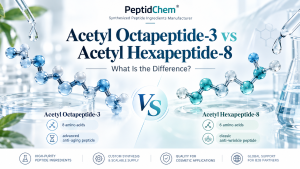
SNAP-8, also known as Acetyl Octapeptide-3, is a synthetic cosmetic octapeptide primarily associated with expression-line and wrinkle-focused skincare formulations. It belongs to the broader category of neurotransmitter-inhibitor cosmetic peptides and is structurally related to Acetyl Hexapeptide-8, commonly known as Argireline.
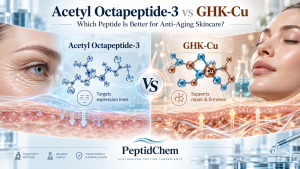
Compared with other cosmetic peptides, SNAP-8 is particularly relevant when a formulation strategy focuses on expression lines and visible wrinkle appearance, while peptides such as palmitoyl pentapeptide-4 and GHK-Cu are generally associated with different biological approaches, including extracellular-matrix and skin-conditioning pathways.
However, the scientific evidence should not be overstated. A 2025 review of commercial cosmetic peptides found substantial variation in the quality and type of evidence supporting different cosmetic peptide ingredients. A 2026 systematic review of randomized controlled trials also found that peptide-based interventions can improve several skin-aging parameters, but the pooled effect on wrinkles was modest.
For cosmetic brands and formulators, therefore, SNAP-8 should be evaluated according to mechanism, formulation requirements, documentation, purity, stability and available product-specific evidence—not simply by marketing claims.
What Is SNAP-8 Peptide?
SNAP-8 is a synthetic eight-amino-acid peptide used as a cosmetic ingredient for advanced anti-aging and expression-line formulations.
Its commonly referenced identity is:
| Specification | SNAP-8 |
|---|---|
| Common name | SNAP-8 |
| INCI name | Acetyl Octapeptide-3 |
| Peptide type | Synthetic octapeptide |
| Application | Cosmetic formulations |
| Main positioning | Anti-aging / expression-line skincare |
| Typical formats | Serums, creams, essences, eye-area products |
| Manufacturing approach | Chemical peptide synthesis |
| Quality documentation | COA, HPLC, LC-MS/TDS/SDS depending on supplier |
SNAP-8 is structurally related to the SNAP-25 region involved in SNARE-complex biology. Its cosmetic positioning is based on the concept of modulating processes associated with neurotransmitter release and facial-expression-related muscle activity.
Importantly, a topical cosmetic peptide should not be presented as equivalent to injectable botulinum toxin. Current scientific literature continues to identify skin penetration and delivery as important limitations for topical peptides.
How Does SNAP-8 Work Compared with Other Cosmetic Peptides?
Cosmetic peptides are not one uniform ingredient category. They can be classified according to their proposed biological roles.
A useful formulation-level comparison is:
| Cosmetic peptide | General peptide category | Main formulation positioning | Wrinkle-related approach |
|---|---|---|---|
| SNAP-8 | Neurotransmitter-inhibitor peptide | Expression-line skincare | Modulation of expression-related pathways |
| Acetyl Hexapeptide-8 | Neurotransmitter-inhibitor peptide | Fine-line / expression-line products | Similar SNAP-25-related concept |
| Palmitoyl Pentapeptide-4 | Signal peptide | Anti-aging / skin-conditioning | Supports extracellular-matrix-related signaling |
| GHK-Cu | Copper carrier peptide | Skin conditioning / repair-focused products | Associated with extracellular-matrix and remodeling pathways |
| Other signal peptides | Signal peptides | Firming / anti-aging | Cell-signaling and matrix-related pathways |
The literature generally divides cosmetic peptides into categories including signal peptides, carrier peptides, neurotransmitter-inhibitor peptides and enzyme-inhibitor peptides.
This distinction is important for B2B buyers because the best ingredient choice depends on the product concept and claim strategy, rather than simply choosing the peptide with the longest or most recognizable name.
Is SNAP-8 Better Than Argireline for Wrinkle Reduction?
SNAP-8 and Argireline are closely related cosmetic peptides, but they should not automatically be described as having a clinically proven hierarchy.
Argireline generally refers to Acetyl Hexapeptide-8, while SNAP-8 is Acetyl Octapeptide-3. SNAP-8 is an extended peptide designed around a related structural concept.
A recent review of Acetyl Hexapeptide-8 highlighted promising cosmetic results but also identified a major formulation challenge: its hydrophilic nature and molecular size can limit penetration through the stratum corneum.
For SNAP-8, the publicly available human evidence is comparatively limited, and published studies involving SNAP-8 have often evaluated it as part of multi-ingredient delivery systems rather than isolating the effect of the peptide alone.
Therefore, a responsible B2B comparison should describe SNAP-8 as a specialized expression-line peptide rather than claim that it universally outperforms Argireline.
How Does SNAP-8 Compare with Palmitoyl Pentapeptide-4?
Palmitoyl pentapeptide-4 represents a different cosmetic-peptide strategy.
Rather than primarily focusing on neurotransmitter-related mechanisms, palmitoyl pentapeptide-4 is commonly positioned as a signal peptide associated with extracellular-matrix and skin-aging pathways.
There is also human clinical evidence for the broader palmitoyl pentapeptide technology. A double-blind, placebo-controlled split-face study involving 93 women reported significant improvements in facial wrinkles and fine lines after topical use of palmitoyl-KTTKS over 12 weeks.
This illustrates why formulators should distinguish between peptide categories:
SNAP-8 → expression-line focused strategy
Palmitoyl pentapeptide-4 → matrix/signaling-focused strategy
For some premium formulations, these different mechanisms can be complementary rather than mutually exclusive.
How Does SNAP-8 Compare with GHK-Cu?
GHK-Cu is another widely discussed cosmetic peptide, but it operates through a substantially different formulation concept.
GHK and its derivatives have been investigated in relation to collagen, extracellular-matrix biology, skin remodeling and wound-healing processes. However, a recent review found that although GHK-Cu and related derivatives are widely used in anti-wrinkle products, clinical evidence specifically evaluating GHK-Cu as a topical anti-wrinkle ingredient remains limited.
GHK-Cu also presents formulation and permeability considerations.
Therefore:
- SNAP-8 is relevant to expression-line-focused formulations.
- GHK-Cu is relevant to carrier-peptide and skin-repair/matrix-oriented formulations.
- Palmitoyl peptides are commonly positioned around signaling and extracellular-matrix pathways.
The choice should be based on the intended formulation architecture and substantiated claims.
What Makes SNAP-8 Attractive for Cosmetic Formulators?
For B2B skincare manufacturers, SNAP-8 can be attractive because it provides a recognizable peptide active for premium anti-aging and expression-line formulations.
Key formulation advantages include:
1. Clearly defined synthetic structure
Synthetic peptide production allows manufacturers to establish a defined molecular sequence and batch specifications.
2. Premium anti-aging positioning
SNAP-8 fits naturally into high-value facial serum, eye-care and advanced anti-aging concepts.
3. Compatibility with peptide-focused formulations
SNAP-8 can be considered alongside other cosmetic actives depending on formulation objectives.
4. Strong commercial keyword demand
Terms such as SNAP-8 peptide, Acetyl Octapeptide-3, cosmetic peptide supplier and anti-wrinkle peptide ingredient reflect ingredient-level purchasing intent.
5. Suitable for B2B ingredient sourcing
Brands, contract manufacturers and formulation laboratories can evaluate SNAP-8 based on identity, purity, analytical documentation and application requirements.
What Should Buyers Look for in a SNAP-8 Cosmetic Peptide Supplier?
Choosing a cosmetic peptide supplier requires more than comparing a quoted price.
For professional procurement, buyers should evaluate:
1. Peptide identity
Confirm:
- INCI name
- CAS number where applicable
- molecular identity
- sequence information
- batch identification
2. Purity testing
Ask whether the supplier provides appropriate analytical documentation, such as:
- HPLC
- LC-MS/MS or MS
- chromatographic purity data
- batch-specific COA
3. Manufacturing method
For synthetic peptide ingredients, ask whether the material is manufactured through a controlled solid-phase peptide synthesis (SPPS) or another validated synthesis route.
4. Batch consistency
A cosmetic ingredient manufacturer should be able to provide consistent specifications between production batches.
5. Technical documentation
B2B buyers may require:
- COA
- SDS
- TDS
- specification sheet
- storage recommendations
- stability information
- packaging information
- regulatory documentation applicable to the destination market
6. Custom sourcing requirements
For larger cosmetic brands, supplier evaluation may also include:
- MOQ
- sample availability
- bulk packaging
- production capacity
- lead time
- export documentation
- customized specifications
Why Choose a Synthesized Peptide Ingredient Manufacturer?
For brands developing peptide-based skincare, working directly with a synthesized peptide ingredient manufacturer can provide greater control over ingredient specifications and supply-chain documentation.
A manufacturer specializing in synthesized peptide ingredients can support the procurement process from laboratory evaluation to commercial-scale sourcing.
For SNAP-8, buyers should request a product specification package covering:
| Buyer Requirement | Recommended Information |
|---|---|
| Ingredient | SNAP-8 / Acetyl Octapeptide-3 |
| Peptide type | Synthetic cosmetic peptide |
| Identity | Confirmed by analytical testing |
| Purity | Batch-specific specification |
| Analysis | HPLC / MS as applicable |
| Documentation | COA, SDS, TDS |
| Sample | Available for formulation evaluation |
| Packaging | According to commercial requirement |
| MOQ | Confirmed according to order volume |
| Application | Facial serum, cream, essence, eye-care |
| Storage | Follow supplier specification |
| Supply | Laboratory → pilot → bulk procurement |
This approach gives cosmetic manufacturers a more practical basis for supplier qualification than relying on generic anti-aging claims.
SNAP-8 Peptide vs Other Cosmetic Peptides: Which Is Appropriate for Your Formula?
There is no single cosmetic peptide that fits every wrinkle-care formulation.
Instead, formulators can select ingredients according to the desired product concept:
For expression-line positioning
Consider SNAP-8 or related neurotransmitter-inhibitor peptides.
For extracellular-matrix/signaling positioning
Consider palmitoyl peptides and other signal peptides.
For carrier-peptide concepts
Consider GHK-Cu and related copper peptides, subject to formulation and evidence requirements.
For multi-peptide formulations
Combining different peptide categories may allow a formulation to address multiple cosmetic objectives, although each combination should be evaluated for compatibility, stability, dosage and substantiated claims.
A 2025 review identified 102 commercially available cosmetic peptides and emphasized that their supporting evidence varies considerably across ingredients and experimental models.
SNAP-8 Cosmetic Peptide Product Specification
For B2B buyers searching for SNAP-8 raw material, the following specification format can be used as a product evaluation sheet:
| Product Specification | SNAP-8 |
|---|---|
| Product Name | SNAP-8 Peptide |
| INCI | Acetyl Octapeptide-3 |
| Category | Cosmetic Peptide |
| Type | Synthetic Octapeptide |
| Primary Application | Anti-aging skincare |
| Target Product Types | Serum, cream, essence, eye-care |
| Intended Cosmetic Positioning | Expression-line / wrinkle appearance |
| Manufacturing | Synthetic peptide production |
| Quality Testing | HPLC / MS according to specification |
| Documentation | COA / SDS / TDS |
| Sample | Available according to supply program |
| Bulk Supply | Available according to manufacturer capacity |
| MOQ | Confirmed according to required quantity |
| Packaging | Customized for B2B orders |
Note: Commercial specifications such as purity, MOQ, packaging and lead time should be confirmed against the current batch specification and purchase agreement rather than treated as universal industry values.
How Can Cosmetic Brands Source SNAP-8 in Bulk?
Brands and contract manufacturers looking for bulk SNAP-8 peptide should provide the supplier with:
- Required quantity
- Intended cosmetic application
- Target market
- Required purity specification
- Packaging requirements
- Documentation requirements
- Sample requirements
- Expected annual volume
For a cosmetic peptide supplier, the ability to provide traceable batch documentation and analytical testing can be as important as the ingredient itself.
If your company specializes in synthesized peptide ingredients, SNAP-8 can be positioned within a broader portfolio of cosmetic peptides for serum, cream, eye-care and premium anti-aging formulation development.📩 Contact us to request a quotation or discuss your specific requirements. Let’s build a strong partnership supply for your anti-aging cosmetics product line.
Also See
Palmitoyl Pentapeptide-4 vs Palmitoyl Tripeptide-1: Which Peptide Should Brands Choose
Copper Tripeptide-1 vs Retinol: Comparing Modern Anti-Aging Skincare Ingredients
GHK-Cu vs Matrixyl: Which Peptide Is Better for Collagen Support and Skin Repair?
FAQs:
Q1.What is SNAP-8 peptide?
SNAP-8 is a synthetic octapeptide commonly identified as Acetyl Octapeptide-3 and used as a cosmetic ingredient in anti-aging and expression-line skincare formulations.
Q2.Is SNAP-8 the same as Argireline?
No. SNAP-8 and Argireline are different peptide ingredients. Argireline commonly refers to Acetyl Hexapeptide-8, whereas SNAP-8 refers to Acetyl Octapeptide-3. They are structurally related and share a similar general mechanistic concept.
Q3.Is SNAP-8 a cosmetic peptide?
Yes. SNAP-8 is used as a cosmetic peptide ingredient for formulation development, particularly in anti-aging and expression-line skincare.
Q4.Is SNAP-8 better than other cosmetic peptides?
There is not enough independent head-to-head clinical evidence to make a universal claim that SNAP-8 is superior to all other cosmetic peptides. Different peptides have different mechanisms and evidence profiles.
Q5.What products can contain SNAP-8?
SNAP-8 can be considered for formulations such as:
- Anti-aging serums
- Facial creams
- Eye creams
- Essences
- Premium wrinkle-care products
- Multi-peptide skincare formulas
Q6.Can SNAP-8 be purchased in bulk?
Yes, SNAP-8 is commercially supplied as a cosmetic peptide raw material. B2B buyers should confirm purity, batch documentation, MOQ, packaging and lead time directly with the manufacturer.
Q7.What documents should I request from a SNAP-8 supplier?
A professional procurement package may include a COA, SDS, TDS, analytical results and product specification sheet. Depending on the market and application, additional regulatory or quality documents may also be required.
References
Nukaly, H. Y., et al. (2026). Oral and topical peptides for skin aging: Systematic review and meta-analysis of randomized controlled trials. Frontiers in Medicine.
van Walraven, N., FitzGerald, R. J., Danneel, H.-J., & Amigo-Benavent, M. (2025). Bioactive peptides in cosmetic formulations: Review of current in vitro and ex vivo evidence. Peptides, 193, 171440.
Pintea, A., et al. (2025). Peptides: Emerging Candidates for the Prevention and Treatment of Skin Senescence—A Review. Biomolecules, 15(1), 88.
Mortazavi, S. M., Mohammadi Vadoud, S. A., & Moghimi, H. R. (2025). Topically applied GHK as an anti-wrinkle peptide: Advantages, problems and prospective. BioImpacts, 15, 30071.
Schagen, S. K. (2017). Topical peptide treatments with anti-aging effects: A review. Cosmetics.
Robinson, L. R., Fitzgerald, N. C., Doughty, D. G., Dawes, N. C., Berge, C. A., & Bissett, D. L. (2005). Topical palmitoyl pentapeptide provides improvement in photoaged human facial skin. International Journal of Cosmetic Science.
FDA. Wrinkle Treatments and Other Anti-aging Products. U.S. Food and Drug Administration.
Acetyl Hexapeptide-8 in Cosmeceuticals—A Review of Skin Permeability and Efficacy. PubMed-indexed review.