





Learn how sodium hyaluronate powder differs from hyaluronic acid powder. Compare chemical form, CAS numbers, molecular weight, solubility and cosmetic applications.
What Is the Difference Between Sodium Hyaluronate Powder and Hyaluronic Acid Powder?
Hyaluronic acid (HA) is one of the most widely recognized moisturizing ingredients in modern skincare formulations. It is commonly incorporated into facial serums, moisturizers, creams, lotions, masks, and other personal care products because of its ability to bind and retain water.However, when purchasing cosmetic raw materials, formulators frequently encounter two product names: Hyaluronic Acid Powder and Sodium Hyaluronate Powder.
Are they the same ingredient? Do they have different chemical properties? Which one is more suitable for cosmetic formulations? Does sodium hyaluronate have a lower molecular weight or better skin penetration?
Although these ingredients share the same fundamental polysaccharide backbone, they are not chemically identical. The primary distinction is that sodium hyaluronate is the sodium salt of hyaluronic acid.
Understanding this distinction is important for cosmetic manufacturers, formulation chemists, skincare brands, and raw material procurement professionals who need to select ingredients based on chemical identity, molecular weight, purity, and formulation compatibility.
What Is Hyaluronic Acid Powder?
Hyaluronic acid powder is the powdered form of hyaluronic acid, a naturally occurring, linear glycosaminoglycan (GAG) found in connective tissues, skin, and other biological structures.
Chemically, hyaluronic acid consists of repeating disaccharide units of:
- D-glucuronic acid
- N-acetyl-D-glucosamine
In cosmetic formulations, hyaluronic acid is primarily valued for its humectant and skin-conditioning properties. It attracts and retains moisture, helping improve skin hydration and maintain a smoother skin surface.
Key characteristics of hyaluronic acid powder:
- Chemical category: Glycosaminoglycan (polysaccharide)
- INCI name: Hyaluronic Acid
- CAS number: 9004-61-9
- Physical form: Typically white or off-white purified powder
- Molecular weight: Varies according to manufacturing process
- Cosmetic function: Humectant and skin-conditioning agent
- Applications: Serums, creams, moisturizers, lotions, and facial masks
Hyaluronic acid can be manufactured through microbial fermentation or obtained through animal-derived extraction processes. Manufacturing and purification methods influence the quality, purity, and molecular weight distribution of the resulting ingredient.
What Is Sodium Hyaluronate Powder?
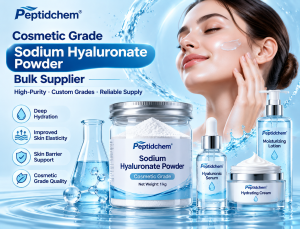
Sodium hyaluronate powder is the sodium salt of hyaluronic acid. It shares the same fundamental polysaccharide backbone but differs in the chemical form of its carboxyl groups.
In the sodium salt form, the hydrogen associated with the carboxyl group is replaced by a sodium counterion.
This modification produces sodium hyaluronate, which is widely used in cosmetic and personal care formulations.
Sodium hyaluronate is particularly common in modern skincare ingredient lists because of its established use as a moisturizing and skin-conditioning ingredient.
Key characteristics of sodium hyaluronate powder:
- Chemical category: Glycosaminoglycan sodium salt
- INCI name: Sodium Hyaluronate
- CAS number: 9067-32-7
- Physical form: White or almost-white hygroscopic powder
- Molecular weight: Available in different molecular weight grades
- Cosmetic function: Humectant and skin-conditioning agent
- Applications: Hydrating serums, creams, lotions, masks, and other personal care products
According to the United States Pharmacopeia’s Food Chemicals Codex, sodium hyaluronate is the sodium salt of hyaluronic acid. Its molecular weight varies considerably depending on the material specification.
Commercial sodium hyaluronate is commonly produced through microbial fermentation, followed by purification and drying.
What Is the Main Difference Between Sodium Hyaluronate and Hyaluronic Acid?
The fundamental difference is their chemical form.
Hyaluronic acid represents the acid form of the polysaccharide, whereas sodium hyaluronate represents its sodium salt form.
The two materials share the same underlying polymer structure, but their ionic characteristics and chemical identities differ.
Chemical structure comparison
| Property | Hyaluronic Acid | Sodium Hyaluronate |
|---|---|---|
| Chemical form | Free acid form | Sodium salt form |
| INCI name | Hyaluronic Acid | Sodium Hyaluronate |
| CAS number | 9004-61-9 | 9067-32-7 |
| Chemical backbone | Glycosaminoglycan | Same glycosaminoglycan backbone |
| Molecular weight | Variable | Variable |
| Water compatibility | Water-soluble | Water-soluble; grade-dependent dissolution |
| Cosmetic function | Humectant and skin conditioning | Humectant and skin conditioning |
| Typical applications | Skincare and personal care | Skincare and personal care |
The molecular weight is not determined simply by whether the ingredient is in acid or sodium salt form. Both materials can be manufactured in different molecular weight ranges.
Does Sodium Hyaluronate Have a Lower Molecular Weight Than Hyaluronic Acid?
No. Sodium hyaluronate does not automatically have a lower molecular weight than hyaluronic acid.
This is a common misconception in cosmetic ingredient marketing.
Molecular weight refers to the size of the polymer chain. It is influenced by the manufacturing process, fermentation conditions, and subsequent processing or degradation.
Converting hyaluronic acid into its sodium salt does not automatically shorten its polymer chain.
Instead, lower molecular weight hyaluronic acid or sodium hyaluronate can be produced through controlled chemical or enzymatic hydrolysis, which breaks longer polymer chains into smaller fragments.
For cosmetic formulators, molecular weight is an important parameter because it influences:
- Solution viscosity
- Film-forming properties
- Water retention
- Texture and sensory characteristics
- Interaction with the skin surface
- Potential skin penetration
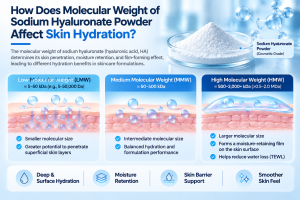
Common molecular weight classifications
The following categories are useful formulation-oriented classifications rather than universal regulatory definitions.
| Classification | Approximate molecular weight | Formulation characteristics |
|---|---|---|
| Low molecular weight | Below 50 kDa | Smaller polymer fragments; formulation and penetration characteristics differ from high-MW grades |
| Medium molecular weight | 100–500 kDa | Intermediate viscosity and hydration characteristics |
| High molecular weight | Above 700 kDa | Film formation, surface hydration, and viscosity contribution |
The molecular weight ranges above follow the terminology used in a 2025 review published in Biomolecules.
Research indicates that molecular weight can influence how hyaluronic acid interacts with the skin. Higher molecular weight materials are generally associated with surface film formation, while smaller molecular weight fractions may show different penetration profiles.
However, molecular weight alone does not guarantee a particular cosmetic outcome. Concentration, formulation composition, delivery system, and experimental conditions also matter.
Which Powder Is More Soluble in Water?
Both hyaluronic acid and sodium hyaluronate are used in water-based cosmetic formulations.
However, it is not scientifically appropriate to claim that sodium hyaluronate always dissolves faster or that every grade has superior water solubility.
The actual dissolution and hydration behavior can depend on:
- Molecular weight
- Polymer concentration
- Powder particle size
- Water temperature
- pH
- Ionic strength
- Mixing speed and hydration time
The USP Food Chemicals Codex describes fermentation-derived sodium hyaluronate as sparingly soluble in water, whereas a specific sodium hyaluronate grade evaluated in an FDA-submitted GRAS dossier is described as water-soluble.
These descriptions illustrate why product-specific technical data are important.
For cosmetic manufacturers, suppliers should provide recommended dispersion procedures, dissolution conditions, viscosity specifications, and storage instructions for the actual grade being purchased.
Which Is Better for Cosmetic Formulations?
Neither ingredient is universally better.
The appropriate selection depends on the intended formulation, the desired sensory properties, the required INCI declaration, and the raw material specification.
When to consider hyaluronic acid
Hyaluronic acid may be appropriate when:
- The formulation specifically requires the acid-form ingredient.
- The product specification identifies Hyaluronic Acid as the required INCI.
- The formulation has been developed and validated using that particular grade.
When to consider sodium hyaluronate
Sodium hyaluronate may be appropriate when:
- The formulation requires Sodium Hyaluronate as its INCI ingredient.
- A commercially established sodium salt grade is preferred.
- The formulation requires a specified molecular weight and viscosity profile.
- The material has been validated for the intended aqueous formulation.
Formulation recommendation: Do not substitute one ingredient for the other solely because their names are frequently used interchangeably in marketing. Verify the INCI name, CAS number, molecular weight, and technical specifications before approving a raw material.
How Is Hyaluronic Acid Powder Used in Cosmetic Products?
Hyaluronic acid and sodium hyaluronate are widely incorporated into cosmetic products because of their moisture-retention and skin-conditioning properties.
Common applications include:
Facial serums: Used as moisturizing ingredients in water-based serum formulations.
Moisturizing creams: Help improve skin hydration and contribute to a smoother skin feel.
Hydrating lotions: Support moisture retention in lightweight personal care formulations.
Sheet masks and facial masks: Used in hydration-focused formulations.
Anti-aging skincare products: Incorporated into formulations designed to improve the appearance of dryness and fine lines associated with dehydration.
Hair care products: Certain hyaluronate grades are also investigated and used for conditioning and moisture-related applications.
The Cosmetic Ingredient Review (CIR) has assessed hyaluronic acid and related hyaluronate ingredients for cosmetic use, recognizing their skin-conditioning and humectant functions.
What Should Buyers Check Before Purchasing Cosmetic-Grade Hyaluronic Acid Powder?
For global purchasers, selecting a cosmetic raw material involves more than comparing the product name and price.
A reliable purchasing decision should be based on verifiable specifications and batch documentation.
The following parameters should be evaluated:
| Quality parameter | Why it matters |
|---|---|
| INCI name | Confirms the ingredient identity for formulation and labeling |
| CAS number | Helps distinguish acid and sodium salt forms |
| Molecular weight | Determines important physicochemical and formulation characteristics |
| Purity/assay | Indicates the measured content of the specified material |
| Viscosity | Helps predict performance in the intended formulation |
| pH | Important for formulation compatibility |
| Moisture content | Influences powder quality and storage |
| Microbiological limits | Supports cosmetic raw material quality control |
| Heavy metals | Helps evaluate potential chemical contaminants |
| Protein and endotoxin limits | Relevant to controlling biologically derived impurities |
| Source and manufacturing method | Helps assess traceability and material origin |
Essential supplier documentation
Before approving a cosmetic raw material, request:
- Certificate of Analysis (COA)
- Technical Data Sheet (TDS)
- Safety Data Sheet (SDS)
- Molecular weight test results and analytical method
- Microbiological specifications
- Manufacturing and source information
- Batch traceability and storage recommendations
The COA should correspond to the actual production batch being supplied rather than a generic specification sheet.
Is Hyaluronic Acid a Peptide?
No. Hyaluronic acid is not a peptide.
This distinction is particularly important when selecting cosmetic active ingredients.
Hyaluronic acid is a polysaccharide belonging to the glycosaminoglycan family. It consists of repeating sugar units.
Peptides, in contrast, are chains of amino acids linked by peptide bonds.
Both ingredient categories are used in modern cosmetic formulations, but they have different chemical structures, properties, and formulation requirements.
For skincare brands developing advanced formulations, hyaluronic acid and synthesized cosmetic peptides may be considered complementary ingredient categories.
For example, a formulation may incorporate a moisturizing hyaluronate ingredient alongside a suitable cosmetic peptide active, provided that compatibility and stability are established through formulation testing.
Looking for a Reliable Cosmetic Peptide Supplier?
Peptidchem is specializes in the manufacturing of synthesized peptide ingredients for cosmetic and personal care applications.
We focus on supplying peptide raw materials to cosmetic manufacturers, skincare brands, formulation laboratories, and ingredient distributors.
If your business is developing peptide-based skincare products or sourcing synthetic peptide ingredients in bulk, our technical team can assist with product specifications and sourcing enquiries.
Contact our team to discuss:
- Cosmetic peptide ingredient requirements
- Bulk peptide raw material procurement
- Custom peptide synthesis enquiries
- Technical specifications and batch documentation
- Sample availability and commercial quotations
📩 Contact us to request a quotation or discuss your specific requirements. Let’s build a strong partnership supply for your anti-aging cosmetics product line.
Also See
How Much Sodium Hyaluronate Powder Should Be Added to Cosmetic Formulations
What Specification Should Cosmetic Brands Look for When Buying Sodium Hyaluronate Powder in Bulk
How to Choose the Right Sodium Hyaluronate Powder Supplier for Cosmetic Brands
FAQs:
Q1. Is sodium hyaluronate powder the same as hyaluronic acid powder?
Not chemically identical. Sodium hyaluronate is the sodium salt of hyaluronic acid. Both share the same fundamental polysaccharide backbone, but they have different chemical identities and CAS numbers.
Q2. Which is better: sodium hyaluronate or hyaluronic acid?
Neither is universally superior. The appropriate ingredient depends on the formulation requirements, molecular weight, concentration, INCI specification, and intended cosmetic application.
Q3. Does sodium hyaluronate have a smaller molecular size?
Not automatically. Sodium hyaluronate can have either high or low molecular weight. Polymer chain length depends on the manufacturing and processing conditions, not simply the presence of sodium.
Q4. What is the CAS number of sodium hyaluronate powder?
The CAS number of sodium hyaluronate is 9067-32-7.
Q5. What is the CAS number of hyaluronic acid powder?
The CAS number of hyaluronic acid is 9004-61-9.
Q6. Can sodium hyaluronate and hyaluronic acid be used together?
They can be incorporated into the same cosmetic formulation when their specifications and formulation compatibility have been evaluated. However, using both is not automatically necessary or more effective.
Q7. Is cosmetic-grade sodium hyaluronate suitable for facial serums?
Yes. Sodium hyaluronate is widely used in hydrating facial serums. Its suitability depends on the selected molecular weight, viscosity, concentration, purity, and formulation requirements.
United States Pharmacopeia (USP). Sodium Hyaluronate (from Microbial Fermentation), Food Chemicals Codex.
Becker, L. C., Bergfeld, W. F., Belsito, D. V., et al. (2009). Final report of the safety assessment of hyaluronic acid, potassium hyaluronate, and sodium hyaluronate. International Journal of Toxicology, 28(4 Suppl.), 5–67.
Zanchetta, C., Scandolera, A., & Reynaud, R. (2025). Hyaluronic acid in topical applications: The various forms and biological effects of a hero molecule in the cosmetics industry. Biomolecules, 15(12), 1656.
GRAS Associates, LLC. (2020). GRAS Notice No. 976: Sodium Hyaluronate.
Cosmetic Ingredient Review. (2023). Safety Assessment of Hyaluronates as Used in Cosmetics.