





Learn the recommended sodium hyaluronate powder dosage for serums, creams and toners, with percentage calculations, mixing tips and formulation guidance.
How Much Sodium Hyaluronate Powder Should Be Added to Cosmetic Formulations?
Sodium hyaluronate powder is widely used in skincare formulations because of its excellent water-binding properties, moisturizing effects and ability to improve skin feel. However, selecting the correct concentration is essential for achieving the desired hydration, texture, viscosity and formulation stability.Sodium hyaluronate powder is commonly formulated at approximately 0.01%–0.5%, depending on its molecular weight, grade and intended application. For many high-molecular-weight skincare formulations, 0.05%–0.1% is a practical starting range. Low-molecular-weight grades may require higher concentrations, depending on the supplier’s technical recommendations.
What Is Sodium Hyaluronate Powder?
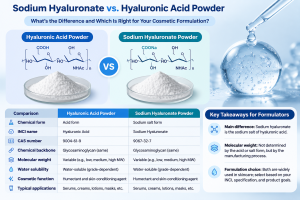
Sodium hyaluronate is the sodium salt of hyaluronic acid. It is a water-soluble polysaccharide belonging to the glycosaminoglycan family.
Its ability to bind and retain water makes it a valuable ingredient in moisturizing and skin-conditioning formulations.
INCI Name: Sodium Hyaluronate
CAS Number: 9067-32-7
Appearance: White to off-white powder, depending on the grade
Solubility: Water-soluble
Primary Cosmetic Functions: Humectant, skin-conditioning agent and film former.
According to the Cosmetic Ingredient Review (CIR), sodium hyaluronate is used in cosmetic products as a skin-conditioning ingredient and is included among the hyaluronate ingredients assessed for cosmetic safety.
Its applications include:
- Facial serums and hydrating essences.
- Moisturizing creams and lotions.
- Anti-aging skincare formulations.
- Facial masks and sheet masks.
- Eye creams and gels.
- Haircare and scalp-conditioning products.
How Much Sodium Hyaluronate Powder Should Be Added to Cosmetic Formulations?
The appropriate concentration depends primarily on the molecular weight of the sodium hyaluronate, the product type and the desired formulation characteristics.
A practical starting point for many skincare formulations is 0.05%–0.1% for high-molecular-weight sodium hyaluronate.
However, different commercial grades have different recommended use levels.
Recommended Sodium Hyaluronate Concentrations
| Molecular weight / grade | Suggested starting concentration | Example supplier use range |
|---|---|---|
| High molecular weight (HMW) | 0.01%–0.10% | 0.02%–0.50% |
| Low molecular weight (LMW) | 0.05%–0.30% | 0.05%–1.00% |
These are formulation starting suggestions and supplier-specific examples, not universal industry limits. Always check the specifications of the exact raw material being purchased.
For example, Contipro lists a recommended powder concentration of 0.01%–0.1% for its particular sodium hyaluronate grade. Other commercial supplier grades specify wider ranges depending on molecular weight.
Recommended Concentration by Cosmetic Product
The following are useful initial trial ranges for formulators. They should be adjusted according to the selected molecular-weight grade and finished-product requirements.
| Cosmetic product | Initial trial concentration |
|---|---|
| Facial toner | 0.02%–0.10% |
| Hydrating serum | 0.05%–0.20% |
| Moisturizing cream | 0.05%–0.20% |
| Facial lotion | 0.05%–0.20% |
| Facial gel | 0.05%–0.20% |
| Facial mask | 0.05%–0.20% |
| Facial cleanser | 0.02%–0.10% |
These ranges are suggested starting points rather than validated specifications for every product. The final concentration must be established through stability, compatibility and sensory testing.
How to Calculate Sodium Hyaluronate Powder for Cosmetic Formulations
One of the most important steps in cosmetic manufacturing is calculating the correct quantity of powder.
The following formula can be used:
Required Sodium Hyaluronate (g) = Total Batch Weight (g) × Desired Concentration (%) ÷ 100
Example: Preparing a 100 g Cosmetic Serum
Suppose you want to prepare 100 g of hydrating serum containing 0.1% sodium hyaluronate.
Calculation:
100 × 0.1 ÷ 100 = 0.1 g
Therefore, you need 0.1 g (100 mg) of sodium hyaluronate powder.
Sodium Hyaluronate Powder Calculation Table
| Desired concentration | For 100 g formulation | For 1 kg formulation |
|---|---|---|
| 0.01% | 0.01 g | 0.10 g |
| 0.05% | 0.05 g | 0.50 g |
| 0.10% | 0.10 g | 1.00 g |
| 0.20% | 0.20 g | 2.00 g |
| 0.50% | 0.50 g | 5.00 g |
Important: These quantities refer to pure sodium hyaluronate powder, not a diluted sodium hyaluronate solution.
For example, if you use a 1% sodium hyaluronate solution at 5% of the finished formula, the actual sodium hyaluronate concentration is only 0.05%.
This distinction is important when calculating the active ingredient concentration during commercial production.
Does Molecular Weight Affect Sodium Hyaluronate Dosage?
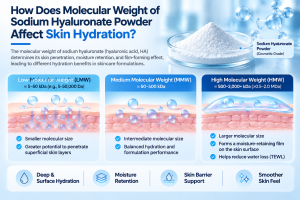
Yes. Molecular weight is one of the most important factors when selecting sodium hyaluronate for cosmetic applications.
Different molecular-weight grades can produce different hydration characteristics, viscosity, film formation and skin-feel properties.
High Molecular Weight Sodium Hyaluronate
High-molecular-weight sodium hyaluronate generally contributes to:
- Surface hydration.
- Moisture-retaining film formation.
- Improved skin feel.
- Increased viscosity in aqueous formulations.
- Reduced moisture loss from the skin surface.
It is particularly suitable for moisturizing creams, facial gels and hydrating serums.
Low Molecular Weight Sodium Hyaluronate
Low-molecular-weight sodium hyaluronate is generally associated with:
- Hydration in formulations with lower viscosity.
- Different skin-permeation characteristics compared with high-molecular-weight grades.
- Use in lightweight serums and essences.
- Formulation flexibility when combining different molecular-weight grades.
Research suggests that molecular weight influences the skin interaction and penetration characteristics of hyaluronic acid. However, penetration and performance depend on the complete formulation, not molecular weight alone.
For manufacturers, selecting the correct molecular-weight distribution is just as important as selecting the concentration.
How Should Sodium Hyaluronate Powder Be Added to Cosmetic Formulations?
Correct incorporation is essential to prevent powder aggregation, incomplete hydration and uneven distribution.
Sodium hyaluronate is water-soluble but may hydrate rapidly at the powder surface, creating lumps if added improperly.
The following procedure provides a useful starting approach.
Step 1: Weigh the required quantity
Calculate the required concentration based on the total batch weight. Use a precision balance because relatively small quantities may be required.
Step 2: Prepare the aqueous phase
Prepare the required quantity of purified or deionized water according to the formulation.
Step 3: Pre-disperse the powder
Sodium hyaluronate may be pre-wetted with glycerin or propanediol to facilitate dispersion.
Alternatively, gradually sprinkle the powder into a well-agitated water phase.
Avoid adding the entire quantity at once.
Step 4: Allow complete hydration
Continue mixing according to the supplier’s recommended procedure. Allow sufficient time for the powder to hydrate completely.
Higher-molecular-weight grades may require more hydration time than lower-molecular-weight grades.
Step 5: Incorporate into the final formulation
Add the hydrated ingredient to the remaining formulation according to the manufacturing process.
If the formulation involves heating, consider adding the aqueous sodium hyaluronate solution during cooling, provided the selected grade’s technical instructions permit this.
Step 6: Check the final formulation
Evaluate:
- Appearance and uniformity.
- Viscosity.
- pH.
- Texture and skin feel.
- Compatibility with other ingredients.
- Microbiological quality.
- Accelerated and real-time stability.
What Temperature and pH Should Be Maintained?
Temperature and pH can influence the performance and stability of sodium hyaluronate.
Temperature
Different sodium hyaluronate grades have different processing requirements.
Some supplier guidelines allow cold or warm processing. DSM’s HYA-ACT formulation guidelines recommend incorporating an aqueous solution during cooling at temperatures below 40°C to avoid unnecessary heating of the active ingredient.
Another supplier’s technical information reports that prolonged heating at 90°C for 45 minutes can reduce the molecular weight of its sodium hyaluronate grade by up to 20%.
Therefore, avoid unnecessary prolonged exposure to high temperatures and follow the specific manufacturer’s processing recommendations.
pH
The appropriate pH depends on the sodium hyaluronate grade and the complete formulation.
Some commercial grades have recommended formulation windows around pH 4–8, while other supplier systems specify wider compatibility ranges.
Do not assume that every grade has the same pH stability. Check the TDS and conduct compatibility testing using the final ingredient combination.
Can Sodium Hyaluronate Be Combined with Cosmetic Peptides?
Yes cosmetic peptides can be considered for complementary skincare formulations.
Sodium hyaluronate primarily contributes hydration, moisture retention and skin-conditioning properties. Cosmetic peptides are a diverse group of active ingredients used in formulations targeting different skin-related concerns.
Combining these ingredients may help manufacturers develop multifunctional skincare products, including:
- Hydrating peptide serums.
- Anti-aging facial creams.
- Skin-conditioning gels.
- Moisturizing facial treatments.
- Advanced skincare formulations.
However, compatibility should never be assumed.
Peptides differ in molecular structure, charge, solubility and recommended processing conditions. Sodium hyaluronate can also interact with certain cationic compounds and proteins, potentially resulting in precipitation in some systems.
Before combining them, manufacturers should evaluate:
- The recommended pH of each ingredient.
- Solubility and compatibility.
- Processing temperature.
- Ionic strength and other formulation components.
- Long-term physical and chemical stability.
For cosmetic manufacturers developing peptide-based skincare products, sourcing consistent, well-characterized peptide ingredients is an important part of formulation development.
What Should Manufacturers Check When Purchasing Sodium Hyaluronate Powder?
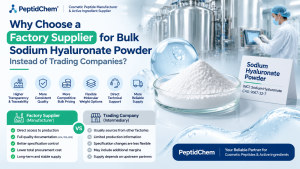
Peptidchem have reliable raw material is essential for achieving consistent cosmetic product quality.
Before purchasing sodium hyaluronate powder, manufacturers should review the following specifications:
| Quality parameter | Why it matters |
|---|---|
| INCI name | Confirms ingredient identity |
| Molecular weight | Influences viscosity and formulation performance |
| Purity | Helps establish raw material quality |
| Moisture content | Important for powder specifications and storage |
| Microbial limits | Supports microbiological quality control |
| Heavy metals | Helps control potential contaminants |
| Endotoxin and protein impurities | Relevant to biologically produced material |
| Certificate of Analysis (COA) | Provides batch-specific analytical results |
| Technical Data Sheet (TDS) | Provides formulation and processing guidance |
| Safety Data Sheet (SDS) | Provides handling and safety information |
The Cosmetic Ingredient Review emphasizes the importance of controlling biological impurities, including proteins, nucleic acids and endotoxins, as well as contaminants such as heavy metals.
Manufacturers should therefore evaluate the supplier’s quality documentation rather than selecting a raw material based solely on price.
Conclusion
Choosing the right amount of sodium hyaluronate powder in cosmetic formulations is essential for achieving effective hydration, desirable texture, and product stability. A typical usage range is 0.01%–0.5%, with 0.05%–0.1% serving as a practical starting point for many skincare formulations. The optimal concentration depends on molecular weight, product type, and formulation requirements.
📩 Contact us manufacturers developing advanced skincare products, combining sodium hyaluronate with compatible cosmetic peptide ingredients can support innovative formulation development. Partnering with a reliable cosmetic peptide supplier helps ensure consistent ingredient quality and access to technical documentation.
Also See
What Specification Should Cosmetic Brands Look for When Buying Sodium Hyaluronate Powder in Bulk
How to Choose the Right Sodium Hyaluronate Powder Supplier for Cosmetic Brands
Why Should Cosmetic Manufacturers Buy D-Panthenol Powder Directly from a Factory
What Types of Skincare Products Can Use Hydrolyzed Collagen Peptides
FAQs:
Q1. What is the recommended percentage of sodium hyaluronate in skincare products?
A practical starting concentration for many high-molecular-weight skincare formulations is 0.05%–0.1%. Other grades may require different concentrations, so always consult the supplier’s technical specifications.
Q2. Can I use 1% sodium hyaluronate powder in a serum?
Some low-molecular-weight grades have supplier-recommended use levels extending to 1%. However, 1% is not necessary for every formulation. Higher concentrations may significantly affect viscosity, texture and skin feel.
Q3. Is sodium hyaluronate powder soluble in water?
Yes. Sodium hyaluronate is water-soluble. Its dissolution rate depends on factors including molecular weight, mixing conditions and hydration time.
Q4. Can sodium hyaluronate be dissolved in oil?
Conventional sodium hyaluronate powder is water-soluble and is not soluble in oils, fats or waxes. It should generally be incorporated through an appropriate aqueous phase.
Q5. Is sodium hyaluronate better than hyaluronic acid?
Both ingredients are related forms of hyaluronic acid chemistry. Sodium hyaluronate is the sodium salt of hyaluronic acid and is widely used in cosmetic formulations because of its water solubility and formulation versatility. The better choice depends on the specific ingredient grade and product requirements.
Q6. Can sodium hyaluronate be used with peptides?
Yes, selected sodium hyaluronate and peptide ingredients can be combined. However, compatibility, pH, processing temperature and stability should be evaluated for the specific combination.
Q7. Does increasing sodium hyaluronate concentration improve hydration?
Not necessarily. Increasing the concentration can also increase viscosity and change the film-forming properties and sensory characteristics of the finished product. The best concentration is the one that provides the desired performance without compromising product quality.
Cosmetic Ingredient Review (2023). Safety Assessment of Hyaluronates as Used in Cosmetics. Final Report, July 7, 2023.
Contipro. Hyaluronic Acid: Collected Technical Data. Technical information on molecular weight, recommended concentrations, solubility and processing.
DSM. HYA-ACT Formulation Guidelines. Technical guidance on solubility, incorporation, temperature and compatibility.
Zanchetta, C., Scandolera, A., & Reynaud, R. (2025). Hyaluronic Acid in Topical Applications: The Various Forms and Biological Effects of a Hero Molecule in the Cosmetics Industry. Biomolecules, 15(12), 1656.
Benefits of topical hyaluronic acid for skin quality and signs of skin aging: From literature review to clinical evidence (2022). Dermatologic Therapy.
Flychem. HyaPure H and HyaPure L: Sodium Hyaluronate Product Information. Supplier-specific molecular-weight and use-level guidance.