





Buy cosmetic-grade D-Panthenol powder direct from a verified factory. Compare batch quality, COA documentation, bulk pricing, MOQ and supply support.
Why Should Cosmetic Manufacturers Buy D-Panthenol Powder Directly from a Factory?
Choosing the right raw material supplier is an important decision for cosmetic manufacturers. Ingredient quality, batch consistency, supply reliability and purchasing costs can directly influence manufacturing operations and final product quality.
D-Panthenol, also known as Dexpanthenol or Provitamin B5, is widely used in skincare and haircare formulations because of its skin-conditioning, humectant and hair-conditioning functions.
But an important question remains: Should cosmetic manufacturers purchase D-Panthenol powder through distributors or directly from a manufacturing factory?
Buying directly from a verified manufacturer can provide better supply-chain transparency, direct technical communication, batch-level quality documentation and more competitive bulk purchasing arrangements. It can also help manufacturers establish long-term supply relationships and maintain consistent raw material specifications.
In this article, we explain the key advantages of factory-direct D-Panthenol powder purchasing and what cosmetic manufacturers should evaluate before selecting a supplier.
What Is D-Panthenol Powder and Why Is It Used in Cosmetics?
D-Panthenol, commonly known as Dexpanthenol, is an alcohol derivative of pantothenic acid (Vitamin B5). It is also called Provitamin B5 because it can be converted into pantothenic acid in biological systems.
Its basic identification information includes:
| Property | Information |
|---|---|
| Ingredient name | D-Panthenol |
| Common name | Dexpanthenol |
| INCI name | Panthenol |
| CAS number | 81-13-0 |
| Molecular formula | C9H19NO4 |
| Molecular weight | 205.25 g/mol |
| Cosmetic function | Humectant, skin conditioning, hair conditioning |
D-Panthenol is valued in cosmetic formulations for its moisture-retaining and conditioning properties.
According to the 2022 Cosmetic Ingredient Review (CIR) safety assessment, Panthenol functions as a skin-conditioning humectant, solvent and hair-conditioning agent. The expert panel concluded that the assessed ingredients were safe under their present practices of cosmetic use and concentration.
What Are the Main Cosmetic Applications of D-Panthenol?
Skincare formulations
D-Panthenol is used in:
- Moisturizing creams and lotions.
- Facial moisturizers.
- Skin-conditioning products.
- Body-care formulations.
- Cosmetic serums.
Haircare formulations
It is commonly incorporated into:
- Shampoos.
- Hair conditioners.
- Hair masks.
- Leave-in conditioners.
- Hair-care treatments.
Its conditioning function makes it useful in formulations designed to improve hair softness, manageability and appearance.
Personal-care formulations
Depending on the formulation, D-Panthenol can also be incorporated into other personal-care products requiring skin-conditioning or hair-conditioning ingredients.
Why Should Cosmetic Manufacturers Buy D-Panthenol Powder Directly from a Factory?
Purchasing directly from a manufacturer offers several potential commercial and technical advantages.
Better Control Over Raw Material Quality
Raw material quality is essential for maintaining consistent cosmetic production.
When manufacturers purchase directly from a verified factory, they can communicate directly with the production and quality-control teams.
This makes it easier to obtain information about:
- Raw material identification.
- Manufacturing and batch traceability.
- Active ingredient assay.
- Impurity profile.
- Moisture content.
- Physical appearance.
- Quality-control testing.
A reliable manufacturer should provide a batch-specific Certificate of Analysis (COA) so buyers can evaluate whether the supplied material meets the agreed specifications.
More Competitive Bulk Purchasing Prices
Why do cosmetic manufacturers consider factory-direct purchasing?
One major reason is cost control.
Purchasing through multiple distributors can introduce additional commercial margins and handling costs. Direct factory purchasing may reduce intermediary costs, particularly for manufacturers ordering larger quantities.
However, the lowest quoted price does not necessarily represent the best purchasing decision.
Buyers should compare the total landed cost, including:
- Raw material price.
- Packaging costs.
- Transportation.
- Customs duties.
- Import-related charges.
- Quality documentation.
- Payment terms.
A transparent factory quotation helps manufacturers evaluate their actual procurement costs.
More Consistent Batch-to-Batch Supply
Consistency is particularly important for cosmetic manufacturers operating regular production schedules.
Variations in raw material specifications can affect formulation performance and quality-control results.
Direct communication with a manufacturer can help buyers establish agreed specifications for recurring orders.
Before placing bulk orders, request:
- Product specifications.
- Batch-specific COAs.
- Approved reference samples.
- Quality-control procedures.
- Batch traceability information.
These measures help establish a more reliable procurement process.
Direct Access to Technical Documentation
Professional cosmetic ingredient suppliers should provide the technical documents required for ingredient evaluation and formulation development.
Important documents include:
| Document | Purpose |
|---|---|
| COA | Confirms the tested quality parameters of a particular batch. |
| TDS | Provides technical specifications and product characteristics. |
| SDS | Communicates chemical handling, storage and safety information. |
| Product specification | Defines agreed acceptance criteria. |
| Regulatory documentation | Supports market-specific ingredient assessments. |
Buying directly from a manufacturer can simplify communication when additional technical information or updated documentation is required.
Better Technical Communication
Cosmetic manufacturers often need technical clarification before introducing a new raw material into production.
Questions may concern:
- Ingredient compatibility.
- Solubility.
- Recommended incorporation method.
- Storage conditions.
- Moisture sensitivity.
- Formulation stability.
Direct communication with the manufacturer’s technical team can help reduce delays in obtaining product-related information.
The buyer should still conduct its own formulation compatibility and stability testing before commercial production.
Flexible Packaging and Bulk Supply Arrangements
Different cosmetic manufacturers have different purchasing requirements.
Small formulation laboratories may require samples and smaller quantities, while industrial cosmetic manufacturers may need regular bulk shipments.
A qualified factory should clearly communicate its available:
- Packaging options.
- Minimum order quantity (MOQ).
- Production capacity.
- Sample availability.
- Lead times.
- Export and shipping arrangements.
Discussing these requirements directly with the manufacturer can help establish a purchasing arrangement that suits your production schedule.
Stronger Long-Term Supplier Relationships
A direct relationship with a manufacturer can improve communication, purchasing forecasts and supply planning.
For cosmetic manufacturers, a reliable long-term supplier is not simply a source of raw materials. It is an important part of the overall production and procurement system.
Working directly with a verified factory can support better coordination regarding quality requirements, recurring orders and future production needs.
What Should Buyers Check Before Purchasing D-Panthenol Powder?
Not every supplier offering D-Panthenol is necessarily the original manufacturer.
Before placing an order, cosmetic manufacturers should evaluate the supplier carefully.
Essential Supplier Evaluation Checklist
1. Manufacturing identity
Confirm whether the supplier actually manufactures the ingredient or operates as a distributor or trading company.
2. Product identity and purity
Check the CAS number, INCI name, chemical identity, assay and stereochemical identity of the supplied material.
3. Batch-specific COA
Request an authentic COA containing the batch number, analytical methods, test results and acceptance criteria.
4. Physical form
Confirm whether the product is crystalline powder, viscous liquid or a diluted formulation. Also check whether any carrier or additional component is present.
5. Storage and packaging
Evaluate moisture protection, packaging integrity, storage requirements and stated shelf life.
6. Quality-management system
Request relevant quality-system certifications and confirm their validity and scope.
7. Supply capability
Discuss MOQ, production capacity, lead time, sample availability and export experience.
A supplier that can provide transparent answers to these questions is easier to evaluate as a long-term business partner.
D-Panthenol Powder vs. D-Panthenol 75W: What Is the Difference?
This is an important purchasing consideration that cosmetic manufacturers should not overlook.
D-Panthenol can occur in different physical forms depending on its grade and conditions. Some technical references describe crystalline material, while D-Panthenol may also occur as a clear, viscous liquid.
D-Panthenol 75W is a different commercial presentation: a 75% aqueous solution, rather than a dry powder.
Therefore, buyers should not select a product based on its name alone.
Before purchasing, confirm:
- Whether the product is supplied as a powder or liquid.
- Its actual D-Panthenol assay.
- Whether water or other carriers are included.
- The complete INCI declaration.
- The relevant technical specifications.
- Its suitability for the intended formulation.
This distinction helps prevent incorrect raw material selection and formulation calculations.
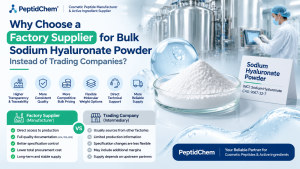
Why Is a Verified Factory More Valuable Than a Trading Company?
Both manufacturers and trading companies can participate in cosmetic ingredient supply chains. However, they offer different levels of access to production information.
| Evaluation factor | Direct manufacturer | Trading company |
|---|---|---|
| Production information | Direct access, if genuinely manufactured in-house | Usually obtained from upstream suppliers |
| Quality communication | Direct with production/QC teams | Through intermediaries |
| Batch traceability | Can be obtained from production records | Depends on upstream documentation |
| Custom specifications | Potentially more flexible | Depends on manufacturer |
| Pricing structure | Fewer intermediary margins may apply | May include additional margins |
| Supply planning | Direct production coordination | Depends on supplier network |
The important point is not simply whether a company calls itself a factory.
Buyers should verify its actual manufacturing capabilities, product origin, quality systems and documentation.
How Can Cosmetic Manufacturers Purchase D-Panthenol Powder in Bulk?
The purchasing process can be straightforward when product requirements are clearly defined.
Step 1: Identify the required product grade
Specify the required D-Panthenol form, assay, cosmetic application and technical requirements.
Step 2: Request technical documentation
Ask for the latest TDS, SDS, product specification and representative or batch-specific COA.
Step 3: Request a sample
Evaluate the material through appropriate identity, quality and formulation compatibility testing.
Step 4: Obtain a factory quotation
Request pricing based on quantity, packaging, destination and delivery terms.
Step 5: Confirm the commercial conditions
Agree on MOQ, payment terms, lead time, packaging, shipping arrangements and documentation.
Step 6: Establish a long-term supply arrangement
Once the material has been approved, define the agreed specifications and quality requirements for subsequent batches.
Why Choose a Specialized Manufacturer of Cosmetic Ingredients?
Selecting an ingredient supplier requires more than comparing product prices.
Manufacturing expertise, quality-control procedures, technical documentation and supply-chain transparency all contribute to a dependable purchasing relationship.
Peptidchem is primary manufacturing specialization is synthesized peptide ingredients for cosmetic applications.
We focus on providing professional B2B ingredient solutions, technical product information and manufacturing-oriented support.
For customers evaluating D-Panthenol powder, [insert your verified manufacturing or factory-direct sourcing status, actual product specifications, available grades and supply arrangements].
Our broader ingredient portfolio also supports cosmetic manufacturers looking for specialized peptide ingredients and synthetic peptide solutions.
Looking for a reliable cosmetic peptide supplier?
Explore our synthetic cosmetic peptide ingredients and contact our team to discuss bulk purchasing, technical specifications and custom peptide synthesis requirements.
Request a D-Panthenol Powder Quotation
Are you looking for a dependable D-Panthenol powder supplier for your cosmetic manufacturing business?
Before choosing a supplier, make sure you understand the product specifications, manufacturing origin, quality documentation and total purchasing cost.📩 Contact us to request a quotation or discuss your specific requirements. Let’s build a strong partnership supply for your anti-aging cosmetics product line.
Request the following information:
- Product specifications.
- Latest COA.
- Technical Data Sheet (TDS).
- Safety Data Sheet (SDS).
- Available packaging sizes.
- Minimum order quantity.
- Bulk quotation.
- Sample availability.
- Production and delivery lead times.
Also See
What Is the Recommended Dosage of D-Panthenol Powder in Cosmetic Formulas
What Are the Key Specifications of Cosmetic Grade D-Panthenol Powder
How Can Skincare Brands Formulate Anti-Aging Products with D-Panthenol Powder
What Is the Difference Between Liquid Panthenol and D-Panthenol Powder
FAQs:
Q1. What is D-Panthenol powder used for in cosmetics?
D-Panthenol is used as a skin-conditioning humectant and hair-conditioning ingredient. It is commonly incorporated into moisturizing creams, lotions, shampoos, conditioners and other personal-care formulations.
Q2. What is the CAS number of D-Panthenol?
The CAS Registry Number for D-Panthenol (Dexpanthenol) is 81-13-0.
Q3. Is D-Panthenol the same as Vitamin B5?
Not exactly. D-Panthenol is a provitamin B5 compound that can be converted into pantothenic acid (Vitamin B5) in biological systems.
Q4. What is the difference between D-Panthenol and DL-Panthenol?
D-Panthenol refers to the dextrorotatory form, while DL-Panthenol is a racemic mixture containing both D and L forms. Buyers should verify the required stereochemical identity when purchasing.
Q5. Is D-Panthenol water-soluble?
D-Panthenol is water-soluble. However, manufacturers should confirm the solubility information and formulation instructions for their specific commercial grade.
Q6. Why should manufacturers buy D-Panthenol directly from a factory?
Factory-direct purchasing can provide more direct access to manufacturing information, batch documentation, technical teams, pricing arrangements and supply planning.
Scott, L. N., Fiume, M., Bergfeld, W. F., Belsito, D. V., Hill, R. A., Klaassen, C. D., Liebler, D. C., Marks, J. G., Shank, R. C., Slaga, T. J., Snyder, P. W., & Heldreth, B. (2022). Safety assessment of panthenol, pantothenic acid, and derivatives as used in cosmetics. International Journal of Toxicology, 41(3_suppl), 77S–128S.
National Center for Biotechnology Information. (n.d.). PubChem compound summary: Dexpanthenol.
Tokyo Chemical Industry. (n.d.). D-Panthenol (CAS RN 81-13-0): Product information and specifications.
Google Search Central. (n.d.). Creating helpful, reliable, people-first content.