


Learn the recommended D-Panthenol powder dosage for cosmetic formulas. Explore 0.5–5% usage levels, solubility, formulation tips and supplier guidance.
What Is the Recommended Dosage of D-Panthenol Powder in Cosmetic Formulas?
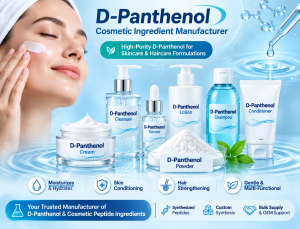
D-Panthenol, also known as Provitamin B5, is a widely used cosmetic ingredient valued for its moisturizing, skin-conditioning and hair-conditioning properties. It is incorporated into a variety of personal care formulations, including facial creams, body lotions, serums, shampoos, conditioners and hair masks.
However, one of the most important questions for cosmetic formulators is: What is the recommended dosage of D-Panthenol powder in cosmetic formulas?
The appropriate concentration depends on the product type, raw material grade, active content, formulation requirements and desired sensory properties.
In general, cosmetic ingredient suppliers recommend a usage range of 0.5% to 5% for Panthenol powder. For many everyday skincare formulations, starting at 0.5–2% is a practical formulation approach, while higher concentrations can be evaluated for intensive haircare and conditioning products.
What Is the Recommended Dosage of D-Panthenol Powder in Cosmetic Formulas?
The generally recommended formulation range for Panthenol powder is 0.5–5% of the total finished formulation by weight (w/w).
The appropriate level should be selected according to the intended application and the specifications of the supplied ingredient.
Recommended D-Panthenol concentrations
| Cosmetic product | Suggested starting concentration |
|---|---|
| Facial creams | 0.5–2% |
| Moisturizing lotions | 0.5–2% |
| Facial serums | 0.5–2% |
| Body creams | 0.5–2% |
| Hair conditioners | 0.5–3% |
| Hair masks | 1–3% |
| Shampoos | 0.5–3% |
| Intensive haircare formulations | 2–5% |
These are practical formulation starting points, not legally established concentration limits or universal efficacy thresholds. The wider 0.5–5% range is consistent with a published cosmetic-grade DL-Panthenol powder specification.
Why is 0.5–5% recommended?
Panthenol functions primarily as a humectant and conditioning ingredient. Its purpose is to help maintain moisture, improve the feel of skin and support hair conditioning.
Using an appropriate concentration helps formulators balance:
- Moisturizing performance.
- Skin-conditioning properties.
- Hair softness and manageability.
- Product texture and sensory characteristics.
- Compatibility with other formulation ingredients.
Increasing the concentration does not automatically guarantee better cosmetic performance. Formulators should evaluate the finished product through stability, compatibility and sensory testing.
How Much D-Panthenol Powder Is Required for Different Batch Sizes?
Cosmetic manufacturers should calculate the ingredient quantity according to the total weight of the finished formulation.
The following table assumes a powder with 100% active content.
| Target concentration | 100 g batch | 500 g batch | 1 kg batch |
|---|---|---|---|
| 0.5% | 0.5 g | 2.5 g | 5 g |
| 1% | 1 g | 5 g | 10 g |
| 2% | 2 g | 10 g | 20 g |
| 3% | 3 g | 15 g | 30 g |
| 5% | 5 g | 25 g | 50 g |
Practical calculation example
Suppose a cosmetic manufacturer wants to prepare 1 kg of moisturizing facial cream containing 1% Panthenol.
The calculation is:
Required Panthenol = 1,000 g × 1%
Required Panthenol = 10 g
Therefore, the manufacturer should incorporate 10 g of pure Panthenol powder into the formulation and adjust the other ingredients to maintain a final batch weight of 1,000 g.
Important: If the supplied powder has an assay below 100%, adjust the quantity according to its actual active content.
For example, to achieve 1% active Panthenol using a raw material with 98% assay:
Required raw material = 10 ÷ 0.98 = 10.20 g.
For a liquid grade containing 75% Panthenol, the equivalent calculation is 10 ÷ 0.75 = 13.33 g.
Always confirm whether the supplier’s recommended usage level refers to the supplied material or the active ingredient.
What Are the Main Benefits of D-Panthenol in Cosmetic Formulations?
D-Panthenol is valued for its versatility in skincare and haircare applications.
A. Skin moisturization
Panthenol acts as a humectant, helping maintain skin hydration. It is therefore frequently incorporated into moisturizing creams, facial lotions and hydrating serums.
B. Skin conditioning
It helps improve the softness and overall feel of cosmetic formulations. This makes it useful in products designed for dry or moisture-depleted skin.
C. Hair conditioning
Panthenol is used in shampoos, conditioners and hair masks to improve hair feel, softness and manageability.
D. Improved hair appearance
Cosmetic formulations containing Panthenol may help improve hair smoothness, shine and the appearance of hair condition.
E. Versatile formulation applications
Its water solubility and compatibility with a variety of aqueous cosmetic systems make it useful in several product categories.
The Cosmetic Ingredient Review (CIR) identifies Panthenol as a hair-conditioning ingredient and a skin-conditioning humectant.
Is D-Panthenol Powder Water-Soluble?
Yes. Panthenol is water-soluble and can be incorporated into the aqueous phase of cosmetic formulations.
It is also soluble in alcohol, while it is not suitable for direct incorporation into an oil-only phase.
For efficient incorporation:
- Measure the required quantity of Panthenol powder accurately.
- Add it gradually to the aqueous phase while mixing.
- Allow sufficient time for complete dissolution.
- Incorporate the dissolved ingredient into the remaining formulation.
- Check the final product for uniformity, pH and stability.
For emulsions, formulators can consider dissolving Panthenol in a separate portion of the water phase before adding it to the main batch.
If the formulation involves elevated processing temperatures, follow the supplier’s technical recommendations and avoid unnecessary prolonged heat exposure.
What Is the Difference Between D-Panthenol and DL-Panthenol Powder?
This is an important technical consideration when purchasing cosmetic-grade Panthenol.
Although both forms are associated with the INCI name Panthenol, they have different stereochemical identities.
| Parameter | D-Panthenol | DL-Panthenol |
|---|---|---|
| Chemical form | D-isomer | Racemic mixture |
| CAS number | 81-13-0 | 16485-10-2 |
| Composition | D-form | D- and L-forms |
| Cosmetic applications | Skincare and haircare | Skincare and haircare |
| Typical supply form | Viscous liquid or crystalline material | Commonly crystalline powder |
D-Panthenol is the biologically active stereoisomer associated with conversion to D-pantothenic acid (Vitamin B5). DL-Panthenol contains both D- and L-isomers.
The BASF technical information document explains the distinction between these forms and their physiological activity.
Why does this matter to cosmetic manufacturers?
When purchasing D-Panthenol powder, manufacturers should not rely exclusively on the product name or physical appearance.
They should verify:
- INCI name.
- CAS number.
- Isomer identification.
- Assay and purity.
- Specific optical rotation, where applicable.
- Certificate of Analysis (COA).
- Technical Data Sheet (TDS).
This is particularly important when the product specification requires D-Panthenol rather than DL-Panthenol.
How Should D-Panthenol Powder Be Incorporated into Cosmetic Formulas?
Correct incorporation is essential for achieving a uniform finished product.
Recommended formulation procedure
Step 1: Prepare the aqueous phase
Measure the required quantity of purified or deionized water.
Step 2: Weigh the Panthenol powder
Calculate the ingredient quantity according to the desired concentration and raw material assay.
Step 3: Dissolve the powder
Gradually introduce the powder into the water phase with continuous mixing until dissolved.
Step 4: Incorporate into the formulation
Add the prepared Panthenol solution to the main formulation according to the selected manufacturing process.
Step 5: Evaluate the finished product
Check:
- Appearance and homogeneity.
- Final pH.
- Viscosity.
- Physical stability.
- Compatibility with other active ingredients.
- Microbiological quality and preservative effectiveness, where applicable.
Manufacturers should conduct appropriate formulation and stability testing before commercial production.
What Quality Specifications Should Manufacturers Check When Buying D-Panthenol Powder?
Selecting a reliable cosmetic raw material supplier is as important as selecting the correct dosage.
The following specifications should be considered when purchasing Panthenol for industrial formulation.
| Quality parameter | What manufacturers should verify |
|---|---|
| INCI name | Panthenol |
| CAS number | Correct for D- or DL-form |
| Assay | Confirm actual Panthenol content |
| Appearance | Consistent with the specified grade |
| Solubility | Water-solubility specification |
| Water content | According to product specification |
| Impurities | Aminopropanol and relevant residual impurities |
| Heavy metals | Compliance with applicable specifications |
| Documentation | COA, TDS and SDS |
| Storage | Sealed packaging and moisture protection |
For example, BASF’s D-Panthenol Care technical information specifies a D-Panthenol content of 98–102% on an anhydrous basis, with a maximum water content of 1.0%.
These values illustrate why reviewing the batch-specific COA is essential rather than assuming all Panthenol grades have identical specifications.
Is D-Panthenol Safe for Cosmetic Use?
The Cosmetic Ingredient Review (CIR) Expert Panel published a safety assessment of Panthenol, Pantothenic Acid and related derivatives in 2022.
The assessment concluded that the seven ingredients reviewed were safe in cosmetics under the present practices of use and concentration described in the report.
The assessment also documented reported Panthenol concentrations of up to 5.3% in certain leave-on product categories and up to 5% in rinse-off products, based on the underlying industry use data.
However, these reported concentrations should not be interpreted as universal legal maximums or automatic approval for every formulation.
Cosmetic manufacturers remain responsible for:
- Following the applicable regulations in their target markets.
- Conducting appropriate safety assessments.
- Evaluating ingredient compatibility.
- Establishing finished-product specifications.
- Supporting cosmetic marketing claims with appropriate evidence.
Where Can Cosmetic Manufacturers Source Quality Cosmetic Active Ingredients?
Selecting a reliable raw material manufacturer is an important part of cosmetic product development.
Professional buyers should consider more than price when evaluating a cosmetic ingredient supplier.
Important purchasing criteria include:
- Consistent product quality.
- Verified manufacturing specifications.
- Batch-to-batch consistency.
- Technical documentation.
- Reliable production capacity.
- International supply capabilities.
- Research and development support.
- Custom ingredient development capabilities.
Looking for a Reliable Cosmetic Peptide Supplier?
Beyond conventional cosmetic ingredients such as Panthenol, the development of advanced skincare products increasingly involves specialized active ingredients, including synthesized cosmetic peptides.
Peptidechem specializes in the manufacturing of synthesized peptide ingredients for cosmetic and personal care applications.
Our focus is on providing peptide ingredient solutions for manufacturers, formulators, cosmetic brands and ingredient distributors seeking reliable raw material partnerships.
For B2B buyers looking for a synthetic cosmetic peptide manufacturer, relevant sourcing considerations include:
- Custom peptide synthesis.
- Cosmetic peptide raw materials.
- Bulk peptide ingredient supply.
- Peptide purity and analytical documentation.
- HPLC and LC-MS characterization, where applicable.
- Technical support for cosmetic ingredient development.
Whether you are developing a new skincare formulation or sourcing specialized cosmetic peptide ingredients, selecting a technically capable manufacturing partner is essential.📩 Contact us to request a quotation or discuss your specific requirements. Let’s build a strong partnership supply for your anti-aging cosmetics product line.
Also See
How Can Skincare Brands Formulate Anti-Aging Products with D-Panthenol Powder
What Are the Key Specifications of Cosmetic Grade D-Panthenol Powder
How Can Cosmetic Brands Use D-Panthenol Powder in Moisturizing Skincare Formulations
FAQs:
Q1. What is the recommended dosage of D-Panthenol powder in cosmetic formulas?
The commonly recommended usage range for Panthenol in cosmetic formulations is 0.5–5% of the total formulation weight. The exact concentration depends on the product application, raw material grade and active content. For everyday skincare products, 0.5–2% is a practical starting point, while haircare formulations may use higher concentrations.
Q2. Can D-Panthenol be used in facial creams and serums?
Yes. D-Panthenol is widely used in facial creams, moisturizing lotions, hydrating serums and other skincare products. It functions as a humectant and skin-conditioning ingredient, helping improve skin hydration and softness.
Q3. Is D-Panthenol powder water-soluble?
Yes. Panthenol is water-soluble and can be incorporated into the aqueous phase of cosmetic formulations. It should be properly dissolved or dispersed according to the supplier’s technical instructions to achieve uniform distribution throughout the finished product.
Q4. What is the difference between D-Panthenol and DL-Panthenol?
D-Panthenol is the biologically active D-isomer of Panthenol, whereas DL-Panthenol is a mixture of D- and L-isomers. D-Panthenol is commonly supplied as a viscous liquid, while DL-Panthenol is often available in crystalline powder form. Manufacturers should verify the CAS number, INCI name and product specifications before purchasing.
Q5. Is D-Panthenol suitable for haircare formulations?
Yes. D-Panthenol is commonly incorporated into shampoos, conditioners, hair masks, leave-in conditioners and scalp-care products. It functions as a hair-conditioning ingredient and helps improve hair softness, smoothness and manageability.
Scott, L. N., et al. (2022). Safety Assessment of Panthenol, Pantothenic Acid, and Derivatives as Used in Cosmetics. International Journal of Toxicology, 41(3_suppl).
BASF. D-Panthenol Care – Technical Information. Product specification PRD 30703421.
MakingCosmetics Inc. (2024). Provitamin B5 Powder (DL-Panthenol) – Specification Sheet.
Cosmetic Ingredient Review. Safety Assessment of Panthenol, Pantothenic Acid, and Derivatives as Used in Cosmetics.