





Explore cosmetic-grade D-Panthenol powder specifications, purity, CAS number, solubility, skincare applications, quality standards and bulk supply options.
What Are the Key Specifications of Cosmetic Grade D-Panthenol Powder?
Cosmetic Grade D-Panthenol Powder is a widely used cosmetic raw material known as Provitamin B5. It is incorporated into skincare, haircare and personal-care formulations because of its skin-conditioning, moisture-retention and hair-conditioning properties. For cosmetic manufacturers and ingredient formulators, selecting the right D-Panthenol grade requires careful evaluation of its chemical identity, purity, physical characteristics, solubility, impurity profile and quality documentation.
D-Panthenol, also known as Dexpanthenol, is the D-isomer of Panthenol and is associated with the biological activity of Vitamin B5. It is used in cosmetic formulations such as facial creams, moisturizers, serums, shampoos, conditioners, lotions and other personal-care products.
For B2B buyers, however, the product name alone is not sufficient to establish ingredient quality. A reliable purchasing decision should be based on a batch-specific Certificate of Analysis (COA), technical data sheet (TDS), safety documentation and verified product specifications.
This guide explains the essential specifications of cosmetic-grade D-Panthenol, its applications, quality requirements and important considerations when sourcing it in bulk.
What Is Cosmetic Grade D-Panthenol Powder?
D-Panthenol is the alcohol analogue of pantothenic acid, commonly known as Vitamin B5. It is also referred to as Dexpanthenol or D-(+)-Panthenol. Following application, D-Panthenol can be converted into pantothenic acid, which participates in biological processes associated with coenzyme A.
In cosmetic formulations, Panthenol is primarily used as a skin-conditioning agent, humectant and hair-conditioning ingredient. Its ability to support moisture retention makes it a useful component in formulations designed for dry skin, hair-conditioning products and daily personal-care applications.
The term cosmetic grade refers to material supplied with specifications and quality documentation appropriate for the intended cosmetic application. It does not represent a single universally applicable specification. Buyers should therefore evaluate the supplier’s actual product specification rather than relying exclusively on the grade description.
Key product identification:
- Product name: D-Panthenol
- Alternative name: Dexpanthenol
- INCI name: Panthenol
- CAS number: 81-13-0
- Molecular formula: C9H19NO4
- Molecular weight: 205.25 g/mol
- Ingredient category: Cosmetic active ingredient
- Functional classification: Skin-conditioning agent, humectant and hair-conditioning agent
What Are the Key Specifications of Cosmetic Grade D-Panthenol Powder?
The technical specifications of D-Panthenol determine its suitability for cosmetic manufacturing. Buyers should assess the following parameters before purchasing the ingredient.
1. Chemical Identity and CAS Number
Chemical identification is the first requirement when evaluating D-Panthenol quality.
D-Panthenol has the CAS number 81-13-0, while DL-Panthenol, which contains both D- and L-isomers, has the CAS number 16485-10-2.
This distinction is particularly important for manufacturers seeking the D-isomer rather than a racemic Panthenol product.
A reliable supplier should provide appropriate identification testing, such as infrared spectroscopy (IR), together with suitable stereochemical verification.
2. Molecular Formula and Molecular Weight
The chemical composition of D-Panthenol is represented by the following molecular formula:
C9H19NO4
Its molecular weight is approximately 205.25 g/mol.
These values provide a standard chemical reference for ingredient identification, formulation calculations and technical documentation.
3. Appearance and Physical Form
Appearance is an important quality-control parameter.
The physical form of Panthenol depends on its isomeric composition and grade. The Cosmetic Ingredient Review (CIR) reports that racemic DL-Panthenol commonly occurs as a white crystalline powder, whereas D-Panthenol may occur as a clear, colorless to slightly yellow viscous liquid that can crystallize during storage.
Consequently, a white crystalline appearance alone cannot establish that a material is pure D-Panthenol.
For products marketed specifically as D-Panthenol Powder, manufacturers should verify the physical form, isomeric identity and optical rotation through appropriate batch testing.
4. Purity and Assay
Purity is one of the most important purchasing criteria for cosmetic raw materials.
The United States Pharmacopeia (USP) Dexpanthenol monograph specifies an assay range of 98.0%–102.0%, calculated on an anhydrous basis.
This is a useful compendial reference when evaluating Dexpanthenol specifications. However, it should not automatically be interpreted as the universal specification for every cosmetic-grade powder.
A supplier should clearly disclose:
- Assay percentage.
- Analytical method.
- Whether the result is calculated on an anhydrous basis.
- Batch-specific test results.
- Applicable impurity limits.
Higher and consistent assay results can support more accurate formulation calculations and quality control.
5. Specific Optical Rotation
Specific optical rotation is particularly relevant when confirming the identity of D-Panthenol.
Because D-Panthenol is an optically active stereoisomer, optical rotation testing can help distinguish it from racemic DL-Panthenol.
For example, a published D-Panthenol 98+ supplier specification reports a specific optical rotation of +29.0° to +32.0° under its stated testing conditions.
The actual acceptance range and analytical method should be confirmed against the manufacturer’s approved specification.
6. Moisture Content
D-Panthenol is hygroscopic, meaning that it can absorb moisture from the surrounding environment.
Excessive moisture can affect the material’s physical characteristics, handling properties and storage stability.
Moisture content should therefore be evaluated using an appropriate analytical method, such as Karl Fischer titration.
A published supplier specification for D-Panthenol 98+ lists water content at not more than 1.0%. This is an example of a supplier specification, not a universal acceptance limit for all cosmetic-grade products.
7. Solubility
Solubility determines how easily an ingredient can be incorporated into a cosmetic formulation.
Panthenol is generally compatible with aqueous formulation systems. CIR technical information describes DL-Panthenol as freely soluble in water, alcohol and propylene glycol.
This property makes Panthenol suitable for various water-based cosmetic formulations.
Formulators should nevertheless verify the solubility characteristics of the exact D-Panthenol grade being purchased.
8. Impurity Profile and Heavy Metals
Impurity testing is essential for establishing the quality and consistency of cosmetic raw materials.
Depending on the manufacturing process and applicable specification, relevant parameters may include:
- 3-Aminopropanol.
- Pantolactone and related impurities.
- Residual organic solvents.
- Heavy metals.
- Lead.
- Sulfated ash or residue on ignition.
A 2022 CIR safety assessment reports manufacturer-provided D-Panthenol specifications that include limits for water, sulfated ash, heavy metals, lead, 3-aminopropanol and residual solvents.
These parameters should be evaluated against the actual product specification and intended application.
9. Microbiological Quality
Microbiological testing helps assess the suitability of raw materials for cosmetic manufacturing.
Depending on the product, application and quality-risk assessment, manufacturers may request testing for:
- Total aerobic microbial count.
- Total yeast and mould count.
- Specified objectionable microorganisms.
Suppliers should provide the applicable microbiological acceptance criteria and testing documentation when required by the customer’s quality system.
10. Packaging and Storage Stability
Appropriate packaging and storage conditions are necessary to maintain raw-material quality.
Because D-Panthenol is hygroscopic, it should be stored in tightly sealed, moisture-protective containers.
Recommended purchasing and storage considerations include:
- Moisture-resistant packaging.
- Protection from excessive heat.
- Storage in a cool, dry environment.
- Proper batch identification and traceability.
- Compliance with the manufacturer’s recommended shelf life.
The exact shelf life and storage temperature should be established using the supplier’s technical documentation.
D-Panthenol Product Specification Summary
The following table provides a practical specification checklist for cosmetic manufacturers and B2B buyers.
| Parameter | Reference specification or requirement |
|---|---|
| Product name | D-Panthenol / Dexpanthenol |
| INCI name | Panthenol |
| CAS number | 81-13-0 |
| Molecular formula | C9H19NO4 |
| Molecular weight | 205.25 g/mol |
| Appearance | Confirm actual D-isomer physical form |
| Assay | USP reference: 98.0%–102.0%, anhydrous basis |
| Specific optical rotation | Example supplier range: +29.0° to +32.0° |
| Water content | Example supplier limit: NMT 1.0% |
| Solubility | Water-compatible; verify grade-specific data |
| Heavy metals | As specified in the approved COA |
| Residual solvents | As specified in the approved COA |
| Microbiological quality | As per applicable specification |
| Packaging | Moisture-protective, tightly sealed |
| Storage | Cool, dry conditions, protected from moisture and heat |
Technical note: The values identified as examples are drawn from published compendial and supplier references. They are not a substitute for the actual product’s approved specification or batch-specific COA.
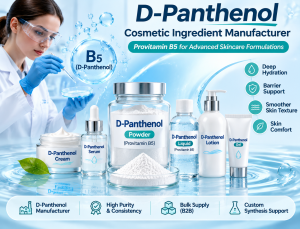
What Are the Main Cosmetic Applications of D-Panthenol?
D-Panthenol is incorporated into different cosmetic formulations because of its moisturizing and conditioning functions.
1. Skincare Formulations
D-Panthenol is used in skincare formulations as a humectant and skin-conditioning ingredient.
Common applications include:
- Facial moisturizers.
- Hydrating creams.
- Facial serums.
- Hand creams.
- Body lotions.
- Cleansing formulations.
- After-sun cosmetic products.
It is particularly useful in formulations designed to improve skin hydration and maintain a conditioned skin feel.
2. Haircare Formulations
Panthenol is also used as a hair-conditioning ingredient.
Typical applications include:
- Shampoos.
- Hair conditioners.
- Leave-in conditioners.
- Hair masks.
- Hair styling formulations.
- Scalp-care products.
Its conditioning properties make it useful in products designed to improve hair softness, manageability and appearance.
3. Personal-Care Products
D-Panthenol can also be incorporated into selected personal-care formulations, including:
- Body-care products.
- Liquid cleansing products.
- Hand-care formulations.
- Selected nail-care products.
- Other water-based personal-care products.
The suitability of the ingredient depends on the formulation design, product stability and applicable cosmetic regulations.
What Is the Recommended Concentration of D-Panthenol in Cosmetic Formulations?
The appropriate concentration depends on the formulation type, desired functionality, product characteristics and supplier recommendations.
The 2022 Cosmetic Ingredient Review assessment reports historical industry use concentrations of up to 5.3% Panthenol in body and hand products and up to 5% in skin-cleansing products and hair conditioners.
These figures describe reported industry use, not universal recommended formulation levels or legal maximum limits.
Cosmetic formulators should determine the appropriate concentration through formulation trials, stability testing and a finished-product safety assessment.
How Should D-Panthenol Be Incorporated into Cosmetic Formulations?
D-Panthenol is generally suitable for aqueous formulation systems.
During product development, formulators should consider:
- Checking the solubility and physical form of the supplied grade.
- Following the supplier’s recommended incorporation procedure.
- Evaluating the compatibility of the ingredient with the formulation’s pH.
- Avoiding unnecessary prolonged exposure to elevated processing temperatures.
- Conducting stability and compatibility testing.
- Evaluating the finished formulation before commercial production.
The CIR assessment identifies heat sensitivity around 70°C as a consideration for Panthenol, including the potential for racemization. Therefore, thermal processing conditions should be carefully controlled when maintaining D-isomer identity is important.
What Quality Documents Should a D-Panthenol Supplier Provide?
Before purchasing cosmetic-grade D-Panthenol, B2B buyers should evaluate the supplier’s technical and quality documentation.
A professional supplier should be able to provide the following documents, where applicable:
| Document | Purpose |
|---|---|
| Certificate of Analysis (COA) | Confirms batch-specific test results |
| Technical Data Sheet (TDS) | Provides product specifications and technical properties |
| Safety Data Sheet (SDS) | Provides handling, storage and safety information |
| Product specification sheet | Defines approved acceptance limits |
| Heavy metal analysis | Documents relevant elemental impurity results |
| Residual solvent analysis | Supports impurity control |
| Microbiological report | Documents applicable microbial quality |
| Origin and traceability information | Supports supplier qualification |
Buyers should also verify applicable manufacturing certifications and regulatory documentation rather than assuming that every supplier holds the same approvals.
How to Choose a Reliable Cosmetic Grade D-Panthenol Powder Supplier?
Selecting the right supplier is important for maintaining product consistency and uninterrupted manufacturing operations.
When evaluating a D-Panthenol supplier, consider the following factors:
1. Verified product identity
Confirm that the material is D-Panthenol rather than DL-Panthenol when the D-isomer is specifically required.
2. Consistent purity
Review assay results, optical rotation, moisture content and relevant impurity limits.
3. Batch-specific documentation
Request an updated COA, TDS and SDS before placing a bulk order.
4. Manufacturing and quality control
Evaluate the supplier’s production or sourcing arrangements, traceability and quality management procedures.
5. Bulk supply capability
Confirm minimum order quantities, available packaging, production or procurement lead times and export arrangements.
6. Technical support
A knowledgeable supplier should be able to clarify product specifications, storage requirements and formulation-related questions.
Why Choose Peptidchem for Cosmetic Raw Materials and Synthesized Peptide Ingredients?
Peptidchem focuses on the manufacture of synthesized peptide ingredients for cosmetic and personal-care applications.
Our product portfolio is developed around the requirements of cosmetic ingredient manufacturers, formulators, skincare brands and B2B raw-material buyers.
For D-Panthenol Powder, we offer [insert verified manufacturing or qualified sourcing status], supported by product-specific technical documentation and customer-oriented supply arrangements.
We focus on the quality parameters that matter to professional buyers, including:
- Product identity and specification verification.
- Batch-specific quality documentation.
- Technical information and formulation support.
- Bulk purchasing and B2B supply arrangements.
- Customer-specific packaging and order requirements, where available.
Whether you are developing a skincare formulation, expanding a haircare product portfolio or sourcing cosmetic active ingredients for commercial manufacturing, our team can assist with product information and quotation requests.
Request a quotation for Cosmetic Grade D-Panthenol Powder.
📩Contact our sales team to discuss product specifications, available quantities, COA, TDS, samples and bulk purchasing requirements.
Also See
How Can Skincare Brands Formulate Anti-Aging Products with D-Panthenol Powder
How Can Cosmetic Brands Use Hydrolyzed Collagen Peptide Powder in Serums, Creams, and Masks
FAQs:
Q1. What is the CAS number of D-Panthenol?
The CAS number of D-Panthenol, also known as Dexpanthenol, is 81-13-0. DL-Panthenol has a different CAS number: 16485-10-2.
Q2. What is the INCI name of D-Panthenol?
The INCI name is Panthenol. This is the ingredient name generally used for cosmetic ingredient declarations.
Q3. What is the purity of cosmetic-grade D-Panthenol?
Purity depends on the supplier’s approved product specification. The USP Dexpanthenol monograph specifies 98.0%–102.0% assay on an anhydrous basis. Buyers should verify the actual batch assay through the COA.
Q4. What is the difference between D-Panthenol and DL-Panthenol?
D-Panthenol contains the D-isomer, whereas DL-Panthenol is a racemic mixture of D- and L-isomers. The D-isomer is associated with Vitamin B5 activity. Both forms may have cosmetic conditioning applications, but they should not be treated as chemically identical grades.
Q5. Is D-Panthenol water-soluble?
Panthenol is suitable for water-based cosmetic formulations. The precise solubility characteristics should be confirmed using the technical data sheet for the supplied grade.
Q6. Is D-Panthenol suitable for skincare products?
Yes. Panthenol is used in skincare as a humectant and skin-conditioning ingredient. It is commonly incorporated into moisturizers, facial creams, serums and body-care formulations.
References
United States Pharmacopeia (USP). Dexpanthenol. USP-NF Monograph.
Scott, L. N., et al. (2022). Safety assessment of Panthenol, Pantothenic Acid, and derivatives as used in cosmetics. International Journal of Toxicology, 41(3_suppl), 77S–128S.
National Center for Biotechnology Information. PubChem: Dexpanthenol.
European Commission. CosIng: Cosmetic Ingredient Database.
Thermo Fisher Scientific. D-Panthenol, 98+%: Product Specification.