





Learn how low, medium and high molecular weight sodium hyaluronate affect skin hydration, penetration and formulation. Explore this cosmetic-grade powder guide.
How Does Molecular Weight of Sodium Hyaluronate Powder Affect Skin Hydration?
Understanding the science behind low, medium, and high molecular weight sodium hyaluronate for advanced skincare formulations.Sodium hyaluronate is widely used in cosmetic formulations because of its excellent water-binding properties and moisturizing performance. However, not all sodium hyaluronate powders behave identically. One of the most important factors influencing their performance is molecular weight (MW).The molecular weight of sodium hyaluronate determines how the ingredient interacts with the skin, how it forms a moisture-retaining film, how readily it can penetrate superficial skin layers, and how it influences formulation viscosity.Low molecular weight sodium hyaluronate generally offers greater potential for penetration into superficial skin layers, whereas high molecular weight sodium hyaluronate primarily provides surface hydration and film-forming benefits. Medium molecular weight grades offer intermediate formulation characteristics.
What Is Sodium Hyaluronate Powder?
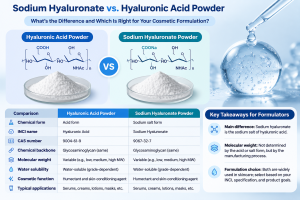
Sodium hyaluronate is the sodium salt of hyaluronic acid (HA), a naturally occurring glycosaminoglycan found in human skin and other connective tissues.
It is a highly hydrophilic polymer capable of binding and retaining water. In cosmetic formulations, it functions primarily as a humectant, moisturizer, and film-forming ingredient.
Its water-retention capacity makes it particularly useful in:
- Facial moisturizing serums
- Hydrating creams and lotions
- Anti-aging skincare formulations
- Eye-care products
- Skin-conditioning formulations
- Hydrating masks and gels
The INCI name is Sodium Hyaluronate, and its CAS number is 9067-32-7.
However, an important formulation consideration is that sodium hyaluronate is not a single molecular-size material. Its polymer chains can have different molecular weights, and these differences influence its physicochemical and cosmetic properties.
How Does Molecular Weight Affect Skin Hydration?
Molecular weight refers to the average mass of the polymer molecules and is generally expressed in Daltons (Da), kilodaltons (kDa), or megadaltons (MDa).
One kilodalton equals 1,000 Daltons, while one megadalton equals 1,000 kilodaltons.
In cosmetic applications, sodium hyaluronate is commonly discussed in three broad molecular-weight categories:
- Low Molecular Weight (LMW)
- Medium Molecular Weight (MMW)
- High Molecular Weight (HMW)
These categories are illustrative rather than universally standardized. Different suppliers and scientific publications may use different molecular-weight boundaries.
Low Molecular Weight Sodium Hyaluronate
Low molecular weight sodium hyaluronate contains shorter polymer chains than high molecular weight grades.
Because of their smaller molecular size, these chains generally have greater potential to diffuse into superficial skin layers than larger HA molecules.
Key formulation characteristics:
- Greater potential for penetration into superficial skin layers.
- Supports hydration within the upper skin layers.
- Suitable for lightweight hydrating serums and advanced moisturizing formulations.
- Generally produces lower solution viscosity than comparable concentrations of high molecular weight grades.
Research has demonstrated that some low molecular weight HA fractions can diffuse beyond the stratum corneum. However, actual penetration depends on molecular size, formulation composition, concentration, and experimental conditions.
Medium Molecular Weight Sodium Hyaluronate
Medium molecular weight sodium hyaluronate provides an intermediate molecular-size profile.
It can be considered when formulators want a balance between hydration, formulation viscosity, and skin-surface performance.
Key formulation characteristics:
- Intermediate polymer-chain size.
- Contributes to moisture retention.
- Provides useful viscosity and texture characteristics.
- Can complement other molecular-weight grades in multi-weight formulations.
Medium molecular weight sodium hyaluronate is particularly relevant when developing moisturizing lotions, creams, and hydrating gels.
High Molecular Weight Sodium Hyaluronate
High molecular weight sodium hyaluronate contains longer polymer chains.
Its larger molecular size limits its ability to penetrate the skin barrier. Instead, it primarily remains on the skin surface, where it forms a hydrated polymeric film.
Key formulation characteristics:
- Excellent film-forming properties.
- Helps retain moisture at the skin surface.
- Supports a smoother skin feel.
- Contributes to formulation viscosity.
- Helps reduce transepidermal water loss (TEWL).
High molecular weight sodium hyaluronate is particularly useful in moisturizing creams, hydrating gels, and formulations designed to provide surface hydration.
Comparison: Low, Medium, and High Molecular Weight Sodium Hyaluronate
The following table summarizes the typical differences relevant to cosmetic formulation.
| Property | Low MW | Medium MW | High MW |
|---|---|---|---|
| Polymer size | Smaller | Intermediate | Larger |
| Skin penetration potential | Greater | Intermediate | Limited |
| Primary hydration role | Superficial skin-layer hydration | Balanced hydration | Surface hydration |
| Film formation | Generally lower | Intermediate | Stronger |
| Solution viscosity | Generally lower | Intermediate | Generally higher |
| Formulation applications | Lightweight serums | Lotions and gels | Creams and hydrating gels |
Note: These are general formulation trends. Actual performance depends on the specified molecular-weight distribution, concentration, testing method, and finished formulation.
Does Low Molecular Weight Sodium Hyaluronate Provide Better Hydration?
Not necessarily.Although low molecular weight sodium hyaluronate has greater potential to penetrate superficial skin layers, high molecular weight sodium hyaluronate provides important surface-level hydration benefits.
The two grades perform complementary functions.
Low molecular weight HA can contribute to hydration within superficial skin layers, whereas high molecular weight HA forms a moisture-retaining film that helps reduce water loss from the skin surface.
A 2024 double-blind randomized controlled trial investigated the effectiveness of topical hyaluronic acid formulations with different molecular weights in 36 elderly participants with dry skin.
After four weeks, the low molecular weight HA-treated areas demonstrated significantly higher skin capacitance measurements than both the high molecular weight HA-treated areas and the vehicle control.
The reported measurements were:
- Low molecular weight HA: 56.37 AU
- High molecular weight HA: 52.37 AU
- Vehicle control: 49.01 AU
However, the study did not find significant differences between the groups in transepidermal water loss or the specified clinical symptom scores.
These findings suggest that molecular weight can influence hydration outcomes, but it does not establish that low molecular weight HA is universally superior for every cosmetic formulation.
What Does Clinical Research Say About Different Molecular Weights?
A clinical study published in the Journal of Drugs in Dermatology in 2011 examined topical hyaluronic acid formulations containing five molecular weights:
- 50 kDa
- 130 kDa
- 300 kDa
- 800 kDa
- 2,000 kDa
The study involved 76 female participants aged between 30 and 60 years.
All tested formulations contained 0.1% hyaluronic acid and were applied twice daily for 60 days.
The findings demonstrated that all tested molecular-weight formulations significantly improved skin hydration and elasticity compared with the vehicle-treated control areas.
Additionally, the 50 kDa and 130 kDa groups demonstrated significant improvements in wrinkle-depth measurements after 60 days.
This research reinforces the importance of molecular weight when developing cosmetic formulations with specific hydration and skin-conditioning objectives.
The practical conclusion: Molecular weight should be selected according to the desired formulation performance, rather than assuming that one molecular-weight grade is suitable for every skincare application.
Why Are Multiple Molecular Weights Used in Skincare Formulations?
Many advanced skincare formulations incorporate more than one molecular-weight grade of sodium hyaluronate.
The purpose is to combine complementary physicochemical characteristics.
For example:
Low molecular weight sodium hyaluronate
Supports hydration in superficial skin layers.
High molecular weight sodium hyaluronate
Creates a moisture-retaining film on the skin surface.
Medium molecular weight sodium hyaluronate
Provides an intermediate hydration and viscosity profile.
Combining different grades can help formulators develop products with multiple hydration characteristics and improved sensory properties.
The exact blend ratio should be determined through formulation trials, stability studies, and appropriate skin-hydration testing.
How Should Cosmetic Manufacturers Select Sodium Hyaluronate Powder?
For cosmetic manufacturers, molecular weight should be only one part of the raw-material selection process.
A reliable procurement process should also consider the following parameters.
Molecular Weight Verification
Request the molecular-weight specification and the analytical method used to determine it.
For polymeric materials, techniques such as size-exclusion chromatography (SEC) or gel-permeation chromatography (GPC) may be used, depending on the analytical method and material.
Where available, request information about weight-average molecular weight (Mw), number-average molecular weight (Mn), and molecular-weight distribution.
Purity and Quality
The purity of sodium hyaluronate can influence its suitability for different cosmetic applications.
Review the manufacturer’s certificate of analysis (COA) and verify the relevant specifications.
Viscosity
Molecular weight and concentration influence the viscosity of sodium hyaluronate solutions.
Manufacturers should evaluate viscosity under defined testing conditions, including concentration, temperature, and measurement method.
Microbiological Quality
Microbial limits are particularly important for cosmetic ingredients intended for leave-on skincare formulations.
Manufacturers should obtain relevant microbiological testing information and verify compliance with their internal raw-material specifications.
Supporting Technical Documentation
Before procurement, request the following documentation where applicable:
- Certificate of Analysis (COA)
- Technical Data Sheet (TDS)
- Safety Data Sheet (SDS)
- Molecular-weight test report
- Purity and assay results
- Heavy-metal analysis
- Microbiological test results
- Batch identification and traceability information
A transparent documentation system helps cosmetic manufacturers evaluate raw-material consistency and establish appropriate quality-control procedures.
Applications of Sodium Hyaluronate Powder in Cosmetic Formulations
Different molecular-weight grades can be selected according to the intended product characteristics.
| Cosmetic product | Relevant formulation objective |
|---|---|
| Hydrating facial serum | Lightweight moisture delivery |
| Moisturizing cream | Surface moisture retention |
| Facial lotion | Balanced hydration and texture |
| Hydrating gel | Moisture retention and viscosity |
| Eye-care formulation | Skin conditioning and hydration |
| Anti-aging skincare | Hydration and improvement in the appearance of fine lines |
The final product’s performance depends on the complete formulation, not simply the presence of sodium hyaluronate.
Concentration, molecular-weight distribution, other humectants, emollients, film-forming agents, pH, and stability should all be evaluated during product development.
Looking for a Reliable Cosmetic Peptide Supplier?
While sodium hyaluronate is an important polysaccharide-based moisturizing ingredient, cosmetic peptides represent a different category of functional skincare ingredients.
For skincare manufacturers developing advanced cosmetic formulations, sourcing high-quality synthetic peptide ingredients is an important part of product development.
Peptidchem is specializes in the manufacture of synthesized cosmetic peptide ingredients, supporting cosmetic brands, ingredient distributors, and formulation companies seeking reliable peptide raw materials.
Our peptide manufacturing and technical capabilities include:
- Peptide design and synthesis.
- Solid-phase peptide synthesis (SPPS).
- Purification using high-performance liquid chromatography (HPLC).
- Analytical testing using HPLC and LC-MS.
- Technical documentation and batch traceability, subject to product-specific availability.
Cosmetic peptide ingredient categories
Our cosmetic peptide portfolio can be organized into the following categories:
- Signal peptides: Used in formulations targeting skin-conditioning and anti-aging applications.
- Carrier peptides: Used in cosmetic formulations designed around peptide-mediated delivery concepts.
- Enzyme-inhibiting peptides: Used in formulations targeting specific skin-conditioning functions.
- Neurotransmitter-modulating peptides: Used in formulations targeting the appearance of expression-related lines.
We focus on supporting B2B customers through technical product information, ingredient sourcing, and manufacturing discussions.
Looking for a cosmetic peptide supplier for your next skincare formulation?
📩Contact our technical team to discuss available peptide ingredients, specifications, quality documentation, bulk requirements, and custom synthesis possibilities.
Also See
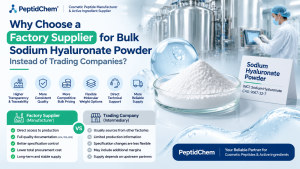
Why Choose a Factory Supplier for Bulk Sodium Hyaluronate Powder Instead of Trading Companies
FAQs:
Q1. What is the best molecular weight of sodium hyaluronate for skin hydration?
There is no universally best molecular weight. Low molecular weight grades offer greater penetration potential, whereas high molecular weight grades provide surface hydration and film formation. The choice depends on the intended cosmetic application.
Q2. Does low molecular weight sodium hyaluronate penetrate the skin?
Low molecular weight sodium hyaluronate has greater potential to penetrate superficial skin layers than high molecular weight grades. Actual penetration depends on molecular size, formulation, concentration, and skin conditions.
Q3. What is the difference between high and low molecular weight sodium hyaluronate?
High molecular weight sodium hyaluronate primarily forms a moisture-retaining film on the skin surface. Low molecular weight sodium hyaluronate has greater potential to diffuse into superficial skin layers.
Q4. Can different molecular weights of sodium hyaluronate be combined?
Yes. Combining different molecular-weight grades can provide complementary hydration and formulation properties. The optimal combination should be established through formulation testing.
Q5. Is sodium hyaluronate powder suitable for cosmetic serums?
Yes. Sodium hyaluronate is widely used in hydrating serums, creams, lotions, and gels. Its concentration and molecular-weight grade should be selected according to the formulation requirements.
Q6. Does molecular weight affect sodium hyaluronate viscosity?
Yes. At comparable concentrations and under comparable solution conditions, higher molecular weight sodium hyaluronate generally produces greater viscosity than lower molecular weight grades.
Q7. How can manufacturers verify sodium hyaluronate molecular weight?
Manufacturers should request the molecular-weight specification and supporting analytical data. SEC/GPC methods may be used to characterize polymer molecular weight and distribution.
Muhammad, P., et al. (2024). Effectiveness of topical hyaluronic acid of different molecular weights in xerosis cutis treatment in elderly: A double-blind, randomized controlled trial. Archives of Dermatological Research, 316, 329.
Pavicic, T., et al. (2011). Efficacy of cream-based novel formulations of hyaluronic acid of different molecular weights in anti-wrinkle treatment. Journal of Drugs in Dermatology, 10(9), 990–1000.
Bravo, B., et al. (2022). Benefits of topical hyaluronic acid for skin quality and signs of skin aging: From literature review to clinical evidence. Dermatologic Therapy, 35(12), e15903.
Zanchetta, C., Scandolera, A., & Reynaud, R. (2025). Hyaluronic Acid in Topical Applications: The Various Forms and Biological Effects of a Hero Molecule in the Cosmetics Industry. Biomolecules, 15(12), 1656.