



Compare D-Panthenol powder with hyaluronic acid and glycerin for hydration, skin barrier support, formulation benefits, and cosmetic sourcing.
How Does D-Panthenol Powder Compare with Other Humectants Like Hyaluronic Acid and Glycerin?
Looking for high-performance moisturizing ingredients for your next skincare formulation and glycerin can help cosmetic manufacturers select ingredients based on hydration performance, skin barrier benefits, formulation compatibility, and product positioning.
All three ingredients contribute to skin moisturization, but they do not work in exactly the same way.
D-Panthenol (provitamin B5) is a multifunctional humectant particularly valued for skin hydration and barrier-supporting properties. Hyaluronic acid is a water-binding polymer widely used for skin hydration and texture enhancement, while glycerin is a versatile, cost-effective humectant with extensive evidence supporting skin moisturization. Rather than competing directly, these ingredients can be combined in advanced cosmetic formulations.
For skincare brands, contract manufacturers, and cosmetic raw material buyers, the optimal ingredient depends on the desired product claims, sensory profile, formulation requirements, and budget.
What Is D-Panthenol Powder, and Why Is It Used in Cosmetics?
D-Panthenol powder is a solid form of dexpanthenol, the biologically active D-isomer of panthenol, commonly known as provitamin B5.
When applied topically, dexpanthenol contributes to moisturization and supports normal skin barrier function. Its cosmetic applications include facial serums, moisturizing creams, soothing lotions, scalp treatments, and hair care products.
Key Benefits of D-Panthenol Powder
- Skin hydration: Helps maintain moisture in the stratum corneum, the outermost layer of the epidermis.
- Skin barrier support: Clinical studies associate topical dexpanthenol formulations with reduced transepidermal water loss (TEWL).
- Skin conditioning: Helps improve the appearance and feel of dry, rough skin.
- Formulation versatility: Suitable for many water-containing cosmetic systems, subject to grade-specific compatibility and stability testing.
- Hair care applications: Commonly incorporated into conditioners, shampoos, and leave-in treatments for conditioning benefits.
What Does Scientific Research Say?
A randomized, double-blind, placebo-controlled study by Gehring and Gloor (2000) found that seven days of topical dexpanthenol treatment improved stratum corneum hydration and reduced TEWL compared with vehicle control.
These findings support the use of dexpanthenol in moisturizing and skin barrier-focused formulations.
Important: Clinical findings for finished dexpanthenol-containing formulations should not be interpreted as guaranteed performance claims for every D-Panthenol powder grade or concentration.
D-Panthenol vs. Hyaluronic Acid vs. Glycerin: What Are the Main Differences?
Although all three ingredients are used in moisturizing skincare, their chemical structures, formulation behavior, and supporting evidence differ.
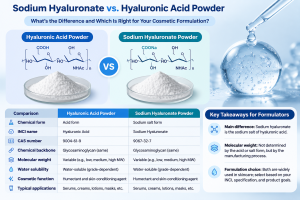
| Comparison | D-Panthenol Powder | Hyaluronic Acid | Glycerin |
|---|---|---|---|
| Ingredient category | Provitamin B5, humectant | Glycosaminoglycan, humectant | Polyol, humectant |
| Primary cosmetic function | Hydration and skin conditioning | Water binding and hydration | Moisture retention |
| Skin barrier benefits | Supported by clinical studies | Supports skin hydration; effects depend on formulation | Well-established barrier-supporting properties |
| Texture contribution | Generally low at typical use levels | Can increase viscosity and create a hydrated film | Can influence tackiness and skin feel |
| Water solubility | Water-soluble | Depends on form and molecular weight | Water-miscible |
| Cost considerations | Grade- and supplier-dependent | Often higher for specialized grades | Generally economical |
| Typical applications | Serums, creams, lotions, hair care | Serums, gels, creams | Almost all water-based skincare categories |
| Main formulation advantage | Multifunctional conditioning | Hydration and rheology modification | Versatility and cost efficiency |
Comparison reflects established ingredient properties and general formulation behavior, not a controlled head-to-head clinical trial.
Is D-Panthenol Better Than Hyaluronic Acid for Skin Hydration?
Short Answer: Neither ingredient is universally better. D-Panthenol is especially useful when hydration and skin barrier support are both priorities, whereas hyaluronic acid is frequently selected for its water-binding capacity and contribution to cosmetic texture.
How Does D-Panthenol Work?
D-Panthenol acts as a humectant and is converted in biological tissues to pantothenic acid, a component of coenzyme A.
Research indicates that dexpanthenol-containing formulations can improve stratum corneum hydration and support barrier recovery after experimentally induced irritation.
How Does Hyaluronic Acid Work?
Hyaluronic acid is a naturally occurring glycosaminoglycan capable of binding water and contributing to hydrated skin surfaces.
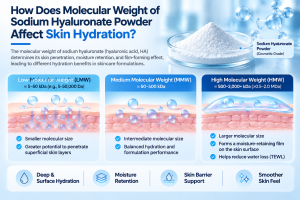
Its performance in topical cosmetics depends on factors such as molecular weight, concentration, chemical modification, and delivery system.
Higher-molecular-weight forms are often used for surface hydration and film-forming effects. Lower-molecular-weight forms may have different interactions with the skin, but penetration and biological effects should not be assumed without supporting evidence.
Which Ingredient Should Cosmetic Manufacturers Choose?
Choose D-Panthenol when developing products emphasizing:
- Skin comfort and conditioning
- Moisturization with barrier-supporting benefits
- Dry or sensitive-skin cosmetic positioning
- Multifunctional facial and body care
Choose hyaluronic acid when developing products emphasizing:
- Hydrating facial serums
- Water-binding and plumping cosmetic effects
- Gel-like sensory characteristics
- Specialized hydration technologies
Formulation Insight: Combining D-Panthenol with hyaluronic acid can provide complementary moisturizing functions. However, the final product’s performance must be verified through stability, compatibility, and efficacy testing.
Is D-Panthenol Better Than Glycerin?
Short Answer: D-Panthenol provides a different multifunctional profile, but glycerin remains one of the most extensively studied and economical cosmetic humectants.
Glycerin, also known as glycerol, attracts and retains moisture and contributes to normal epidermal hydration.
A scientific review by Fluhr, Darlenski, and Surber (2008) describes glycerol’s roles in skin hydration, elasticity, barrier function, and protection against environmental dryness.
Why Use D-Panthenol Instead of Glycerin?
D-Panthenol may be selected when a formulation requires a provitamin B5 positioning and additional skin-conditioning functionality.
Glycerin may be preferred when the formulation requires a broadly compatible, cost-efficient humectant that can be used across many product categories.
Can D-Panthenol and Glycerin Be Used Together?
Yes. Both are compatible candidates for water-based moisturizing systems, subject to the full formulation.
A combined system can provide the established humectant functionality of glycerin alongside the conditioning and barrier-supporting properties associated with dexpanthenol.
For many manufacturers, using the two ingredients together may be more practical than replacing glycerin entirely.
What Does Clinical Evidence Reveal About D-Panthenol and Skin Barrier Function?
D-Panthenol has been investigated in controlled human studies.
Study 1: Epidermal Hydration and Barrier Function
Gehring and Gloor (2000) reported improved stratum corneum hydration and reduced TEWL after seven days of dexpanthenol treatment compared with vehicle control.
Study 2: Moisturization and Barrier Restoration
Stettler et al. (2017) evaluated a panthenol-containing emollient in randomized studies. In the barrier assessment involving 23 participants, the formulation demonstrated improved hydration and barrier-related measurements compared with control.
The study reported a statistically significant difference in the area-under-the-curve measure of TEWL reduction (p = 0.023).
Study 3: Barrier Recovery After Irritation
Proksch and colleagues (2009) investigated dexpanthenol-containing formulations following sodium lauryl sulfate-induced irritation and reported accelerated barrier recovery compared with vehicle-treated or untreated skin.
Scientific Interpretation: These studies support dexpanthenol as a valuable cosmetic ingredient for moisturization and barrier-focused formulations. They do not establish that D-Panthenol is universally superior to glycerin or hyaluronic acid.
Can D-Panthenol Be Combined with Cosmetic Peptides?
Yes. D-Panthenol can be considered as a complementary moisturizing ingredient in cosmetic formulations containing synthesized peptides.
Cosmetic peptides are a diverse category of ingredients used in skincare products targeting concerns such as the appearance of fine lines, skin conditioning, and cosmetic skin rejuvenation. Their functions depend on the specific peptide sequence and supporting evidence.
D-Panthenol does not replace a cosmetic peptide. Instead, it can form part of the moisturizing base of a peptide-containing skincare product.
Why Combine D-Panthenol with Synthetic Peptides?
A formulation may incorporate:
- D-Panthenol: To support hydration and skin conditioning.
- Hyaluronic acid: To provide water-binding and textural properties.
- Glycerin: To establish a reliable humectant base.
- Cosmetic peptides: To deliver peptide-specific cosmetic functionality supported by appropriate evidence.
For peptide-focused skincare manufacturers, this approach allows product development teams to combine specialized active ingredients with established moisturizing materials.
Peptide compatibility, hydrolytic stability, pH tolerance, preservative interactions, and packaging suitability should be evaluated individually.
How Should Formulators Use D-Panthenol Powder?
D-Panthenol powder is commonly considered for aqueous cosmetic formulations because of its water solubility.
However, processing conditions depend on the supplier’s exact material specification.
Practical Formulation Considerations
1. Ingredient concentration
Select the concentration according to the desired cosmetic function, grade-specific technical documentation, and finished-product testing. Do not automatically transfer clinical-study concentrations to a new formulation.
2. Water-phase incorporation
D-Panthenol can generally be incorporated into a suitable aqueous phase. Confirm the recommended processing temperature, dissolution procedure, and order of addition with the supplier.
3. pH compatibility
Verify the pH range against the specific grade’s technical data sheet and evaluate stability throughout the intended shelf life.
4. Compatibility with peptides
When combining D-Panthenol with cosmetic peptides, evaluate peptide integrity, color, odor, viscosity, and activity-related analytical characteristics during stability studies.
5. Product performance testing
For moisturization claims, consider corneometry. For barrier-related claims, consider TEWL measurements alongside appropriate controls.
What Should Buyers Check Before Purchasing Bulk D-Panthenol Powder?
Peptidchem as cosmetic manufacturers and ingredient distributors should assess supplier documentation rather than purchasing solely on the basis of advertised purity.
| Procurement criterion | What to verify |
|---|---|
| Ingredient identity | D-Panthenol / dexpanthenol and relevant CAS identification |
| Grade | Cosmetic suitability and applicable specifications |
| Assay | Batch-specific certificate of analysis |
| Stereochemical identity | Confirmation of the D-isomer where relevant |
| Physical characteristics | Appearance and grade-specific solid-form specifications |
| Impurities | Relevant analytical limits and test methods |
| Microbiological quality | Appropriate cosmetic raw material specifications |
| Documentation | COA, TDS, SDS and regulatory statements as applicable |
| Packaging | Moisture protection and transport suitability |
| Supply | MOQ, lead time, batch consistency and traceability |
Buyer Tip: Confirm that the offered material is genuinely D-Panthenol powder. Panthenol may also be sold in liquid solutions or other forms, and these should not be treated as interchangeable on a weight-for-weight basis without accounting for assay and composition.
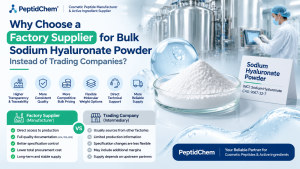
Why Work with a Specialized Cosmetic Peptide Supplier?
Peptide cosmetic is skincare brands developing advanced formulations, sourcing peptides and complementary cosmetic raw materials requires more than comparing ingredient prices.
A qualified synthetic peptide manufacturer should be able to provide information about peptide identity, purity, analytical methods, batch traceability, stability, and suitable handling conditions.
Our core business focuses on synthesized peptide ingredients for cosmetic formulation development. We support B2B discussions involving peptide selection, ingredient specifications, and formulation-oriented sourcing requirements.
Customers developing moisturizing peptide serums, barrier-focused cosmetic products, or multifunctional skincare systems can inquire about peptide ingredients and the availability of complementary raw materials.
Specific product availability, manufacturing origin, documentation, and commercial terms are confirmed during the quotation process.
Request Cosmetic Ingredient Specifications and a Bulk Quotation
Developing your next moisturizing serum, barrier-care cream, or peptide-based skincare product?
📩 Contact us our team to discuss synthesized cosmetic peptide ingredients and relevant raw material sourcing requirements.
Send us your inquiry with:
- Required ingredient or peptide sequence
- Target purity or material specification
- Estimated order quantity
- Intended cosmetic application
- Required documentation
- Destination country or market
Also See
FAQs:
Q1. What is the main difference between D-Panthenol and hyaluronic acid?
D-Panthenol is a provitamin B5 humectant associated with hydration and skin barrier support. Hyaluronic acid is a water-binding glycosaminoglycan commonly used for moisturizing and texture modification. Their functions overlap but are not identical.
Q2. Is D-Panthenol more effective than glycerin?
Not necessarily. Both ingredients have evidence supporting moisturizing functions. D-Panthenol is particularly valued for its multifunctional skin-conditioning profile, while glycerin is economical, versatile, and extensively researched.
Q3. Can D-Panthenol, hyaluronic acid, and glycerin be used in the same serum?
Yes. They can be combined in cosmetic formulations, provided the finished system passes compatibility, stability, preservation, and performance testing.
Q4. Is D-Panthenol powder suitable for sensitive-skin products?
It is commonly used in products positioned for dry or sensitive skin. However, suitability and tolerability depend on the complete formulation, concentration, and testing.
5. Is D-Panthenol powder a cosmetic peptide?
No. D-Panthenol is a provitamin B5 ingredient, whereas cosmetic peptides consist of amino acids linked by peptide bonds. They can serve complementary functions in skincare.
Q6. What is the difference between D-Panthenol powder and liquid D-Panthenol?
They differ in physical form and potentially in active concentration and formulation handling. Buyers should compare the specific product assay, solvent composition, and technical specifications before substitution.
Q7. What is the recommended concentration of D-Panthenol in cosmetics?
There is no universally optimal concentration for every product. The appropriate level depends on the grade, product category, intended claims, and formulation testing. Supplier documentation and regulatory requirements should guide selection.
References
These are suitable references to link from the published page.
Gehring, W., & Gloor, M. (2000). Effect of topically applied dexpanthenol on epidermal barrier function and stratum corneum hydration. Arzneimittelforschung, 50(7), 659–663.
Stettler, H., et al. (2017). A new topical panthenol-containing emollient: Results from two randomized controlled studies assessing its skin moisturization and barrier restoration potential, and the effect on skin microflora. Journal of Dermatological Treatment, 28(2), 173–180.
Fluhr, J. W., Darlenski, R., & Surber, C. (2008). Glycerol and the skin: Holistic approach to its origin and functions. British Journal of Dermatology, 159(1), 23–34.
Verdier-Sévrain, S., & Bonté, F. (2007). Skin hydration: A review on its molecular mechanisms. Journal of Cosmetic Dermatology, 6(2), 75–82.
Applications and delivery mechanisms of hyaluronic acid used for topical/transdermal delivery: A review (2020).
Dexpanthenol enhances skin barrier repair and reduces inflammation after sodium lauryl sulphate-induced irritation (2009).