





Learn how to import SNAP-8 peptide powder for cosmetic manufacturing in the USA and EU, including supplier qualification, documentation, testing, and compliance.
How to Import SNAP-8 Peptide Powder for Cosmetic Manufacturing in the USA and EU
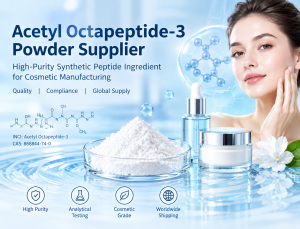
For skincare brands, formulators, distributors, and cosmetic manufacturers, importing SNAP-8 peptide powder requires more than finding a supplier with an attractive specification sheet. Buyers need to verify ingredient identity, purity, analytical documentation, packaging, transportation conditions, intended cosmetic use, and the regulatory responsibilities associated with the finished product.SNAP-8 is commonly identified as Acetyl Octapeptide-3, a synthetic peptide ingredient. Public chemical databases identify Acetyl Octapeptide-3 with CAS 868844-74-0, and the FDA’s Global Substance Registration System lists the substance with FDA UNII 8K14HJF88S.
What Is SNAP-8 Peptide Powder?
SNAP-8 is a synthetic cosmetic peptide ingredient also known as Acetyl Octapeptide-3.
Public chemical references identify Acetyl Octapeptide-3 as a peptide associated with the SNAP-8 name. PubChem lists CAS 868844-74-0 and the molecular information associated with the substance.
For cosmetic ingredient procurement, buyers should distinguish between:
- Trade name: SNAP-8
- INCI name: Acetyl Octapeptide-3
- CAS: 868844-74-0
- Material form: commonly supplied as a peptide preparation or powder, depending on the supplier specification
- Application: cosmetic formulation and skincare product development
A critical purchasing point is that the specification of the commercial material must be verified batch by batch. A supplier’s product name alone does not establish purity, identity, stability, or regulatory suitability.
SNAP-8 procurement specification checklist
| Specification | What the buyer should verify |
|---|---|
| Ingredient identity | Acetyl Octapeptide-3 / SNAP-8 |
| CAS number | 868844-74-0 |
| Appearance | Supplier-defined specification |
| Assay/purity | Defined analytical method and acceptance criterion |
| Identity | Appropriate analytical confirmation such as LC-MS/HPLC |
| Water content | Applicable batch specification |
| Residual solvents | Applicable analytical limits |
| Microbiology | Appropriate cosmetic raw-material limits |
| Heavy metals/elemental impurities | Risk-based specification |
| Packaging | Moisture/light/temperature appropriate packaging |
| Storage | Validated supplier storage conditions |
| Batch documentation | COA and traceability |
| Safety documentation | SDS and supporting technical documents |
The EU Scientific Committee on Consumer Safety emphasizes that the purity and impurity profile of a cosmetic ingredient should be clearly characterized, and that analytical methods and representative commercial material are important when evaluating safety.
Why Should Cosmetic Manufacturers Qualify a SNAP-8 Supplier Before Importing?
Peptidchem is cosmetic manufacturer should qualify the supplier before placing a commercial import order because the quality of the incoming peptide becomes part of the finished-product quality and safety assessment.
For a synthetic peptide ingredient, supplier qualification should cover both commercial capability and technical quality.
A professional cosmetic peptide supplier should be able to provide documentation such as:
- Certificate of Analysis (COA)
- Safety Data Sheet (SDS)
- Product specification
- Batch/lot number
- Analytical test methods
- Identity testing information
- Purity/assay results
- Storage conditions
- Shelf-life or retest information
- Manufacturing and traceability information
- Packaging specification
- Relevant quality-system documentation
The SCCS guidance specifically notes that impurities should be identified and quantified using appropriate analytical methods and that safety data should relate to material with a representative purity and impurity profile.
What should you ask a SNAP-8 peptide manufacturer?
Before buying bulk SNAP-8, request:
“Please provide the current COA, specification sheet, SDS, analytical method, batch number, storage conditions, packaging details, and available quality certifications for Acetyl Octapeptide-3.”
This gives the buyer a documented basis for supplier comparison rather than relying only on a product page.
What Documents Are Needed to Import SNAP-8 Peptide Powder into the USA?
The documents required for an import transaction depend on the shipment, importer, product classification, and intended use, but cosmetic manufacturers should establish a complete commercial and technical documentation package before shipment.
Typical documentation can include:
- Commercial invoice
- Packing list
- Bill of lading or airway bill
- Product specification
- COA
- SDS
- Country-of-origin information where applicable
- Customs/import documentation
- Batch/lot information
- Product labeling and packaging information
- Supplier/manufacturer information
- Additional documentation requested by the importer or customs broker
An important distinction is that FDA cosmetic requirements apply to cosmetic products and the parties responsible for them; an FDA registration number should not be represented as “FDA approval.”
Under the U.S. Modernization of Cosmetics Regulation Act of 2022 (MoCRA), applicable cosmetic product facilities must register with FDA, and a responsible person must list each marketed cosmetic product with FDA, subject to applicable exemptions. FDA also states that facility registration and product listing are not cosmetic approval programs.
Therefore, a supplier should avoid making claims such as:“FDA-approved SNAP-8 raw material”
unless there is a specific legal basis for the statement. A more accurate description is:“SNAP-8 / Acetyl Octapeptide-3 supplied as a cosmetic raw material with batch-specific quality documentation.”
What Are the USA Cosmetic Compliance Considerations for SNAP-8?
For a company manufacturing or marketing a finished cosmetic in the United States, the regulatory assessment should focus on the finished cosmetic, its intended use, labeling, safety substantiation, and applicable MoCRA obligations.
FDA explains that companies marketing cosmetics have responsibility for ensuring product safety and maintaining records supporting adequate safety substantiation. FDA does not prescribe one mandatory test package for every cosmetic ingredient or finished product.
Under MoCRA, applicable facilities manufacturing or processing cosmetics for distribution in the United States must register with FDA and renew registration every two years. A responsible person must list each marketed cosmetic product and update the listing annually.
What does this mean for a SNAP-8 buyer?
A U.S. cosmetic brand purchasing SNAP-8 should establish:
Supplier qualification → raw-material specifications → finished-product formulation → safety substantiation → compliant labeling → applicable MoCRA registration/listing obligations.
The raw-material supplier supports the first part of this chain. The finished cosmetic brand or responsible party remains responsible for the applicable requirements concerning its marketed cosmetic.
What Are the EU Requirements for Using Imported SNAP-8 in Cosmetics?
For the EU market, the finished cosmetic product must comply with Regulation (EC) No. 1223/2009 before being placed on the market.
The EU Cosmetics Regulation requires a responsible person for cosmetic products placed on the EU market. It also requires a safety assessment and Cosmetic Product Safety Report (CPSR), and the responsible person must maintain a Product Information File (PIF).
The PIF includes, among other information:
- Cosmetic product description
- Cosmetic Product Safety Report
- Manufacturing method
- Good Manufacturing Practice compliance statement
- Supporting evidence for cosmetic claims where justified
- Relevant animal-testing data
The PIF must be maintained for 10 years after the last batch of the cosmetic product was placed on the market.
The EU regulation also requires cosmetic manufacturing to follow Good Manufacturing Practice (GMP), with conformity presumed where relevant harmonized standards are followed.
Why does this matter to a SNAP-8 supplier?
A cosmetic peptide supplier should provide sufficiently detailed raw-material information to allow the downstream manufacturer and safety assessor to evaluate the ingredient within the finished cosmetic.
For this reason, buyers should request technical information early rather than after the commercial shipment arrives.
How Should You Check the Quality of Imported SNAP-8 Peptide Powder?
The safest purchasing approach is to establish a written raw-material specification and verify each commercial batch against that specification.
For a synthetic peptide, identity and purity are particularly important.
A suitable quality-control framework can include:
| Quality area | Recommended purchasing approach |
|---|---|
| Identity | Confirm peptide identity using appropriate analytical testing |
| Purity | Define minimum acceptable assay/purity |
| Impurities | Establish relevant impurity profile |
| Water/moisture | Set an appropriate specification |
| Residual solvents | Test where relevant to the synthesis process |
| Microbiology | Establish limits appropriate for the intended cosmetic application |
| Elemental impurities | Evaluate based on material/process risk |
| Appearance | Define color and physical form |
| Stability | Establish storage and retest requirements |
| Batch traceability | Link COA to manufacturing batch |
| Packaging | Protect against moisture and environmental degradation |
The SCCS notes that the nature and concentration of impurities can affect safety assessment and that changes in synthesis or purification processes can require renewed consideration of impurity profiles.
For a buyer, this creates an important supplier-qualification question:
Is the quoted purity supported by a defined analytical method and batch-specific COA?
A “99% purity” statement without a defined test method is less informative than a specification that identifies the analytical technique, acceptance criterion, batch number, and test result.
How Do You Import SNAP-8 from a Cosmetic Peptide Manufacturer?
A practical import workflow is to qualify the supplier first, approve the technical specification second, and arrange shipment only after documentation has been reviewed.
Step 1: Define your requirement
Specify:
- SNAP-8 / Acetyl Octapeptide-3
- Required quantity
- Purity specification
- Packaging
- Intended cosmetic application
- Destination country
- Required documentation
- Storage requirements
Step 2: Request a sample
Evaluate the sample before committing to a larger commercial order.
Step 3: Review technical documentation
Check the COA, SDS, specification sheet, analytical methods, batch information, and storage requirements.
Step 4: Qualify the supplier
Review manufacturing capability, quality controls, traceability, documentation practices, and consistency between samples and commercial batches.
Step 5: Approve the commercial specification
The buyer and supplier should agree on the specification before the purchase order is issued.
Step 6: Prepare the import documentation
Work with the relevant importer/customs broker to establish the documentation required for the shipment and destination.
Step 7: Control transportation
Peptide materials may require specific storage and transportation conditions. Follow the supplier’s validated requirements rather than assuming that all peptide powders can be shipped under identical conditions.
Step 8: Inspect the incoming batch
Verify:
- Packaging integrity
- Batch number
- COA
- Quantity
- Labeling
- Appearance
- Required quality tests
Step 9: Release the material for formulation
Only after the incoming material passes the manufacturer’s internal raw-material approval procedure should it be released for production.
How to Choose a SNAP-8 Peptide Powder Supplier for USA and EU Cosmetic Manufacturing?
A suitable cosmetic peptide supplier should combine synthetic peptide manufacturing capability with consistent quality control, documentation, and international B2B supply support.
For a manufacturer specializing in synthesized peptide ingredients, the landing page should focus on verifiable manufacturing capabilities rather than generic “high quality” claims.
B2B SNAP-8 supplier evaluation checklist
| Buyer requirement | What to look for |
|---|---|
| Synthetic peptide manufacturing | Demonstrated peptide synthesis capability |
| Ingredient identity | Acetyl Octapeptide-3 / SNAP-8 documentation |
| Analytical QC | HPLC/LC-MS or other appropriate analytical testing |
| Batch consistency | Batch-specific COA and traceability |
| Documentation | COA, SDS, specifications and technical documents |
| Custom supply | Ability to discuss quantity and packaging requirements |
| International shipping | Experience supplying international B2B customers |
| Quality system | Documented quality-control procedures |
| Technical support | Formulation and raw-material documentation support |
| Commercial supply | Sample-to-bulk procurement pathway |
For B2B search visibility, the most valuable positioning is not simply “SNAP-8 for sale.” A stronger commercial-intent proposition is:SNAP-8 / Acetyl Octapeptide-3 synthetic peptide ingredient for cosmetic manufacturers, formulators, distributors, and skincare brands seeking documented bulk supply.
This naturally targets several search intents without keyword stuffing.
SNAP-8 Peptide Powder Specification Sheet
For your product landing page, you can use the following format and replace any fields with your actual validated specifications:
| Item | SNAP-8 Specification |
|---|---|
| Product Name | SNAP-8 |
| INCI Name | Acetyl Octapeptide-3 |
| CAS No. | 868844-74-0 |
| Ingredient Type | Synthetic cosmetic peptide |
| Appearance | According to approved specification |
| Form | Peptide powder / lyophilized material, as applicable |
| Assay/Purity | According to batch specification |
| Identity | Appropriate analytical method |
| Packaging | According to order requirement |
| Storage | According to validated product specification |
| Documentation | COA, SDS, specification sheet |
| Application | Cosmetic and skincare formulation |
| Supply Model | Sample, development, and bulk B2B supply |
Conclusion
Importing SNAP-8 peptide powder for cosmetic manufacturing in the USA and EU requires a combination of supplier qualification, analytical verification, documentation control, appropriate transportation, and finished-product regulatory planning.📩 Contact us to request a quotation or discuss your specific requirements. Let’s build a strong partnership supply for your anti-aging cosmetics product line.
Also See
Acetyl Hexapeptide-8 vs SNAP-8: Which Cosmetic Peptide Has Better Anti-Aging Potential
Acetyl Octapeptide-3 (SNAP-8): A Next-Generation Peptide Ingredient for Wrinkle Reduction Formulas
Acetyl Octapeptide-3 Powder Stability Guide: SNAP-8 Cosmetic Peptide Manufacturer
FAQs:
Q1.Is SNAP-8 the same as Acetyl Octapeptide-3?
SNAP-8 is commonly associated with Acetyl Octapeptide-3, which is the relevant chemical/ingredient name used in public substance databases. FDA’s substance database also associates SNAP-8 with Acetyl Octapeptide-3 and lists CAS 868844-74-0.
Q2.What is the CAS number of SNAP-8?
The CAS number associated with Acetyl Octapeptide-3 is 868844-74-0.
Q3.Can SNAP-8 peptide powder be imported into the USA?
Cosmetic raw-material imports need to be assessed according to their specific shipment, intended use, importer responsibilities, and applicable U.S. requirements. For finished cosmetics, MoCRA establishes requirements including applicable facility registration and cosmetic product listing obligations.
Q4.Can SNAP-8 be used in cosmetics sold in the EU?
A cosmetic product containing SNAP-8 must comply with the applicable requirements of EU Regulation (EC) No. 1223/2009 before being placed on the EU market. The responsible person must ensure the applicable safety assessment, Product Information File and notification requirements are met.
Q5.What documents should I request from a SNAP-8 supplier?
At minimum, buyers should consider requesting a current COA, SDS, product specification, batch/lot information, analytical testing information, storage conditions, packaging details, and relevant quality documentation.
Q6.What should I check on a SNAP-8 COA?
Check the product identity, batch number, test method, purity/assay result, appearance and other specifications relevant to the material. For synthetic peptides, analytical identity and impurity information are particularly important.
References
U.S. Food and Drug Administration (FDA). Registration & Listing of Cosmetic Product Facilities and Products.
U.S. Food and Drug Administration (FDA). Modernization of Cosmetics Regulation Act of 2022 (MoCRA).
European Parliament and Council. Regulation (EC) No 1223/2009 on Cosmetic Products. EUR-Lex.
European Commission Scientific Committee on Consumer Safety (SCCS). Notes of Guidance for the Testing of Cosmetic Ingredients and Their Safety Evaluation.
National Center for Biotechnology Information (NCBI). PubChem: Acetyl Octapeptide-3.
FDA/NLM Global Substance Registration System. Acetyl Octapeptide-3 substance record.
European Union. Cosmetic Products Regulation – Safety Assessment, Product Information File and Notification requirements