



Discover which skincare products use hydrolyzed collagen peptides, their cosmetic functions, formulation considerations, and how to source peptide ingredients from PeptidChem.
What Types of Skincare Products Can Use Hydrolyzed Collagen Peptides?
Hydrolyzed collagen peptides are widely used in cosmetic formulations designed to improve skin hydration, softness, smoothness, and overall appearance. From facial serums and moisturizers to eye creams, sheet masks, and selected hair-care products, these ingredients offer formulators multiple ways to develop products focused on moisture retention and skin conditioning.
For cosmetic manufacturers, however, choosing the right product format involves more than adding collagen to a formula. Ingredient solubility, molecular-weight distribution, compatibility with other ingredients, formulation stability, and the intended cosmetic claim all influence the final product.
This guide explains which skincare products can use hydrolyzed collagen peptides, how these ingredients function in different formulations, and what cosmetic manufacturers should consider when sourcing peptide ingredients.
What Are Hydrolyzed Collagen Peptides?
Hydrolyzed collagen is produced by breaking down collagen proteins into smaller peptide chains, commonly through enzymatic or other controlled hydrolysis processes. The resulting material contains a distribution of peptides with different molecular weights and properties.
Hydrolyzed collagen is used in personal-care formulations primarily for its humectant, film-forming, emollient, and skin-conditioning functions. Depending on its characteristics and the formulation, it can help the skin feel softer, smoother, and more hydrated.
Research reviews describe collagen-based materials as useful cosmetic ingredients because of their moisture-retention properties and their ability to form films on the skin. However, hydrolyzed collagen should not automatically be considered equivalent to a specialized bioactive synthetic peptide.
Key distinction: Hydrolyzed collagen is a mixture of collagen-derived peptide fragments, whereas synthesized cosmetic peptides are manufactured through controlled chemical synthesis to obtain a specified peptide sequence. Their structures, functions, specifications, and evidence requirements differ.
What Types of Skincare Products Can Use Hydrolyzed Collagen Peptides?
Hydrolyzed collagen peptides can be incorporated into several cosmetic product categories, provided that the selected ingredient grade is compatible with the formulation.
1. Facial Serums
Facial serums are lightweight formulations developed to deliver selected cosmetic ingredients in concentrated or targeted formats. Water-based and gel serums may use hydrolyzed collagen to support a moisturizing, smooth-feeling finish.
Why formulators use it:
- Supports skin hydration and conditioning.
- Can contribute to a smooth, soft skin feel.
- May form a lightweight film on the skin surface.
- Can be combined with compatible humectants and other conditioning ingredients.
Formulation considerations: Check the ingredient’s solubility, molecular-weight distribution, recommended use level, pH compatibility, and preservative requirements. The final concentration should be based on supplier documentation and stability testing rather than a universal dosage.
2. Facial Moisturizers and Creams
Creams and lotions combine water, emollients, and other ingredients to reduce the sensation of dryness and improve skin softness. Hydrolyzed collagen may be included as an additional skin-conditioning ingredient.
It can be particularly relevant to moisturizing products positioned for dry or dehydrated-feeling skin.
Potential formulation benefits:
- Improved surface softness.
- Support for a moisturized skin feel.
- Film formation and skin conditioning.
- Compatibility with selected humectants, depending on the complete formula.
Hydrolyzed collagen does not replace the need for an appropriately designed moisturizing system. Formulators should evaluate the entire combination of humectants, emollients, occlusives, emulsifiers, and preservatives.
3. Anti-Aging and Firming Creams
Hydrolyzed collagen is frequently considered for cosmetic products marketed around smoother-looking skin, hydration, and the appearance of fine lines.
Its role should be described accurately. Topically applied collagen-derived materials can provide surface conditioning and help reduce the visible effects associated with dryness. These effects do not, by themselves, establish that an ingredient penetrates deeply into the skin or rebuilds the body’s collagen network.
For a formulation intended to support specific anti-aging claims, manufacturers should distinguish between:
- Immediate cosmetic effects, such as improved skin feel.
- Hydration-related improvements in the appearance of fine lines.
- Longer-term biological effects that require separate scientific evidence.
For stronger scientific positioning, claims should be supported by studies relevant to the specific ingredient, concentration, formulation, and intended use.
4. Eye Creams and Eye Gels
Eye-care formulations often prioritize hydration, smooth application, and a lightweight skin feel. Hydrolyzed collagen may be considered as a conditioning component in eye creams and gels.
The formulation should be evaluated for skin compatibility, viscosity, stability, and suitability for the intended area of application.
Manufacturers should avoid assuming that hydrolyzed collagen independently eliminates dark circles, removes eye bags, or reverses wrinkles. Such claims require evidence specific to the finished product.
5. Sheet Masks and Hydrogel Masks
Sheet masks and hydrogel-style products are designed to maintain close contact between a formulation and the skin for a defined period. Hydrolyzed collagen can be incorporated into selected mask essences and related cosmetic systems.
Why it may be useful:
- Contributes to skin conditioning.
- Supports a hydrated, smoother-feeling finish.
- Can be included in water-based mask essences when ingredient compatibility permits.
- Complements other moisturizing ingredients.
Formulators should assess the ingredient’s behavior during storage, packaging compatibility, microbial stability, and sensory performance. A mask’s immediate moisturizing effect should not be confused with proof of long-term collagen regeneration.
6. Cleansers and Facial Cleansing Products
Some facial cleansers incorporate skin-conditioning ingredients to help maintain a pleasant skin feel after washing. Hydrolyzed collagen may be used in suitable cleansing formulations where it remains compatible with the surfactant system.
Because cleansers are rinsed off, their exposure time differs from that of leave-on products such as creams and serums. The ingredient’s contribution should therefore be assessed in the context of the complete formula and its actual use conditions.
7. Sunscreens and Makeup Products
Hydrolyzed collagen may also be considered in selected sunscreen, primer, foundation, and other makeup formulations for skin conditioning or film-forming purposes.
However, its presence does not establish UV protection. Sunscreen efficacy depends on the approved UV-filter system, the finished product’s performance, and applicable testing and regulatory requirements.
Similarly, the inclusion of hydrolyzed collagen does not automatically demonstrate improved makeup wear, water resistance, or transfer resistance. These properties require finished-formula testing.
8. Body Lotions and Hand Creams
Body lotions and hand creams provide another potential application for hydrolyzed collagen. These products often target dry-feeling skin, softness, and a smoother surface.
The ingredient may be useful as one component of a broader moisturizing system, particularly when paired with suitable humectants and emollients.
Formulators should choose a grade appropriate for the intended product, manufacturing process, and performance requirements.
9. Shampoos, Conditioners, and Hair Treatments
Hydrolyzed collagen is not limited to facial skincare. It is also used in selected hair-care products for conditioning, film formation, and improvements in hair feel.
Depending on the grade and formulation, it may contribute to softness, manageability, and surface conditioning. Performance varies with hair type, ingredient characteristics, and the rest of the formulation.
For hair-care manufacturers, ingredient compatibility with surfactants, conditioning agents, and the finished product’s pH should be assessed before commercial production.
Which Skincare Products Are Best Suited to Hydrolyzed Collagen?
The most appropriate product depends on the desired cosmetic function, ingredient grade, and formulation architecture.
| Product type | Potential role | Main development consideration |
|---|---|---|
| Facial serum | Hydration and skin conditioning | Solubility, viscosity, stability |
| Moisturizing cream | Skin softness and conditioning | Emulsion compatibility |
| Firming cream | Hydrated, smoother-looking skin | Evidence for specific claims |
| Eye cream or gel | Conditioning and moisturized skin feel | Suitability for the eye area |
| Sheet mask | Surface hydration and conditioning | Essence stability and packaging |
| Facial cleanser | Skin conditioning | Surfactant compatibility and rinse-off use |
| Sunscreen or makeup | Conditioning or film formation | Finished-product performance |
| Body lotion or hand cream | Softness and moisture-related benefits | Compatibility with the emollient system |
| Shampoo or conditioner | Hair conditioning and manageability | Surfactant and conditioning-system compatibility |
This comparison describes potential applications rather than a guarantee that every hydrolyzed collagen grade is suitable for every product category.
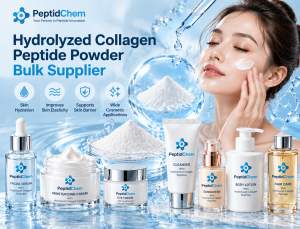
How Do Hydrolyzed Collagen Peptides Work in Skincare Formulations?
Moisture retention
Hydrolyzed collagen can help retain moisture in cosmetic formulations and contribute to skin hydration. Its effectiveness depends on the ingredient’s properties and the surrounding formulation.
Film formation
Certain collagen-derived ingredients form a film on the skin surface. This can contribute to a smoother skin feel and temporary improvements in the appearance of surface dryness.
Skin conditioning
Hydrolyzed collagen may improve the softness and feel of skin when included in a compatible formula. Its cosmetic function is different from that of an ingredient specifically designed to activate a biological signaling pathway.
Molecular weight and performance
Hydrolysis changes collagen’s molecular-weight distribution and other physicochemical characteristics. These changes can influence solubility, viscosity, film formation, and potential skin interactions.
However, a lower molecular weight alone does not prove superior clinical performance or effective delivery to deeper skin layers. Molecular-weight specifications should be interpreted alongside relevant performance data.
Hydrolyzed Collagen vs. Synthesized Cosmetic Peptides
For cosmetic ingredient purchasers, distinguishing between these materials is essential.
| Attribute | Hydrolyzed collagen peptides | Synthesized cosmetic peptides |
|---|---|---|
| Production | Collagen breakdown through hydrolysis | Controlled peptide synthesis |
| Composition | Distribution of collagen-derived peptide fragments | Defined sequence for the specified target peptide |
| Primary formulation role | Commonly skin conditioning, humectancy, and film formation | Depends on peptide sequence and supporting evidence |
| Specification priorities | Source, molecular-weight distribution, composition, solubility | Sequence identity, purity, impurities, analytical confirmation |
| Application decisions | Based on grade and formulation compatibility | Based on sequence-specific function, formulation, and evidence |
| Suitable supplier inquiry | Collagen source, grade, specifications, documentation | Sequence, purity target, scale, analytical methods, documentation |
These categories can complement one another in a formulation when scientifically justified and technically compatible. They should not be treated as interchangeable.
Why source from a specialized peptide manufacturer?
PeptidChem focuses on synthesized peptide ingredients. For buyers developing peptide-based cosmetic products, a supplier discussion can address the specified peptide sequence, required purity, analytical documentation, manufacturing scale, and intended application.
The suitability of any ingredient depends on the actual product specification and supporting documentation. Buyers should request the relevant technical information before selecting an ingredient for commercial development.
What Should Cosmetic Manufacturers Check Before Buying Peptide Ingredients?
Selecting a supplier is an important part of cosmetic product development. Before purchasing, R&D and procurement teams should establish the following requirements.
1. Ingredient identity
Confirm the exact ingredient name and, for synthesized peptides, the required amino-acid sequence and any relevant structural modifications.
2. Purity and analytical methods
Request the stated purity specification and supporting analytical data. Depending on the ingredient, this may include HPLC and mass spectrometry, with suitable methods for identity and impurity assessment.
3. Solubility and formulation compatibility
Confirm the ingredient’s solubility, pH compatibility, and stability under the proposed manufacturing and storage conditions.
4. Technical documentation
Request an appropriate technical data sheet, certificate of analysis, safety data sheet where applicable, and relevant regulatory or quality documentation.
5. Manufacturing and supply requirements
Discuss batch size, production scale, lead time, packaging, storage conditions, and availability of samples where offered.
6. Regulatory suitability
Verify that the ingredient and its intended use meet the requirements of the markets where the finished cosmetic will be sold. Ingredient acceptability and permitted claims can differ by jurisdiction.
Why Choose PeptidChem for Synthesized Peptide Ingredients?
PeptidChem focuses on the manufacture of synthesized peptide ingredients for customers seeking peptide-based materials for specialized applications.
For cosmetic ingredient buyers, the key is to match the requested material to the actual development objective rather than selecting a peptide based on its name alone.
When contacting PeptidChem, buyers can outline:
- The intended cosmetic application.
- The target peptide sequence, if already defined.
- The required purity and analytical specifications.
- The estimated quantity and production scale.
- The documentation and regulatory information required for evaluation.
These details help establish whether a proposed synthesized peptide can meet the project’s technical and supply requirements.
📩 Contact us to request a quotation or discuss your specific requirements. Let’s build a strong partnership supply for your anti-aging cosmetics product line.
Also See
What Is Hydrolyzed Collagen Peptide and Why Is It the Preferred Ingredient for Supplement Brands
How Does Hydrolyzed Collagen Peptide Support Beauty, Joint, and Healthy Aging Supplement Formulas
Why Are Brands Choosing Hydrolyzed Collagen Peptide Powder for Private Label Supplements
Top Anti-Aging Peptides Used in Modern Skincare: Benefits, Functions, and Applications
FAQs:
Q1. What skincare products can use hydrolyzed collagen peptides?
Potential applications include facial serums, moisturizers, eye creams, masks, cleansers, body lotions, and selected makeup and hair-care products. Suitability depends on the ingredient grade and the finished formulation.
Q2. Are hydrolyzed collagen peptides effective in skincare?
Hydrolyzed collagen can contribute to skin conditioning, film formation, and moisture-related cosmetic benefits. Evidence for oral collagen supplementation should not automatically be applied to topical formulations, and ingredient-specific claims require appropriate support.
Q3. Can hydrolyzed collagen peptides reduce wrinkles?
They may help improve the appearance of fine lines associated with surface dryness by supporting hydration and skin conditioning. This is not equivalent to proving that topical hydrolyzed collagen rebuilds dermal collagen or permanently reverses wrinkles.
Q4. Can hydrolyzed collagen be used in a facial serum?
Yes, suitable grades can be considered for water-based or other compatible serum systems. Solubility, pH, concentration, preservation, and stability should be evaluated for the specific formula.
Q5. What is the difference between hydrolyzed collagen and synthetic peptides?
Hydrolyzed collagen consists of collagen-derived fragments with a distribution of molecular weights and sequences. Synthesized cosmetic peptides are manufactured to a specified amino-acid sequence. Their functions and specifications are not interchangeable.
Q6. Is hydrolyzed collagen suitable for sensitive skin?
Suitability depends on the ingredient, its source, impurities, concentration, and the finished formula. The complete product should undergo appropriate safety and skin-compatibility assessments.
References
León-López, A. et al. (2019). “Hydrolyzed Collagen—Sources and Applications.” Molecules, 24(22), 4031.
Salvatore, L. et al. (2020). “Collagen Based Materials in Cosmetic Applications: A Review.” Materials, 13(19), 4279.
Felician, F. F. et al. (2019). “Collagen Hydrolysates for Skin Protection: Oral Administration and Topical Formulation.” International Journal of Molecular Sciences, 20(20), 5077.
de Miranda, R. B., Weimer, P., & Rossi, R. C. (2021). “Effects of hydrolyzed collagen supplementation on skin aging: a systematic review and meta-analysis.” International Journal of Dermatology, 60(12), 1449–1461.
Cosmetic Ingredient Review. For ingredient-specific safety assessments, consult the relevant published safety assessment and verify the exact ingredient identity and scope.