





Discover why SNAP-8 peptide is gaining attention in premium anti-wrinkle formulas and how cosmetic brands can source high-quality synthesized peptide ingredients.
Why Are Cosmetic Brands Looking at SNAP-8?
Premium skincare formulations are increasingly built around targeted cosmetic actives rather than traditional moisturizing ingredients alone. Among these ingredients, synthetic peptides have become an important category for brands developing anti-wrinkle serums, creams, eye-care products and other premium skin-care formulas.
One peptide receiving increasing attention is SNAP-8, commonly identified by the INCI name Acetyl Octapeptide-3.SNAP-8 is a synthetic octapeptide designed around the N-terminal region of SNAP-25, a protein involved in the SNARE complex associated with neurotransmitter release. Its proposed mechanism has made it particularly interesting for formulations targeting the appearance of expression lines and wrinkles.
What Is SNAP-8 Peptide?
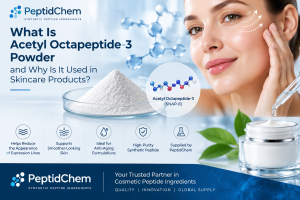
SNAP-8 is a synthetic cosmetic octapeptide also known as Acetyl Octapeptide-3.
It contains eight amino acids and is structurally related to the better-known Argireline family of cosmetic peptides. Supplier technical references commonly identify SNAP-8 as Ac-Glu-Glu-Met-Gln-Arg-Arg-Ala-Asp-NH₂ and associate it with CAS 868844-74-0, although commercial documentation should always be checked against the specific manufacturing specification and batch documentation.
SNAP-8 at a glance
| Specification | SNAP-8 Reference |
|---|---|
| Common name | SNAP-8 |
| INCI name | Acetyl Octapeptide-3 |
| Peptide type | Synthetic octapeptide |
| Sequence | Ac-Glu-Glu-Met-Gln-Arg-Arg-Ala-Asp-NH₂ |
| Main cosmetic positioning | Anti-wrinkle / expression-line formulations |
| Typical applications | Serums, creams, eye-care products, essences |
| Formulation focus | Premium cosmetic active |
| Supply form | Manufacturer-specific; verify COA/TDS |
| Quality verification | HPLC and appropriate analytical documentation |
For B2B purchasers, the COA, analytical method, identity confirmation, impurity profile, storage conditions and batch consistency are more important than relying only on a marketing name.
Why Is SNAP-8 Attractive for Premium Anti-Wrinkle Formulas?
Premium skincare brands increasingly use peptide combinations to build differentiated anti-aging product concepts. SNAP-8 fits this category because its molecular design is associated with the SNAP-25/SNARE pathway involved in neurotransmitter vesicle release.
The proposed cosmetic mechanism is based on the peptide interacting with the molecular machinery associated with SNAP-25 and potentially reducing the efficiency of SNARE-complex formation. This mechanism is the scientific basis behind the ingredient’s positioning for expression-line skincare.
This gives formulators a different story from conventional moisturisers, antioxidants or barrier-support ingredients.
Instead of positioning a formula only around:
- hydration,
- moisturisation,
- antioxidant protection, or
- skin barrier support,
brands can develop a multi-dimensional anti-wrinkle formulation strategy combining peptide technology with ingredients such as hyaluronic acid, niacinamide, antioxidants and other cosmetic peptides.
Importantly, the mechanism should not be presented as equivalent to injectable botulinum toxin. SNAP-8 is a cosmetic ingredient, and cosmetic marketing claims need to remain appropriate to the finished product and supported by evidence.
What Does the Published Evidence Say About SNAP-8?
A 2020 clinical study published in the Journal of Cosmetic Dermatology evaluated hyaluronic-acid microneedle patches containing a combination of arginine/lysine polypeptide, acetyl octapeptide-3, palmitoyl tripeptide-5, adenosine and seaweed extracts. After 12 weeks, the tested formulation was associated with a 25.8% decrease in measured fine lines/wrinkles, together with improvements in hydration, dermal density and thickness.
However, because the product contained several active ingredients, the study does not isolate the individual contribution of SNAP-8.
A separate 2024 clinical study evaluated a dissolving microneedle patch containing hyaluronic acid, acetyl octapeptide-3, L-ascorbic acid 2-glucoside and sodium cyclic lysophosphatidic acid. The study included 24 healthy subjects and reported improved wrinkle-related outcomes compared with a placebo microneedle patch, along with improvements in skin-related measurements and no reported adverse effects in the study population. Again, the formulation contained multiple active components.
What does this mean for cosmetic brands?
The evidence supports continued interest in formulations containing acetyl octapeptide-3, but it would be scientifically inappropriate to attribute every measured improvement in a multi-active formulation solely to SNAP-8.
For responsible B2B marketing, the safer approach is to describe SNAP-8 as a cosmetic peptide used in formulations targeting the appearance of expression lines and wrinkles, while providing product-specific efficacy data when available.
How Is SNAP-8 Used in Premium Skincare Formulations?
Common applications include:
- Anti-wrinkle serums
- Premium facial creams
- Eye-area formulations
- Essence products
- Concentrated peptide treatments
- Multi-peptide anti-aging formulas
- Professional skincare formulations
- Private-label premium skincare products
A formulator should not select an ingredient based only on its peptide name. The actual supplied material, carrier system, concentration, pH compatibility, thermal exposure, preservation system and stability requirements should be evaluated during formulation development.
For example, some commercial suppliers provide SNAP-8 as a powder, while others supply peptide solutions or pre-formulated systems. Therefore, the manufacturer’s technical data should determine the appropriate processing conditions rather than assuming one universal procedure.
What Should Buyers Look for in a SNAP-8 Cosmetic Peptide Supplier?
For cosmetic brands and contract manufacturers, choosing a cosmetic peptide supplier is a quality-control decision as much as a purchasing decision.
Before placing a bulk order, procurement teams should request:
1. Certificate of Analysis
The COA should identify the batch and provide relevant analytical specifications.
2. HPLC Data
HPLC testing can support assessment of peptide purity and batch consistency. Buyers should verify the analytical method and acceptance criteria rather than relying only on a stated percentage.
3. LC-MS or Identity Confirmation
Mass spectrometry or another appropriate identity method can provide additional confirmation that the supplied material corresponds to the intended peptide.
4. Technical Data Sheet
A TDS should provide practical information relevant to formulation and handling.
5. Safety Data Sheet
An SDS is important for transportation, storage and occupational handling.
6. Batch-to-Batch Consistency
For commercial skincare production, consistency is critical. A cosmetic peptide manufacturer should be able to provide documentation supporting reproducible quality between batches.
7. Manufacturing Information
Buyers may also evaluate the manufacturing process, quality-management system, traceability, packaging and storage controls.
For brands selling in regulated markets, the finished cosmetic product—not simply the raw material—must meet the applicable regulatory requirements. Cosmetics Europe notes that cosmetic products require safety assessment, appropriate technical documentation, ingredient/labelling compliance and substantiation for efficacy claims.
Why Is Synthetic Peptide Manufacturing Important for SNAP-8?
SNAP-8 is a synthetic peptide ingredient, making peptide synthesis capability an important consideration when evaluating suppliers.
Synthetic peptide manufacturing can provide controlled production of a specified amino-acid sequence and allows manufacturers to establish analytical controls around:
- peptide identity,
- purity,
- related substances,
- residual materials,
- moisture,
- appearance,
- microbial quality where applicable,
- packaging,
- storage and
- batch traceability.
For B2B buyers, the key issue is not simply whether a supplier calls itself a “peptide manufacturer.” The supplier should be able to demonstrate appropriate analytical and quality-control procedures for the specific cosmetic peptide being supplied.
How Can Brands Build a Premium SNAP-8 Anti-Wrinkle Formula?
A premium anti-wrinkle formula does not necessarily need to rely on one active ingredient.
Formulators can consider combining a peptide active with complementary cosmetic technologies such as:
| Formulation Objective | Ingredient Category |
|---|---|
| Expression-line positioning | Cosmetic peptides such as SNAP-8 |
| Hydration | Hyaluronic acid and humectants |
| Barrier support | Ceramides and skin-conditioning ingredients |
| Antioxidant support | Selected antioxidant actives |
| Brightening | Appropriate cosmetic brightening ingredients |
| Skin-conditioning | Amino acids and functional moisturisers |
| Multi-peptide positioning | Complementary cosmetic peptides |
The exact combination should be determined through formulation testing, compatibility studies and finished-product efficacy evaluation.
For brands targeting the premium skincare segment, this approach also creates opportunities for multi-peptide serum, advanced anti-aging cream, premium eye serum and professional skincare positioning.
Claims should remain tied to the evidence available for the finished formulation. Cosmetics Europe recommends that performance claims be supported by appropriate testing and that the relevance and statistical validity of the supporting evidence be considered.
Why Choose a Specialized Cosmetic Peptide Manufacturer for SNAP-8?
For brands purchasing cosmetic peptides in commercial quantities, supplier qualification should go beyond price.
A suitable SNAP-8 cosmetic peptide supplier should be able to support customers with:
- Synthetic peptide manufacturing capability
- Consistent batch quality
- Analytical testing
- COA documentation
- Technical data
- Safety documentation
- Sample evaluation
- Bulk supply coordination
- Appropriate packaging
- Storage recommendations
- Export documentation where required
Our Cosmetic Peptide Manufacturing Focus
Peptidchem mainly manufacture synthesized peptide ingredients for professional formulation and ingredient-supply applications.
For customers evaluating SNAP-8 / Acetyl Octapeptide-3, the purchasing process should begin with technical qualification rather than simply requesting a quotation.
Recommended buyer checklist:
SNAP-8 → Sample → COA → HPLC/identity verification → Formulation test → Stability evaluation → Finished-product efficacy testing → Commercial production
This workflow helps brands establish whether the supplied material is suitable for their specific formulation before moving to larger-scale procurement.
SNAP-8 Cosmetic Peptide Product Specification
| Item | Reference Information |
|---|---|
| Product | SNAP-8 |
| INCI | Acetyl Octapeptide-3 |
| Category | Cosmetic peptide |
| Peptide type | Synthetic octapeptide |
| Application | Premium skincare and anti-wrinkle formulations |
| Target formulations | Serums, creams, essences, eye-care products |
| Appearance | Supplier specification should be verified by batch |
| Purity | Confirm according to current product specification and COA |
| Identity testing | HPLC / LC-MS or appropriate validated methods |
| Documentation | COA, TDS, SDS and batch analytical documentation |
| Supply | Sample and bulk supply subject to specification |
| Manufacturing | Synthesized peptide ingredient production |
Note: Commercial specifications should always be confirmed against the current batch COA and agreed purchasing specification rather than using generic values from third-party supplier pages.📩 Contact us to request a quotation or discuss your specific requirements. Let’s build a strong partnership supply for your anti-aging cosmetics product line.
Also See
What Makes Acetyl Octapeptide-3 Powder a Popular Ingredient in Anti-Wrinkle Skincare Formulas
Acetyl Octapeptide-3 (SNAP-8): A Next-Generation Peptide Ingredient for Wrinkle Reduction Formulas
Acetyl Hexapeptide-8 vs SNAP-8
FAQs:
Q1.What is SNAP-8?
SNAP-8 is a synthetic octapeptide used as a cosmetic ingredient. It is commonly identified by the INCI name Acetyl Octapeptide-3 and is used in skincare formulations targeting the appearance of expression lines and wrinkles.
Q2.What is the INCI name of SNAP-8?
The commonly used INCI name is Acetyl Octapeptide-3.
Q3.Is SNAP-8 a synthetic peptide?
Yes. SNAP-8 is a synthetic peptide consisting of eight amino acids and is manufactured through peptide synthesis.
Q4.What is SNAP-8 used for in cosmetics?
It is primarily incorporated into skincare products positioned around anti-wrinkle and expression-line appearance, including serums, creams, essences and eye-area formulations.
Q5.Is there clinical evidence for SNAP-8?
Published human studies have evaluated formulations containing acetyl octapeptide-3, including microneedle-based formulations. However, these studies involved multiple active ingredients, so their results should not automatically be interpreted as evidence of SNAP-8 alone.
Q6.How should brands evaluate a SNAP-8 supplier?
Brands should request a representative sample, COA, HPLC and/or identity data, TDS, SDS, storage information and batch specifications before commercial procurement.
Q7.Can SNAP-8 be used in premium anti-aging serums?
Yes. SNAP-8 is commercially used as a cosmetic peptide ingredient in premium skincare concepts, including anti-wrinkle serums and other facial-care formulations. The final formulation must be tested for stability, compatibility and substantiated claims.
Q8.What should I ask a cosmetic peptide manufacturer before buying SNAP-8?
Ask about peptide identity, purity specification, analytical methods, batch consistency, manufacturing process, documentation, packaging, storage, sample availability, MOQ and lead time. Commercial terms should be confirmed directly with the manufacturer.
References
Avcil, M., Akman, G., Klokkers, J., Jeong, D., & Çelik, A. (2020). Efficacy of bioactive peptides loaded on hyaluronic acid microneedle patches: A monocentric clinical study. Journal of Cosmetic Dermatology, 19(2), 328–337.
Shin, J. Y., et al. (2024). Clinical safety and efficacy evaluation of a dissolving microneedle patch having dual anti-wrinkle effects with safe and long-term activities. Annals of Dermatology.
Cosmetics Europe. (2019). Guidelines for Cosmetic Product Claim Substantiation.
Cosmetics Europe. Ensuring the safety of cosmetics. Guidance on cosmetic safety assessment, technical information and regulatory responsibilities.
Cosmetics Europe. Cosmetics Products Regulation (CPR). Guidance on cosmetic product safety, GMP, labelling and substantiation of claims.
Cosmetics Europe. Understanding the label. Information on INCI ingredient naming and cosmetic labelling requirements.