



Discover the differences between Argireline (Acetyl Hexapeptide-8) and SNAP-8 for wrinkle care. Learn mechanisms, formulation benefits, dosage, quality standards, and why Peptidchem is a trusted cosmetic peptide manufacturer.
This advanced guide explains:
What Is Argireline? Complete Guide for Cosmetic Brands
Argireline Powder Manufacturing Process Explained
Top 10 Anti-Aging Peptides for Skincare Formulations in 2026
GHK-Cu vs Argireline vs Matrixyl: Which Peptide Is Best
How to Formulate a Professional Anti-Wrinkle Peptide Serum
Argireline vs SNAP-8: Understanding the Next Generation of Anti-Aging Peptides
The global skincare industry is rapidly moving toward science-backed active ingredients, especially peptides that target visible signs of aging without invasive procedures.
Among the most recognized cosmetic peptides, Argireline (Acetyl Hexapeptide-8) and SNAP-8 (Acetyl Octapeptide-3) are widely used in premium anti-aging serums, eye creams, and professional skincare formulations.
Both peptides are often described as “Botox-like peptides” because they focus on expression lines caused by repeated facial movements. However, choosing the right ingredient depends on formulation goals, clinical evidence, stability, cost, and target customers.
For skincare brands developing next-generation anti-wrinkle products, Argireline remains one of the most established peptide solutions due to its long commercial history and broad formulation compatibility.
What Is Argireline (Acetyl Hexapeptide-8)?
At Peptidchem, specializes in advanced cosmetic peptide ingredients, supplying bulk peptide raw materials for skincare manufacturers worldwide.
| Item | Information |
|---|---|
| INCI Name | Acetyl Hexapeptide-8 |
| Common Name | Argireline |
| Peptide Type | Neurotransmitter-modulating peptide |
| CAS Number | 616204-22-9 |
| Molecular Formula | C34H60N14O12S |
| Appearance | White powder |
| Application | Anti-aging skincare formulations |
Argireline is a synthetic peptide composed of six amino acids. It was developed to mimic a small portion of SNAP-25, a protein involved in neurotransmitter release pathways.
In cosmetic applications, Argireline is designed to help reduce the appearance of dynamic wrinkles by influencing the signals associated with repetitive facial muscle movement.
Common application areas include:
- forehead lines
- crow’s feet
- smile lines
- expression wrinkles around eyes and mouth
Unlike injectable neuromodulators, cosmetic peptides work at the skin surface level and are intended to provide a gradual improvement in the appearance of fine lines.
What Is SNAP-8 Peptide?
SNAP-8, also known as Acetyl Octapeptide-3, is an extended peptide sequence related to Argireline.
The key structural difference:
| Ingredient | Amino Acid Chain |
|---|---|
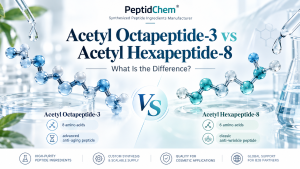
| Argireline | 6 amino acids |
| SNAP-8 | 8 amino acids |
Because SNAP-8 contains additional amino acids, researchers developed it as a next-generation peptide designed to more closely resemble a larger segment of SNAP-25.
However, ingredient selection should not rely only on peptide length. Real-world cosmetic performance depends on:
- peptide purity
- formulation concentration
- delivery system
- stability
- manufacturing quality
A well-formulated Argireline serum may outperform a poorly formulated SNAP-8 product.
Argireline vs SNAP-8: Scientific Comparison
| Feature | Argireline | SNAP-8 |
|---|---|---|
| INCI Name | Acetyl Hexapeptide-8 | Acetyl Octapeptide-3 |
| Peptide Length | 6 amino acids | 8 amino acids |
| Main Target | Expression wrinkles | Expression wrinkles |
| Market History | Established cosmetic active | Newer peptide generation |
| Research Availability | Extensive commercial experience | Growing interest |
| Cost Efficiency | Higher accessibility | Usually higher cost |
| Ideal Users | Mass premium skincare brands | Luxury anti-aging formulas |
Both ingredients are used for similar cosmetic goals, but Argireline has become the industry benchmark because of its established supply chain, formulation experience, and widespread adoption.

Why Argireline Remains a Top Choice for Cosmetic Formulators
1. Strong Consumer Recognition
Consumers searching for:
- “Botox alternative skincare”
- “wrinkle peptide serum”
- “anti-aging peptide”
often recognize Argireline as one of the leading peptide ingredients.
2. Excellent Formulation Compatibility
Argireline can be incorporated into:
- water-based serums
- eye creams
- moisturizers
- peptide complexes
- ampoules
Typical cosmetic usage levels are commonly formulated around several percent depending on product design and supplier recommendations.
3. Suitable for Combination Peptide Systems
Modern anti-aging products rarely rely on only one peptide.
Professional formulations often combine Argireline with:
Collagen-support peptides
Examples:
- Palmitoyl Pentapeptide-4
- Palmitoyl Tripeptide-1
- Palmitoyl Tetrapeptide-7
Repair peptides
Examples:
- GHK-Cu
- Copper peptides
Hydration ingredients
Examples:
- Hyaluronic acid
- Polyglutamic acid
- Ceramides
This creates a multi-pathway anti-aging approach.
Conclusion
The competition between Argireline and SNAP-8 is not simply about which peptide has a longer sequence. For brands seeking a trusted Acetyl Hexapeptide-8 powder supplier, Peptidchem provides cosmetic-grade peptide solutions designed for modern anti-aging product development. From laboratory innovation to industrial production, Contact us helps skincare brands transform advanced peptide science into market-ready products.
FAQs:
Q1:Is Argireline the same as Botox?
No. Argireline is a cosmetic peptide designed to improve the appearance of expression lines. Botox is a medical injectable treatment that affects nerve-muscle communication.
Q2:Is Argireline better than SNAP-8?
Neither ingredient is universally better. Argireline has stronger commercial history and broader adoption, while SNAP-8 represents a newer peptide evolution.
References
Cosmetic peptide research on neurotransmitter-modulating peptides and expression wrinkle applications.
Peptide-based anti-aging ingredient formulation studies.
Cosmetic science literature regarding Acetyl Hexapeptide-8 and SNAP peptide technologies.
Industry formulation guidelines for cosmetic peptides.