





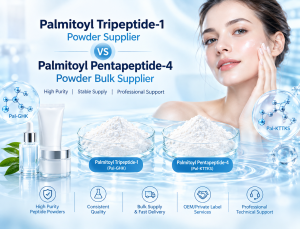
Compare Palmitoyl Pentapeptide-4 and Palmitoyl Tripeptide-1 for skincare formulations. Learn mechanisms, benefits, applications, and choose the right peptide supplier.
Palmitoyl Pentapeptide-4 vs Palmitoyl Tripeptide-1: Which Peptide Is Better for Skincare Formulations?
Peptidchem is become a global skincare industry is rapidly moving toward science-driven active ingredients, and cosmetic peptides have become essential components in premium anti-aging formulations.
Among the most widely used signal peptides are:
- Palmitoyl Pentapeptide-4 (Pal-KTTKS, commonly associated with Matrixyl™)
- Palmitoyl Tripeptide-1 (Pal-GHK)
Both peptides are designed to support skin rejuvenation by communicating with skin cells and promoting extracellular matrix activity. However, they differ in peptide sequence, mechanism, formulation positioning, and ideal product applications.
What Is Palmitoyl Pentapeptide-4?
Palmitoyl Pentapeptide-4 is a synthetic signal peptide composed of five amino acids linked with palmitic acid to improve skin penetration.
Chemical Name: Palmitoyl Pentapeptide-4
Sequence: Pal-KTTKS
Peptide Type: Signal peptide
Primary Application: Anti-aging, collagen-supporting skincare formulations
Palmitoyl Pentapeptide-4 functions as a biomimetic peptide that mimics natural skin repair signals. It is designed to activate fibroblast responses associated with extracellular matrix components.
Scientific reviews report that Palmitoyl Pentapeptide-4 can stimulate procollagen production and influence hyaluronic acid synthesis pathways, supporting improved skin elasticity and reduced appearance of fine lines.
What Is Palmitoyl Tripeptide-1?
Palmitoyl Tripeptide-1 is a synthetic lipidated tripeptide derived from the GHK peptide family.
Chemical Name: Palmitoyl Tripeptide-1
Sequence: Pal-Gly-His-Lys (Pal-GHK)
Peptide Type: Signal peptide / matrikine peptide
Primary Application: Skin repair, firmness, collagen-support formulations
Palmitoyl Tripeptide-1 acts as a messenger peptide by interacting with pathways involved in extracellular matrix remodeling.
Research on matrikines indicates that peptide fragments derived from extracellular matrix proteins can participate in tissue remodeling signaling processes.
What Is the Difference Between Palmitoyl Pentapeptide-4 and Palmitoyl Tripeptide-1?
Comparison Table
| Feature | Palmitoyl Pentapeptide-4 | Palmitoyl Tripeptide-1 |
|---|---|---|
| Peptide Length | 5 amino acids | 3 amino acids |
| Common Name | Pal-KTTKS | Pal-GHK |
| Peptide Category | Signal peptide | Signal peptide / matrikine |
| Main Target | Collagen-support signaling | ECM remodeling and repair signaling |
| Skin Benefit Focus | Wrinkle appearance, firmness | Repair, elasticity, regeneration support |
| Typical Products | Anti-aging creams, serums | Repair serums, firming products |
| Formulation Position | Premium anti-aging active | Skin renewal and recovery active |
How Does Palmitoyl Pentapeptide-4 Work in Skin Care?
Palmitoyl Pentapeptide-4 works through a signaling mechanism.
After application:
Palmitoyl Pentapeptide-4 → Fibroblast Communication → Increased Skin Matrix Support → Improved Skin Firmness Appearance
Its reported cosmetic benefits include:
- Supporting collagen synthesis
- Improving visible skin elasticity
- Reducing the appearance of fine wrinkles
- Supporting smoother skin texture
Clinical and review literature identifies Palmitoyl Pentapeptide-4 as one of the most researched cosmetic signaling peptides.
How Does Palmitoyl Tripeptide-1 Work?
Palmitoyl Tripeptide-1 acts as a biomimetic peptide that resembles natural extracellular matrix signaling molecules.
Its cosmetic functions include:
- Supporting collagen-related pathways
- Improving firmness appearance
- Supporting skin regeneration formulations
- Enhancing anti-aging product positioning
Because of its smaller peptide structure, it is frequently incorporated into formulations designed for lightweight serums and repair-focused products.
Which Peptide Provides Better Anti-Aging Performance?
There is no universal winner because the selection depends on the formulation objective.
Choose Palmitoyl Pentapeptide-4 When Your Brand Wants:
✔ Premium anti-wrinkle positioning
✔ Collagen-support claims
✔ Mature skin formulations
✔ Luxury anti-aging creams and serums
Choose Palmitoyl Tripeptide-1 When Your Brand Wants:
✔ Skin repair positioning
✔ Firmness improvement products
✔ Barrier-support formulations
✔ Regeneration-focused skincare
For advanced formulations, many cosmetic brands combine multiple peptides to create complementary mechanisms.
Can Brands Use Both Peptides Together?
Yes.
Combining Palmitoyl Pentapeptide-4 and Palmitoyl Tripeptide-1 can provide a broader peptide technology platform.
A multi-peptide formula may target:
- Collagen-support signaling
- Extracellular matrix communication
- Skin firmness
- Visible aging concerns
Modern skincare development increasingly uses peptide combinations together with:
- Hyaluronic acid
- Ceramides
- Niacinamide
- Antioxidants
- Growth-factor-inspired ingredients
What Should Cosmetic Brands Consider When Selecting a Peptide Supplier?
Choosing a reliable cosmetic peptide supplier requires evaluation of:
1. Peptide Purity
High-quality synthesized peptide ingredients should provide:
- Verified purity percentage
- Analytical testing data
- HPLC characterization
- Batch-to-batch consistency
2. Manufacturing Capability
A professional peptide manufacturer should provide:
- Custom peptide synthesis
- Bulk peptide production
- Cosmetic-grade documentation
- Stability information
- Technical support
3. Regulatory Documentation
Brands should request:
- Certificate of Analysis (COA)
- Safety data sheet (SDS)
- Specification sheet
- Ingredient compliance documents
Why Choose Our Synthesized Cosmetic Peptide Ingredients?
As a specialized synthesized peptide ingredients manufacturer, we provide cosmetic brands with high-quality peptide raw materials designed for modern skincare innovation.
Our capabilities include:
✔ Custom peptide synthesis
✔ Cosmetic-grade peptide ingredients
✔ Bulk supply for skincare manufacturers
✔ Quality-controlled production
✔ Technical formulation support
Our peptide portfolio supports:
- Anti-aging skincare
- Firming serums
- Facial creams
- Eye-care products
- Professional cosmetic formulations
Palmitoyl Pentapeptide-4 vs Palmitoyl Tripeptide-1: Quick Decision Guide
| Brand Goal | Recommended Peptide |
|---|---|
| Anti-wrinkle serum | Palmitoyl Pentapeptide-4 |
| Premium anti-aging cream | Palmitoyl Pentapeptide-4 |
| Skin repair formula | Palmitoyl Tripeptide-1 |
| Firming serum | Both peptides |
| Multi-peptide luxury formula | Combination approach |
Conclusion
Palmitoyl Pentapeptide-4 and Palmitoyl Tripeptide-1 are both valuable cosmetic peptide ingredients, but they serve different formulation strategies.
- Choose Palmitoyl Pentapeptide-4 for strong anti-aging and collagen-support positioning.
- Choose Palmitoyl Tripeptide-1 for repair-oriented and skin-renewal formulations.
- Choose a combination approach for advanced multi-functional skincare products.
📩 Contact us for cosmetic brands seeking reliable peptide raw materials, partnering with an experienced synthesized peptide ingredients manufacturer ensures consistent quality, technical support, and scalable supply.
Also See
Palmitoyl Tripeptide-1 vs Palmitoyl Tetrapeptide-7: Understanding Matrixyl Peptide Technology
Why Are Palmitoyl Peptides Considered Premium Ingredients in Luxury Skincare Formulas
Why Do Formulators Use Palmitoyl Tetrapeptide-7 Powder in Anti-Aging and Skin Repair Solutions
FAQs:
Q1. Is Palmitoyl Pentapeptide-4 safe for cosmetic use?
Yes. Palmitoyl Pentapeptide-4 has been widely used in cosmetic formulations and evaluated for skin compatibility. Reviews report good tolerability when used at cosmetic concentrations.
Q2. Is Palmitoyl Tripeptide-1 better than Palmitoyl Pentapeptide-4?
Neither peptide is universally better. The choice depends on the formulation goal, target consumers, and marketing positioning.
Q3. What concentration of Palmitoyl Pentapeptide-4 is commonly used?
Cosmetic concentrations depend on the supplier specification and formulation system. Brands should follow technical documentation provided by the peptide manufacturer.
Q4. Can peptides replace retinol?
Peptides and retinol work through different mechanisms. Peptides are generally positioned as supportive anti-aging ingredients, while retinoids have different biological targets.
Q5. Where can brands buy cosmetic peptide ingredients?
Brands should source from qualified cosmetic peptide suppliers offering:
- Synthesized peptide ingredients
- Quality certificates
- Technical documentation
- Reliable bulk supply
References
Pintea A. et al. Peptides: Emerging Candidates for the Prevention and Treatment of Skin Aging. Biomolecules, 2025.
Schagen S. Topical Peptide Treatments with Effective Anti-Aging Results. Cosmetics, 2017.
Jariwala N. et al. Matrikines as Mediators of Tissue Remodelling. Matrix Biology, 2022.
Abu Samah N. Topically Applied KTTKS: A Review. International Journal of Cosmetic Science, 2011.