




Discover the differences between GHK-Cu and Matrixyl peptides for collagen support, skin repair, and anti-aging formulations. Compare mechanisms, cosmetic applications, and choose a reliable synthesized peptide ingredient supplier for skincare development.
GHK-Cu vs Matrixyl: Which Peptide Is Better for Collagen Support and Skin Repair?
Peptidchem is become a global skincare industry is increasingly moving toward biotechnology-driven active ingredients. Among the most researched cosmetic ingredients are peptides—short chains of amino acids that act as biological messengers and support processes related to skin appearance, extracellular matrix maintenance, and repair mechanisms.
Two widely recognized cosmetic peptides are:
Both are associated with collagen-related skincare benefits, but they work through different biological pathways.
For cosmetic brands developing advanced anti-aging products, the key question is:
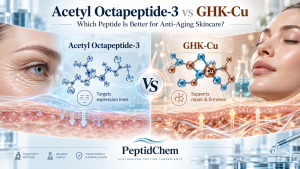
Which peptide is better: GHK-Cu or Matrixyl?
The answer depends on the formulation objective:
- collagen signaling,
- skin regeneration support,
- barrier repair,
- wrinkle appearance reduction,
- or overall anti-aging positioning.
What Is GHK-Cu Peptide?
GHK-Cu, also known as Copper Tripeptide-1, is a naturally occurring copper-binding peptide composed of:
Glycine – Histidine – Lysine (GHK)
The peptide forms a complex with copper ions, creating GHK-Cu, which has been widely studied for its role in tissue remodeling, wound repair, and extracellular matrix regulation.
Research reviews have reported that GHK-Cu may influence collagen synthesis, antioxidant activity, inflammatory pathways, and skin regeneration mechanisms.
How Does GHK-Cu Support Skin Repair?
GHK-Cu is considered a repair-support peptide because it is associated with several cellular processes:
1. Collagen Support
GHK-Cu has been investigated for stimulating fibroblast activity and supporting extracellular matrix components, including collagen and glycosaminoglycans.
2. Skin Remodeling
The peptide is studied for its involvement in:
- extracellular matrix remodeling,
- fibroblast communication,
- tissue regeneration pathways.
3. Antioxidant and Protective Activity
Studies have suggested that GHK-Cu may influence antioxidant defense systems and cellular responses associated with environmental stress.
What Is Matrixyl Peptide?
Matrixyl is a trademarked family of cosmetic signal peptides developed for anti-aging skincare applications.
Common Matrixyl peptides include:
- Matrixyl 3000
- Matrixyl Synthe’6
- Palmitoyl Pentapeptide-4
These peptides are designed to mimic extracellular matrix fragments and send signaling messages associated with skin support.
How Does Matrixyl Work?
Matrixyl belongs to the category of signal peptides.
Its primary cosmetic mechanism is based on:
- stimulating skin communication pathways,
- supporting collagen-related processes,
- improving the appearance of fine lines and wrinkles.
Unlike GHK-Cu, Matrixyl does not function through copper delivery. Instead, it works mainly through peptide signaling mechanisms.
GHK-Cu vs Matrixyl: Scientific Comparison
| Feature | GHK-Cu | Matrixyl |
|---|---|---|
| Peptide Type | Copper-binding peptide | Signal peptide |
| Main Function | Skin repair and regeneration support | Collagen signaling support |
| Key Component | Gly-His-Lys + Copper | Palmitoylated peptide sequences |
| Primary Target | Fibroblast activity, extracellular matrix | Skin signaling pathways |
| Anti-aging Application | Repair-focused formulations | Wrinkle and firmness-focused formulations |
| Suitable Product Types | Serums, recovery creams, advanced repair formulations | Anti-wrinkle creams, peptide serums |
| Formulation Positioning | Regenerative skincare | Collagen-support skincare |
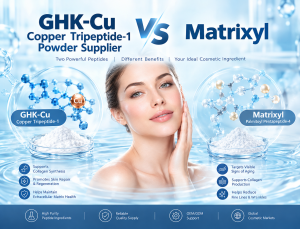
Which Peptide Is Better for Collagen Support?
There is no universal winner because both peptides have different mechanisms.
GHK-Cu Advantages:
- Strong association with tissue remodeling research
- Copper-dependent biological activity
- Suitable for repair-oriented skincare concepts
- Frequently used in advanced regenerative cosmetic formulations
GHK-Cu research has demonstrated potential effects on collagen production and skin regeneration pathways, although further large-scale clinical studies are needed to fully define cosmetic performance.
Matrixyl Advantages:
- Established cosmetic signal peptide technology
- Widely used in anti-aging formulations
- Strong consumer recognition in peptide skincare products
Which Peptide Is Better for Skin Repair?
The choice depends on product positioning.
Choose GHK-Cu When Developing:
- skin recovery serums,
- advanced anti-aging products,
- post-procedure supportive skincare,
- regenerative cosmetic concepts,
- premium peptide formulations.
Choose Matrixyl When Developing:
- daily anti-wrinkle creams,
- collagen-support moisturizers,
- firmness-enhancing products,
- mainstream anti-aging skincare.
Can GHK-Cu and Matrixyl Be Used Together?
Yes. Many advanced peptide formulations combine multiple peptide technologies because different peptides may target different cosmetic pathways.
A combination approach can provide:
- repair-focused positioning from GHK-Cu,
- signal peptide benefits from Matrixyl,
- broader anti-aging marketing potential.
However, formulation compatibility, stability, concentration, pH, and delivery systems should always be evaluated during product development.
Why Choose a Professional Cosmetic Peptide Manufacturer?
Selecting the right peptide ingredient manufacturer is critical for product quality.
A reliable cosmetic peptide supplier should provide:
High Purity Synthetic Peptides
Important quality parameters include:
- peptide purity testing,
- analytical characterization,
- batch consistency,
- stability evaluation.
Custom Peptide Synthesis Capability
Professional manufacturers should support:
- research-grade peptides,
- cosmetic-grade peptide ingredients,
- customized peptide sequences,
- bulk production.
Regulatory Documentation
Global cosmetic brands typically require:
- Certificate of Analysis (COA),
- HPLC analysis,
- MS identification,
- technical data sheets,
- safety documentation.
Cosmetic Peptide Ingredients We Manufacture
As a professional synthesized peptide ingredient manufacturer, we provide:
GHK-Cu (Copper Tripeptide-1)
Applications:
- anti-aging serums,
- skin repair formulations,
- collagen-support products.
Matrixyl-Type Peptides
Applications:
- wrinkle care products,
- firming formulations,
- premium peptide skincare.
Custom Synthetic Peptide Solutions
Including:
- cosmetic peptides,
- research peptides,
- customized sequences,
- bulk peptide ingredients.
GHK-Cu vs Matrixyl: Final Comparison
For Skin Repair and Regeneration Positioning:
GHK-Cu is often selected because of its copper-dependent repair-related research background.
For Traditional Anti-Aging and Collagen Signaling Products:
Matrixyl remains a popular choice due to its established cosmetic application history.
For Premium Peptide Skincare:
A combination of different peptide technologies may provide broader formulation opportunities.
The best peptide ingredient depends on the desired product claim, formulation strategy, and target consumer 📩 Contact us to request a quotation or discuss your specific requirements. Let’s build a strong partnership supply for your anti-aging cosmetics product line.
Also See
Palmitoyl Pentapeptide-4 (Matrixyl): Why It Remains a Leading Anti-Aging Peptide Ingredient
Copper Tripeptide-1 (GHK-Cu): Cosmetic Formulation Guide | Peptidchem
Palmitoyl Tetrapeptide-7 and Palmitoyl Tripeptide-1: Key Peptides for Advanced Skincare Products
FAQs:
Q1: Is GHK-Cu a collagen peptide?
No. GHK-Cu is not collagen itself. It is a copper-binding tripeptide studied for its ability to influence skin remodeling and collagen-related pathways.
Q2: Is Matrixyl the same as GHK-Cu?
No. Matrixyl and GHK-Cu are different cosmetic peptides with different structures and mechanisms.
Q3: Which peptide is better for wrinkles?
Both are used in anti-aging formulations. Matrixyl is commonly positioned for wrinkle appearance improvement, while GHK-Cu is commonly positioned for skin repair and regeneration support.
Q4: Can peptide ingredients be customized?
Yes. Professional peptide manufacturers can provide customized synthesis according to sequence requirements, purity specifications, and application needs.
Q5: Where can brands source high-quality cosmetic peptides?
Brands should work with experienced synthetic peptide manufacturers offering quality documentation, analytical testing, and consistent production capability.
References
Pickart L. et al. Regenerative and Protective Actions of the GHK-Cu Peptide in the Light of New Gene Data. International Journal of Molecular Sciences. 2018.
Dou Y. et al. The Potential of GHK as an Anti-aging Peptide. International Journal of Molecular Sciences. 2020.
Pickart L. GHK Peptide as a Natural Modulator of Multiple Cellular Pathways. BioMed Research International. 2015.
Veiga E. et al. Anti-aging peptides for advanced skincare. Journal of Cosmetic Dermatology. 2023.