




Discover how to select the right cosmetic peptide blend for anti-aging serum and cream formulations. Learn peptide types, formulation strategies, supplier selection criteria, and how synthesized cosmetic peptides improve skincare product performance.
How to Select the Right Cosmetic Peptide Blend for Anti-Aging Serum and Cream Formulations?
Modern anti-aging skincare formulations increasingly rely on bioactive cosmetic peptides because consumers demand scientifically supported ingredients that improve visible signs of aging, including fine lines, loss of firmness, reduced elasticity, and uneven skin texture.Unlike conventional moisturizing ingredients, cosmetic peptides act as biological signaling molecules. They are designed to interact with skin pathways associated with extracellular matrix maintenance, collagen production, skin repair, and barrier function.For cosmetic manufacturers, selecting the correct peptide blend is not simply about adding multiple peptides together. A successful anti-aging formulation requires understanding:
- peptide mechanism of action,
- compatibility with serum and cream systems,
- stability requirements,
- dosage optimization,
- supplier quality standards.
What Are Cosmetic Peptides Used in Anti-Aging Skincare?
Cosmetic peptides are short chains of amino acids linked by peptide bonds. They are designed as functional cosmetic ingredients that can influence skin appearance through different biological mechanisms.
In skincare formulations, peptides are mainly used to support:
- collagen synthesis,
- skin firmness,
- elasticity improvement,
- wrinkle reduction,
- hydration enhancement,
- skin barrier recovery.
Scientific reviews classify cosmetic peptides according to their functions, including signal peptides, carrier peptides, enzyme inhibitors, and neurotransmitter-modulating peptides.
What Are the Main Types of Cosmetic Peptides for Anti-Aging Formulations?
Selecting the right peptide blend starts with understanding peptide categories.
1. Signal Peptides
Function:
Signal peptides stimulate skin cells to produce extracellular matrix components, especially collagen-related proteins.
Common applications:
- anti-wrinkle serum
- firming cream
- age-defying moisturizer
Benefits:
- improves skin firmness appearance
- supports collagen-related pathways
- enhances skin texture
Examples:
- Palmitoyl Tripeptide-1
- Palmitoyl Tetrapeptide-7
- Palmitoyl Tripeptide-5
2. Carrier Peptides
Carrier peptides transport trace elements required for skin functions.
The most recognized example is copper peptide technology.
Example:
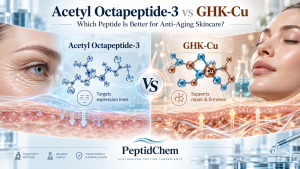
Copper Tripeptide-1 (GHK-Cu)
Applications:
- skin regeneration products
- repair creams
- advanced anti-aging serums
Benefits:
- supports extracellular matrix activity
- improves skin recovery appearance
- enhances formulation value
3. Neurotransmitter-Inhibiting Peptides
These peptides are designed for expression-line reduction applications.
They are commonly included in:
- premium anti-wrinkle serums
- eye creams
- luxury anti-aging products
Example:
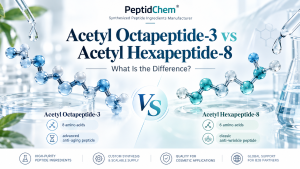
- Acetyl Hexapeptide-8
4. Enzyme-Inhibiting Peptides
These peptides help protect structural proteins by regulating enzymes involved in collagen degradation.
Applications:
- mature skin formulations
- collagen protection products
How Do You Choose the Correct Peptide Blend for an Anti-Aging Serum?
A peptide blend should be selected according to the product objective.
For Collagen Support Serum
Recommended peptide strategy:
| Skin Goal | Suitable Peptide Category |
|---|---|
| Firmness improvement | Signal peptides |
| Wrinkle appearance reduction | Neurotransmitter peptides |
| Skin recovery | Carrier peptides |
| Long-term anti-aging positioning | Multi-peptide combinations |
A combination approach often provides broader marketing positioning than a single peptide.
Should Cosmetic Manufacturers Use Single Peptides or Peptide Blends?
Single Peptide Formulation
Advantages:
- easier stability control
- simpler regulatory documentation
- lower formulation complexity
Suitable for:
- targeted products
- ingredient-focused brands
Multi-Peptide Blend
Advantages:
- multiple mechanisms of action
- stronger product differentiation
- premium anti-aging positioning
Example:
A complete anti-aging serum may combine:
- signal peptide → collagen support
- copper peptide → skin recovery
- expression-line peptide → wrinkle appearance improvement
A well-designed peptide blend creates a multifunctional anti-aging concept.
How Do You Select a Reliable Cosmetic Peptide Supplier?
Choosing the right supplier directly affects product quality and commercial success.
A professional cosmetic peptide manufacturer should provide:
1. Advanced Peptide Synthesis Capability
Look for suppliers experienced in:
- solid-phase peptide synthesis (SPPS)
- purification technology
- analytical characterization
2. Quality Documentation
A reliable supplier should provide:
- Certificate of Analysis (COA)
- HPLC purity analysis
- Mass spectrometry confirmation
- stability data
- safety documentation
3. Custom Peptide Development Capability
Leading peptide manufacturers should support:
- customized peptide sequences
- formulation-specific optimization
- private label ingredient solutions
4. Regulatory Support
International cosmetic suppliers should understand:
- INCI naming requirements
- regional cosmetic regulations
- documentation requirements
What Factors Affect Cosmetic Peptide Stability in Serums and Creams?
Peptides are sensitive active ingredients. Their performance depends on formulation conditions.
Important factors include:
pH Compatibility
Most cosmetic peptides perform best within controlled pH ranges.
Temperature Stability
Manufacturing temperature should be carefully controlled.
Preservative Compatibility
Some preservatives may influence peptide stability.
Packaging Selection
Airless packaging can reduce oxidation and contamination risks.
What Is the Recommended Peptide Concentration in Skincare Products?
The optimal concentration depends on:
- peptide type,
- purity,
- delivery system,
- formulation objective.
Cosmetic manufacturers should follow supplier technical recommendations rather than simply increasing concentration.
Higher concentration does not always mean higher effectiveness.
Why Choose Synthesized Cosmetic Peptides Instead of Natural Peptide Extracts?
Synthetic cosmetic peptides provide several advantages:
Higher Purity
Controlled synthesis enables consistent ingredient quality.
Batch-to-Batch Consistency
Synthetic production provides reproducible performance.
Customization
Manufacturers can design peptide sequences according to specific skincare applications.
Scalability
Synthetic peptide production supports industrial cosmetic manufacturing.
How Can Brands Develop a Premium Anti-Aging Peptide Serum?
A successful peptide serum formulation usually combines:
Core Active System
- cosmetic peptides
- antioxidants
- humectants
- barrier-support ingredients
Texture System
- lightweight serum base
- fast absorption
- consumer-friendly sensory profile
Marketing Positioning
Examples:
- collagen-support serum
- advanced peptide repair serum
- multi-peptide anti-aging complex
Why Partner With a Professional Cosmetic Peptide Manufacturer?
For skincare brands, ingredient selection is only one part of successful product development.
A specialized cosmetic peptide supplier provides:
- high-purity synthesized peptide ingredients
- customized peptide solutions
- technical formulation support
- reliable production capacity
- documentation support
Choosing an experienced peptide manufacturer helps brands develop competitive anti-aging serums, creams, and professional skincare products.
Cosmetic Peptide Supplier Selection Checklist
Before purchasing peptide ingredients, cosmetic manufacturers should evaluate:
✓ Does the supplier manufacture peptides directly?
✓ Is peptide purity verified by analytical methods?
✓ Can the supplier provide technical documentation?
✓ Does the supplier support customized peptide synthesis?
✓ Are peptides suitable for serum and cream applications?
✓ Does the supplier understand international cosmetic markets?
Conclusion
Selecting the right cosmetic peptide blend is essential for developing effective anti-aging serums and creams. A successful formulation depends on choosing peptides based on their specific functions, including collagen support, skin repair, hydration improvement, and wrinkle appearance reduction.📩 Contact us to request a quotation or discuss your specific requirements and partnering with a reliable cosmetic peptide supplier and synthesized peptide manufacturer ensures consistent quality, high purity, technical support, and customized solutions for skincare brands. By combining scientifically designed peptide ingredients with advanced formulation strategies, manufacturers can create innovative, high-performance anti-aging products that meet modern consumer expectations.
Also See
The Future of Anti-Aging Skincare: How Peptide Ingredients Are Transforming Cosmetic Formulations
Peptide Ingredients for Skincare: Understanding Molecular Structure, Benefits, and Applications
FAQs:
Q1:What is the best cosmetic peptide for anti-aging?
There is no single best peptide. The ideal choice depends on the product goal. Signal peptides, copper peptides, and neurotransmitter-modulating peptides are commonly used in anti-aging formulations.
Q2:Are synthetic peptides safe for cosmetic products?
Synthetic cosmetic peptides are widely used in skincare when manufactured according to appropriate quality standards and formulated within recommended usage levels.
Q3:What is the difference between cosmetic peptides and pharmaceutical peptides?
Cosmetic peptides are designed for topical skincare applications, focusing on improving visible skin appearance. Pharmaceutical peptides are developed for therapeutic applications.
Q4:Can peptide blends be customized for private label skincare brands?
Yes. Professional peptide manufacturers can develop customized blends based on target skin concerns, formulation requirements, and product positioning.
Q5:How long does it take to see results from peptide skincare?
Visible improvements depend on peptide type, formulation, skin condition, and consistent use. Anti-aging skincare generally requires continuous application over time.
References
Pintea A. et al. Peptides: Emerging Candidates for the Prevention and Treatment of Skin Aging. 2025.
Rovero P. et al. The Clinical Evidence-Based Paradigm of Topical Anti-Aging Skincare Formulations. 2022.
Schagen S. Topical Peptide Treatments with Effective Anti-Aging Results. Cosmetics Journal. 2017.
Veiga E. et al. Anti-aging Peptides for Advanced Skincare. 2023.
Nukaly H.Y. et al. Oral and Topical Peptides for Skin Aging: Systematic Review and Meta-analysis. 2026.