



Discover synthesized cosmetic peptide ingredients, molecular structures, skincare benefits, applications, and how to choose a reliable cosmetic peptide supplier.
Why Are Peptide Ingredients Becoming Essential in Modern Skincare Formulations?
The global skincare industry is rapidly shifting toward science-driven active ingredients that provide targeted biological functions. Among advanced cosmetic ingredients, peptide ingredients for skincare have become one of the most researched and widely adopted solutions for anti-aging, skin repair, hydration, and barrier protection.
Unlike traditional cosmetic ingredients that mainly improve surface appearance, peptides function as molecular messengers. Their unique amino acid sequences allow them to interact with skin pathways related to collagen synthesis, extracellular matrix remodeling, antioxidant defense, and skin regeneration.
What Are Peptide Ingredients Used in Skincare?
Cosmetic peptidchem are short chains of amino acids connected by peptide bonds. Compared with complete proteins, peptides contain fewer amino acid residues, allowing them to function as targeted signaling molecules.
Generally:
- Dipeptides: 2 amino acids
- Tripeptides: 3 amino acids
- Oligopeptides: approximately 2–20 amino acids
- Polypeptides: longer amino acid chains
The biological activity of a peptide depends mainly on:
- Amino acid sequence
- Molecular structure
- Chemical modification
- Stability in cosmetic formulations
- Delivery system compatibility
Synthetic cosmetic peptides are designed by replicating or optimizing naturally occurring peptide sequences to achieve specific skincare functions.Research has shown that cosmetic peptides can support multiple applications, including collagen stimulation, antioxidant protection, pigmentation regulation, skin barrier support, and wrinkle appearance reduction.
How Does the Molecular Structure of Peptides Determine Their Skincare Function?
The molecular structure of peptides is the foundation of their cosmetic performance.
A peptide structure consists of:
Amino acid sequence → peptide chain → biological activity
Small changes in amino acid arrangement can significantly affect:
- Skin affinity
- Cellular signaling ability
- Stability
- Target activity
For example, biomimetic peptides are designed to imitate natural skin communication molecules. These peptides can provide signals that encourage fibroblast activity and support extracellular matrix components such as collagen and elastin.
Synthetic modification techniques, including lipidation, can improve:
- Skin compatibility
- Formula stability
- Delivery efficiency
- Oil-phase compatibility
For cosmetic manufacturers, controlled peptide synthesis enables consistent quality compared with variable natural extraction sources.
What Are the Main Types of Cosmetic Peptide Ingredients?
Cosmetic peptides are commonly classified according to their biological mechanism.
1. Signal Peptides
Signal peptides communicate with skin cells and are widely used in anti-aging formulations.
Typical applications:
- Firming skincare products
- Anti-wrinkle creams
- Premium facial serums
Examples:
- Palmitoyl Tripeptide-1
- Palmitoyl Tetrapeptide-7
- Palmitoyl Hexapeptide-12
These peptides are commonly associated with supporting collagen-related pathways and extracellular matrix functions.
2. Carrier Peptides
Carrier peptides transport trace elements required for biological processes.
Common examples:
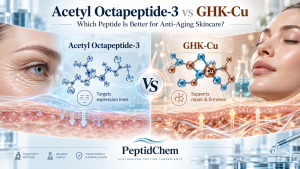
- Copper Tripeptide-1 (GHK-Cu)
- Mineral-binding peptide complexes
Applications include:
- Skin regeneration products
- Repair-focused skincare
- Advanced anti-aging formulations
Carrier peptides are studied for their relationship with collagen metabolism, antioxidant defense, and skin recovery processes.
3. Enzyme-Inhibiting Peptides
These peptides are designed to regulate specific enzyme activities associated with visible skin aging.
Applications:
- Wrinkle care
- Skin texture improvement
- Mature skin formulations
4. Neurotransmitter-Related Peptides
These peptides are commonly used in expression-line skincare products.
Applications:
- Anti-wrinkle serums
- Premium facial treatments
- Luxury skincare formulations
What Are the Benefits of Peptide Ingredients in Skincare Products?
1. Supports Anti-Aging Skincare Formulations
Peptides are among the most popular active ingredients for mature skin products because they can interact with pathways related to collagen and extracellular matrix proteins.
Potential cosmetic benefits include:
- Improved appearance of skin firmness
- Reduced appearance of fine lines
- Enhanced skin smoothness
2. Supports Skin Barrier Function
Certain peptide ingredients can help maintain healthier-looking skin by supporting barrier-related functions.
Benefits include:
- Better moisture retention
- Improved skin comfort
- Enhanced formulation performance
3. Provides Advanced Cosmetic Differentiation
For skincare brands, peptides offer strong marketing advantages because they are:
- Science-backed active ingredients
- Compatible with premium skincare positioning
- Suitable for anti-aging product development
4. Flexible Formulation Applications
Synthetic peptide ingredients can be incorporated into:
- Facial serums
- Anti-aging creams
- Eye creams
- Moisturizers
- Sleeping masks
- Professional skincare products
Why Choose Synthesized Peptide Ingredients Instead of Natural Peptides?
Synthetic peptide production provides important advantages for cosmetic ingredient manufacturers.
Consistent Purity
Chemical synthesis allows precise control of:
- Amino acid sequence
- Purity level
- Batch consistency
Scalable Manufacturing
Professional peptide synthesis enables:
- Bulk production
- Stable supply chains
- Customized peptide development
Customization Capability
Cosmetic brands increasingly require differentiated formulations.
A professional peptide supplier can provide:
- Custom peptide sequences
- Customized purity grades
- Cosmetic application consultation
- Private label ingredient solutions
How to Choose a Reliable Cosmetic Peptide Supplier?
When sourcing peptide raw materials, cosmetic companies should evaluate:
1. Manufacturing Capability
A qualified supplier should provide:
- Advanced peptide synthesis technology
- Quality control systems
- Batch-to-batch consistency
2. Technical Documentation
Important documents include:
- COA (Certificate of Analysis)
- HPLC purity data
- MS identification
- Stability information
- Safety documentation
3. Custom Development Ability
A professional cosmetic peptide manufacturer should support:
- New peptide design
- Small-scale testing
- Commercial production
- Global ingredient supply
What Applications Use Cosmetic Peptide Ingredients?
Synthetic cosmetic peptides are widely used in:
| Application | Function |
|---|---|
| Anti-aging creams | Supports youthful-looking skin |
| Facial serums | High-concentration active delivery |
| Eye care products | Targets fine-line appearance |
| Repair products | Supports skin recovery formulations |
| Premium skincare | Adds biotechnology positioning |
| Professional cosmetics | Provides advanced active solutions |
Why Partner With a Synthesized Cosmetic Peptide Manufacturer?
As demand grows for biotechnology-based skincare ingredients, cosmetic brands require reliable peptide suppliers capable of delivering high-quality synthesized peptide ingredients.
A professional peptide manufacturing partner provides:
- Research-driven peptide design
- High-purity cosmetic peptides
- Custom synthesis services
- Bulk ingredient supply
- Technical formulation support
For skincare brands developing next-generation anti-aging and functional cosmetics, synthetic peptides provide a powerful platform for innovation.📩 Contact us to request a quotation or discuss your specific requirements. Let’s build a strong partnership supply for your anti-aging cosmetics product line.
Also See
Cosmetic Peptide Manufacturer Guide: What Skincare Brands Should Know Before Sourcing Peptides
Inside Cosmetic Peptide Manufacturing: Production Process, Quality Control, and Industry Standards
How to Choose a Reliable Cosmetic Peptide Supplier: Quality, Testing, and Documentation Guide
FAQs:
Q1:What are peptide ingredients in skincare?
Peptide ingredients are short amino acid chains used in cosmetics to support skin functions such as firmness, hydration, repair, and anti-aging appearance.
Q2:Are synthetic peptides safe for cosmetic products?
Cosmetic-grade synthetic peptides are developed according to ingredient safety requirements and undergo quality testing before use in formulations.
Q3:What is the difference between peptides and proteins?
Peptides are smaller amino acid chains, while proteins contain longer and more complex structures. The smaller size allows peptides to act as targeted cosmetic active ingredients.
Q4:Can cosmetic peptide suppliers provide customized peptides?
Yes. Professional peptide manufacturers can develop customized sequences, purity grades, and production scales according to brand requirements.
Q5:What peptide ingredients are commonly used in anti-aging skincare?
Common cosmetic peptides include signal peptides, carrier peptides, copper peptides, and biomimetic peptides designed for advanced skincare applications.
References
Applications of bioactive peptides in cosmeceuticals: a review. Journal of Zhejiang University Science B.
Bioactive peptides in cosmetic formulations: Review of current in vitro and ex vivo evidence. Peptides, 2025.
Overview of Peptides and Their Potential Roles in Skin Health and Beauty. Journal of Peptide Science, 2025.
Cosmeceuticals and peptides. Clinics in Dermatology.
Overview of popular cosmeceuticals in dermatology: Peptides section. Skin Health and Disease.