





Compare factory-direct and trading-company sourcing for bulk sodium hyaluronate powder. Check molecular weight, COA, purity and traceability with PeptidChem.
Why Choose a Factory Supplier for Bulk Sodium Hyaluronate Powder Instead of Trading Companies?
When purchasing bulk sodium hyaluronate powder, choosing the right supplier is just as important as selecting the right molecular weight and purity. For cosmetic manufacturers, skincare brands, and contract manufacturers, buying directly from a verified factory can offer better manufacturing transparency, batch traceability, technical communication, and long-term supply planning.
But is purchasing directly from a manufacturer always better than buying through a trading company?
The answer depends on production control, product specifications, quality documentation, pricing transparency, and the supplier’s ability to maintain consistent commercial batches.
At PeptidChem, we believe that successful cosmetic ingredient procurement should be based on scientific quality, manufacturing transparency, and reliable supply relationships.
This guide explains why factory-direct sourcing deserves consideration when purchasing sodium hyaluronate powder in bulk and what professional cosmetic manufacturers should evaluate before placing an order.
What Is Sodium Hyaluronate Powder and Why Is It Important in Cosmetics?
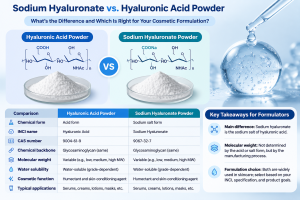
Sodium hyaluronate is the sodium salt of hyaluronic acid, a naturally occurring glycosaminoglycan composed of repeating disaccharide units of glucuronic acid and N-acetylglucosamine.
It is widely used in cosmetic formulations because of its water-binding properties and its ability to function as a humectant and skin-conditioning ingredient.
Basic product information
| Parameter | Description |
|---|---|
| Product name | Sodium Hyaluronate Powder |
| INCI name | Sodium Hyaluronate |
| CAS number | 9067-32-7 |
| Chemical category | Glycosaminoglycan |
| Appearance | White to off-white powder, depending on grade |
| Solubility | Water-soluble |
| Main cosmetic function | Humectant and skin conditioning |
| Common applications | Serums, creams, lotions, gels and facial masks |
Sodium hyaluronate is particularly important in modern skincare because it can help maintain moisture on the skin surface and contribute to the sensory and rheological properties of cosmetic formulations.
Its commercial relevance is also supported by the Cosmetic Ingredient Review (CIR). Its 2023 safety assessment reported that sodium hyaluronate appeared in 4,713 cosmetic formulations in the FDA’s 2023 Voluntary Cosmetic Registration Program dataset. This is historical industry-use data, not a current market-size estimate.
The CIR Expert Panel concluded that the seven hyaluronate ingredients reviewed were safe under the present practices of use and concentrations described in its assessment.
Reference: Cosmetic Ingredient Review, 2023, Safety Assessment of Hyaluronates as Used in Cosmetics.
Why Should You Choose a Factory Supplier Instead of a Trading Company?
The main advantage of buying directly from a verified manufacturer is the possibility of establishing a closer connection with the actual production and quality-control process.
A trading company generally purchases products from manufacturers and resells them to customers. This can be convenient, especially for buyers requiring multiple ingredients or smaller quantities.
However, when purchasing large volumes of sodium hyaluronate powder, manufacturers may benefit from dealing directly with the production source.
Here are six important reasons.
1. Better Manufacturing Transparency and Product Traceability
Do you know where your sodium hyaluronate powder is actually manufactured?
This is one of the most important questions to ask before purchasing bulk cosmetic ingredients.
When buying through multiple intermediaries, identifying the original production facility and obtaining manufacturing information may become more difficult.
A verified factory supplier can provide more direct information about:
- Manufacturing location.
- Production method.
- Raw-material origin.
- Manufacturing batch identification.
- Quality-control procedures.
- Product specifications.
- Batch-specific Certificate of Analysis (COA).
This information helps cosmetic manufacturers establish a more transparent supply chain.
For brands selling internationally, manufacturing traceability is particularly important because ingredient documentation may be required during supplier qualification, quality audits, and regulatory assessments.
2. More Direct Control Over Quality Specifications
Is the quality of sodium hyaluronate powder determined only by its purity percentage?
No. Purity is important, but it does not represent the complete quality profile.
Other parameters, including molecular weight, moisture content, viscosity, microbiological quality, residual proteins, and heavy metals, can influence raw-material suitability.
A direct relationship with the manufacturing facility can make it easier to discuss and agree on product specifications.
For example, cosmetic manufacturers may require:
- A defined molecular-weight range.
- Consistent assay or purity.
- Controlled moisture content.
- Specified microbiological limits.
- Heavy-metal testing.
- Residual protein and nucleic-acid testing, where relevant.
- Consistent viscosity under defined test conditions.
The 2023 CIR safety assessment specifically highlighted the importance of controlling biological impurities, including proteins, nucleic acids and endotoxins, as well as minimizing heavy-metal contamination.
Therefore, buyers should evaluate actual analytical results rather than relying exclusively on promotional claims such as premium quality or ultra-high purity.
3. More Competitive Bulk Purchasing and Pricing Transparency
Why can purchasing directly from a factory be financially attractive?
Trading companies may include additional commercial margins associated with procurement, handling, warehousing, and distribution.
Factory-direct purchasing can potentially reduce intermediary costs, particularly for recurring orders and larger purchasing volumes.
However, the lowest quotation does not necessarily represent the lowest overall procurement cost.
When comparing bulk sodium hyaluronate powder prices, buyers should consider:
- Price per kilogram.
- Minimum order quantity (MOQ).
- Manufacturing and packaging costs.
- Shipping and customs expenses.
- Testing and documentation.
- Product shelf life.
- Order lead time.
- Long-term supply reliability.
A professional factory supplier should provide a quotation based on the requested grade, specifications, quantity, packaging and destination market.
For regular procurement, buyers should also consider annual purchasing agreements and forecast-based supply arrangements.
4. Greater Flexibility in Molecular-Weight Selection
Is every sodium hyaluronate powder suitable for every cosmetic formulation?
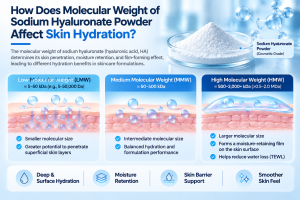
No. Molecular weight is one of the most important characteristics influencing the performance of sodium hyaluronate in cosmetic formulations.
Different molecular-weight grades can produce different viscosity, film-forming, hydration and formulation characteristics.
High Molecular Weight Sodium Hyaluronate
High-molecular-weight sodium hyaluronate is commonly selected for:
- Surface hydration.
- Moisture-retaining film formation.
- Viscosity modification.
- Moisturizing creams.
- Hydrating gels and serums.
Low Molecular Weight Sodium Hyaluronate
Lower-molecular-weight grades are investigated for different skin-distribution and diffusion characteristics.
Research has demonstrated that molecular weight can influence the distribution of hyaluronic acid within skin models. However, penetration depends on the actual material, experimental conditions and finished formulation; it should not be guaranteed based solely on the supplier’s molecular-weight description.
Medium Molecular Weight Sodium Hyaluronate
Intermediate grades may provide different rheological and hydration characteristics and can be selected according to the desired formulation profile.
A reliable supplier should disclose:
- Actual molecular-weight range.
- Average or nominal molecular weight.
- Molecular-weight distribution, where available.
- Analytical testing method.
- Batch-to-batch variation.
Do not purchase sodium hyaluronate based only on broad descriptions such as low, medium or high molecular weight.
Always request numerical specifications.
5. Direct Technical Communication and Faster Problem Resolution
What happens if a bulk ingredient performs differently during formulation?
Cosmetic manufacturers may encounter problems involving dissolution, viscosity, clarity, moisture absorption or compatibility with other formulation ingredients.
When dealing directly with a production facility, technical questions can potentially be addressed closer to the people responsible for manufacturing and quality control.
This can support:
- Product specification clarification.
- Sample evaluation.
- Investigation of batch variations.
- Technical document review.
- Formulation troubleshooting.
- Future specification adjustments.
For manufacturers developing premium skincare products, technical communication is an important part of the supplier relationship.
6. More Reliable Long-Term Supply Planning
Can a trading company guarantee consistent supply over several years?
Not necessarily. Its ability to fulfil recurring orders may depend on its inventory, manufacturing partners and purchasing arrangements.
A verified manufacturing relationship can offer greater visibility into production schedules, available capacity and supply planning.
Before entering a long-term agreement, buyers should examine:
- Production capacity.
- Historical batch consistency.
- Manufacturing lead time.
- Raw-material availability.
- Packaging arrangements.
- Shelf-life information.
- Contingency arrangements for supply interruptions.
For cosmetic brands and contract manufacturers, supply continuity can be as important as the initial purchase price.
Factory Supplier vs. Trading Company: What Is the Difference?
The following comparison summarizes the principal differences when sourcing bulk sodium hyaluronate powder.
| Purchasing factor | Verified factory supplier | Trading company |
|---|---|---|
| Manufacturing access | Direct or closer access to production | Usually through a manufacturer |
| Production information | Can be obtained from the actual producer | Depends on upstream cooperation |
| Batch traceability | Direct production records may be accessible | Depends on documentation from manufacturer |
| Specification discussions | Can involve production and QC teams | Relayed through intermediary |
| Bulk pricing | Potentially fewer intermediary margins | May include additional margins |
| Customization | May offer production-level flexibility | Depends on manufacturing partner |
| Supply planning | Direct production-capacity visibility | Depends on inventory and sourcing |
| Product portfolio | Usually focused on its capabilities | May offer a broader range |
An important distinction: Not every trading company is unreliable, and not every company advertising itself as a factory is necessarily the actual manufacturer. Buyers should verify the manufacturing site, production records, and batch documentation before making a purchasing decision.
A transparent authorized distributor can also be a suitable supplier when it provides verifiable manufacturing documentation and reliable quality support.
What Quality Documents Should You Request Before Buying Bulk Sodium Hyaluronate Powder?
A reliable supplier should be able to provide appropriate technical and quality documents.
The following documentation should be considered during supplier qualification.
| Document | Why It Matters |
|---|---|
| Certificate of Analysis (COA) | Shows batch-specific analytical results |
| Technical Data Sheet (TDS) | Provides technical specifications |
| Safety Data Sheet (SDS) | Explains safe handling and storage |
| Manufacturing origin declaration | Identifies the production source |
| Molecular-weight report | Supports molecular-weight verification |
| Microbiological report | Documents microbial quality |
| Heavy-metal report | Supports contaminant assessment |
| Residual protein information | Helps assess biological impurities |
| Allergen and animal-origin statements | Supports relevant formulation and market requirements |
| Quality certificates | Demonstrate applicable quality-system credentials |
A good COA should identify the batch number, specification limits, actual test results, testing methods and reporting conditions.
For sodium hyaluronate, molecular-weight characterization may involve size-exclusion chromatography or gel-permeation chromatography, depending on the validated analytical method.
The important point is that the method and testing conditions should be disclosed so that results can be compared meaningfully.
How Can You Verify Whether a Supplier Is a Real Manufacturer?
Before placing a large purchase order, cosmetic brands should perform basic supplier verification.
Consider asking the supplier the following questions:
- What is the legal name and location of the manufacturing facility?
- Is the sodium hyaluronate manufactured in-house or sourced from another producer?
- Is the product produced through microbial fermentation or another manufacturing route?
- Can you provide a batch-specific COA?
- Can you share relevant quality certificates and their scope?
- Can the manufacturing site be audited or independently verified?
- Can you provide samples from the actual commercial grade?
- How are changes in manufacturing processes and specifications communicated?
A professional supplier should be comfortable explaining its manufacturing and sourcing arrangements.
If the supplier cannot identify the actual production source, its factory-direct claim should be treated cautiously.
Why Choose PeptidChem for Cosmetic Ingredient Manufacturing and Supply?
At PeptidChem, our approach to cosmetic ingredients is built around manufacturing expertise, scientific development and quality-focused production.
We specialize primarily in synthesized cosmetic peptide ingredients, serving cosmetic brands, skincare manufacturers, contract manufacturers and ingredient distributors.
Our manufacturing capabilities include:
- Custom peptide synthesis.
- Advanced purification technologies.
- Preparative HPLC capabilities.
- Analytical quality control.
- Mass spectrometry-based peptide identification.
- Manufacturing scale-up.
- Technical and commercial support.
Our focus is to help cosmetic manufacturers obtain reliable, well-characterized active ingredients for advanced skincare development.
We also recognize that different cosmetic ingredients require different manufacturing and analytical approaches.
Sodium hyaluronate is a polysaccharide rather than a synthesized peptide. Accordingly, its manufacturing origin, molecular-weight specification and batch documentation must be verified separately for the exact grade offered.
For sodium hyaluronate enquiries, buyers should request confirmation of product availability, actual manufacturing origin, specifications and supporting documentation before placing an order.
How to Request a Bulk Sodium Hyaluronate Powder Quotation
To receive an accurate quotation, cosmetic manufacturers should provide the following information:
- Required sodium hyaluronate molecular-weight range.
- Intended application and cosmetic grade.
- Required quantity in kilograms.
- Target purity and other specifications.
- Required quality documentation.
- Packaging preferences.
- Destination country.
- Expected delivery schedule.
📩 Contact us to request a quotation or discuss your specific requirements. Let’s build a strong partnership supply for your anti-aging cosmetics product line and requesting a sample before a large commercial order is also recommended
Also See
What Is the Difference Between Sodium Hyaluronate Powder and Hyaluronic Acid Powder
Peptides vs Hyaluronic Acid: Which Anti-Aging Ingredient Provides Better Skin Benefits
FAQs:
Q1. Where can I buy bulk sodium hyaluronate powder?
You can purchase bulk sodium hyaluronate powder from verified manufacturers, authorized distributors and specialized cosmetic ingredient suppliers. Before purchasing, compare molecular-weight specifications, purity, batch-specific COAs, manufacturing origin, MOQ and delivery arrangements.
Q2. Is it better to buy sodium hyaluronate directly from a manufacturer?
Buying directly from a verified manufacturer can provide better access to manufacturing information, batch traceability, technical support and production planning. It may also reduce intermediary costs for large-volume orders. However, the supplier’s actual manufacturing role should always be verified.
Q3. What is the CAS number of sodium hyaluronate?
The CAS number of sodium hyaluronate is 9067-32-7. Its INCI name is Sodium Hyaluronate.
Q4. What molecular weight of sodium hyaluronate is best for skincare?
The appropriate molecular weight depends on the desired formulation characteristics. High-molecular-weight grades are commonly selected for surface film formation and hydration, while lower-molecular-weight grades are investigated for different skin-distribution properties. Formulation testing is necessary to establish suitability.
Q5. What is the difference between low and high molecular weight sodium hyaluronate?
The principal differences relate to molecular size, solution viscosity, film formation and skin-distribution characteristics. High-molecular-weight material generally forms a more substantial surface film, whereas lower-molecular-weight material can exhibit different diffusion behaviour.
Q6. What is the typical MOQ for bulk sodium hyaluronate powder?
MOQ depends on the supplier, manufacturing source, grade, packaging and order quantity. Buyers should request the actual MOQ rather than assuming that all manufacturers offer the same purchasing conditions.
References
Cosmetic Ingredient Review (2023).
Cosmetic Ingredient Review.
Bravo, B., et al. (2022).
National Center for Biotechnology Information.
International Organization for Standardization.
U.S. Food and Drug Administration.