





Buying sodium hyaluronate powder in bulk? Learn how to assess molecular weight, purity, moisture, microbiology, heavy metals, COAs and supplier reliability.
What Specifications Should Cosmetic Brands Look for When Buying Sodium Hyaluronate Powder in Bulk?
Sodium hyaluronate has become an important ingredient in modern skincare formulations, particularly in hydrating serums, moisturizers, facial creams, masks and other personal care products. Its water-binding properties and compatibility with different cosmetic formulations make it an attractive ingredient for cosmetic manufacturers.However, purchasing sodium hyaluronate powder in bulk requires more than comparing prices or selecting a supplier based on a general claim of cosmetic-grade quality. Variations in molecular weight, purity, manufacturing origin, moisture content and impurity levels can influence formulation performance, product consistency and raw material quality.For cosmetic brands, contract manufacturers and formulation developers, selecting the right bulk sodium hyaluronate powder means evaluating both its technical specifications and the supplier’s quality management system.The most important parameters include molecular weight, assay and purity, microbial limits, heavy metals, residual proteins, endotoxin levels, moisture content, pH, viscosity, solubility, packaging and batch-to-batch consistency.
What Is Sodium Hyaluronate and Why Is It Used in Cosmetics?
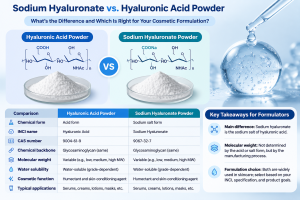
Sodium hyaluronate is the sodium salt of hyaluronic acid, a naturally occurring glycosaminoglycan composed of repeating disaccharide units. Its hydrophilic structure enables it to bind and retain water, making it useful in topical cosmetic formulations.
Its INCI name is Sodium Hyaluronate, and its CAS number is 9067-32-7.
According to the Cosmetic Ingredient Review (CIR) Expert Panel’s 2023 safety assessment, sodium hyaluronate and related hyaluronate ingredients are used in cosmetics primarily as skin-conditioning agents and humectants. The assessment concluded that the reviewed ingredients were safe under the present practices of use and concentrations described in the report [1].
Common applications include:
- Hydrating facial serums.
- Moisturizing creams and lotions.
- Anti-aging skincare formulations.
- Facial masks and sheet masks.
- Eye-care products.
- Hair-conditioning formulations.
- Personal care and skin-conditioning products.
The CIR report also provides useful evidence of commercial relevance. Its review cites 2023 FDA Voluntary Cosmetic Registration Program data reporting sodium hyaluronate in 4,713 cosmetic formulations. A separate 2021 industry survey reported use concentrations of up to 7.5% in certain face and neck products [1].
These figures demonstrate historical industry use. They should not be interpreted as recommended formulation concentrations or regulatory limits.For cosmetic manufacturers, the important consideration is that the selected grade must be appropriate for the intended formulation and supported by reliable quality documentation.
Which Molecular Weight Should Brands Choose When Buying Sodium Hyaluronate Powder?
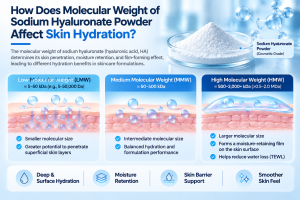
Molecular weight (MW) is one of the most important specifications to examine when purchasing sodium hyaluronate powder in bulk.
It influences the ingredient’s solution viscosity, film-forming properties, hydration characteristics and formulation behavior.
Different molecular weight grades can therefore serve different formulation purposes.
High molecular weight sodium hyaluronate
High molecular weight sodium hyaluronate is generally associated with:
- Higher solution viscosity at comparable concentrations.
- Formation of a moisturizing film on the skin surface.
- Surface hydration and water retention.
- Improved formulation texture and rheological properties.
It is commonly considered for moisturizing creams, gels and hydrating serums.
Low molecular weight sodium hyaluronate
Low molecular weight grades are often selected when formulators want different hydration and skin-distribution characteristics.
Research has investigated the relationship between molecular weight and topical skin diffusion. For example, a study discussed in the literature review by Bravo et al. (2022) found differences in the distribution of hyaluronic acid according to molecular weight.
In the reviewed human skin diffusion experiment, 20–50 kDa material was detected at approximately 100 μm, whereas 100–300 kDa material was detected at approximately 50 μm. The 1,000–1,400 kDa material showed more limited diffusion, with most of the material remaining in the stratum corneum [2].
These findings relate to specific experimental conditions and should not be treated as a guarantee of penetration depth or clinical performance in a finished cosmetic product.
What molecular weight specifications should buyers request?
Cosmetic brands should ask suppliers to disclose:
- The numerical molecular weight range.
- The reported average molecular weight.
- The molecular weight distribution, where available.
- The analytical method used for measurement.
- The acceptable variation between production batches.
- The intrinsic viscosity, if relevant to the formulation.
Procurement recommendation: Avoid purchasing a product based only on descriptions such as low molecular weight, medium molecular weight or high molecular weight. These categories are not applied consistently by every supplier. Request actual numerical values and the analytical method.
The best molecular weight is the one that meets the performance requirements of the finished formulation.
What Purity Level Should Cosmetic-Grade Sodium Hyaluronate Have?
Purity is another essential consideration when sourcing bulk sodium hyaluronate powder.
A supplier should provide an assay result showing the actual sodium hyaluronate content and clearly identify the analytical method.
Buyers should examine:
- Sodium hyaluronate assay.
- Identification test results.
- Moisture-related corrections.
- Residue on ignition or ash content, where relevant.
- Potential inorganic and process-related impurities.
Why is the dry-basis assay important?
Moisture can affect the reported percentage of sodium hyaluronate in a sample. Therefore, cosmetic manufacturers should establish whether the assay is reported on an as-is basis or a dry basis.
For example, two suppliers may report similar assay percentages while using different calculation methods. Without understanding the reporting basis, direct comparisons may be misleading.
The certificate of analysis (COA) should clearly state the specification limit, actual result, test method and reporting basis.
Buyer recommendation: Select a supplier that provides a clearly defined purity specification and consistent analytical results across commercial batches rather than relying on an unsupported claim of high purity.
Why Should Cosmetic Brands Examine Microbial Limits?
Microbiological quality is important when purchasing bulk ingredients intended for topical formulations.
Although sodium hyaluronate powder is a raw material, contamination introduced during manufacturing, drying, handling or packaging may affect the microbiological quality of the final cosmetic product.
Buyers should request information about:
- Total aerobic microbial count.
- Total yeast and mold count.
- Escherichia coli.
- Staphylococcus aureus.
- Pseudomonas aeruginosa.
- Other specified microorganisms where relevant to the product’s risk assessment.
The supplier should identify the testing method, acceptance criteria and actual batch results.
Is ISO 17516 applicable to sodium hyaluronate powder?
An important distinction is necessary.
ISO 17516:2026, published on November 6, 2026, specifies acceptable quantitative and qualitative microbiological limits for finished cosmetic products [3].
It should not be incorrectly presented as a universal microbiological specification for sodium hyaluronate raw material.
Cosmetic manufacturers should establish separate raw-material acceptance criteria based on the intended use, manufacturing process, contamination risks and finished-product requirements.
This distinction is particularly important for manufacturers sourcing ingredients for leave-on products and other formulations with specific microbiological quality requirements.
Which Heavy Metals and Chemical Impurities Should Be Tested?
Heavy metal contamination is another parameter that cosmetic brands should evaluate before purchasing sodium hyaluronate powder in bulk.
The supplier should provide information about relevant elemental impurities, including:
- Lead (Pb).
- Arsenic (As).
- Cadmium (Cd).
- Mercury (Hg).
Where appropriate, additional elements should be included according to the manufacturing process and destination-market requirements.
Why are heavy metal specifications important?
Raw material contamination may originate from manufacturing inputs, processing equipment, water, environmental exposure or inadequate purification.
The CIR’s 2023 safety assessment specifically highlights the importance of minimizing impurities, including heavy metals, in hyaluronate ingredients
For reliable verification, buyers should request test results generated using validated analytical techniques, such as inductively coupled plasma mass spectrometry (ICP-MS), where suitable.
However, there is no single numerical heavy-metal specification that automatically applies to every sodium hyaluronate cosmetic grade worldwide.
Acceptance limits should be established according to applicable regulations, the product category, the intended exposure and the buyer’s quality requirements.
What about residual solvents?
Some manufacturing and purification processes may involve solvents such as ethanol.
Cosmetic brands should request information about:
- Solvents used during manufacturing.
- Residual solvent test results, where applicable.
- The relevant analytical method.
- Compliance with the agreed specification.
A supplier should be able to explain the relationship between its manufacturing process and the impurity profile of the finished ingredient.
Why Are Protein, Nucleic Acid and Endotoxin Specifications Important?
The manufacturing origin of sodium hyaluronate can influence its impurity profile.
Commercial sodium hyaluronate may be obtained through microbial fermentation or animal-derived extraction.
Fermentation-based manufacturing can provide a non-animal production route, but it does not eliminate the need for purification and impurity testing.
The CIR’s 2023 assessment discusses potential biological impurities, including residual proteins, nucleic acids and endotoxins. It also highlights differences in impurity profiles associated with different manufacturing origins [1].
Cosmetic brands should therefore ask suppliers to disclose:
| Parameter | What buyers should verify |
|---|---|
| Manufacturing origin | Microbial fermentation or animal-derived extraction |
| Residual protein | Actual protein content and test method |
| Nucleic acid | Test results where relevant to the process |
| Endotoxin | Risk-based test results and agreed acceptance limits |
| Biological impurities | Purification and contamination-control procedures |
| Animal-origin status | Appropriate source declaration and supporting documentation |
Endotoxin testing is not necessarily a universal release requirement for every conventional topical cosmetic ingredient. However, it may be appropriate depending on the manufacturing route, impurity risk and intended application.
Procurement recommendation: Request a documented manufacturing-origin statement and an impurity profile. Do not assume that a fermentation-derived ingredient is automatically free from biological impurities.
Which Physical and Chemical Properties Should Be Included in the Specification Sheet?
Beyond purity and molecular weight, the physical and chemical properties of sodium hyaluronate determine how conveniently the powder can be processed and incorporated into cosmetic formulations.
The following parameters should be considered.
| Specification | What to check | Why it matters |
|---|---|---|
| Appearance | White to off-white powder | Physical consistency |
| Odor | Characteristic or practically odorless, as agreed | Sensory quality |
| pH | Measured at a defined solution concentration | Formulation compatibility |
| Moisture content | Loss on drying or validated moisture method | Storage stability |
| Solubility | Dissolution behavior in purified water | Processing efficiency |
| Viscosity | Measured under defined conditions | Rheological performance |
| Intrinsic viscosity | Where applicable | Polymer characterization |
| Particle size | Defined particle-size distribution | Handling and dispersion |
| Bulk density | Where relevant | Powder handling and processing |
| Residue on ignition | As required by the grade | Inorganic residue control |
Why should pH be measured under defined conditions?
A pH value without a specified solution concentration and test procedure is difficult to compare.
For example, a supplier reporting pH at 0.1% concentration should not be directly compared with another supplier reporting pH at 1% concentration without considering the test conditions.
Why is viscosity important?
Molecular weight and concentration influence the viscosity of sodium hyaluronate solutions.
However, viscosity is also affected by temperature, hydration time, water quality, pH and other formulation components.
Consequently, buyers should request viscosity results with the following information:
- Sample concentration.
- Temperature.
- Instrument or measurement method.
- Hydration time.
- Test conditions.
This helps cosmetic manufacturers evaluate whether the powder will deliver reproducible performance in their formulations.
What Documents Should a Reliable Bulk Sodium Hyaluronate Supplier Provide?
A technically acceptable powder is only one part of supplier qualification. Documentation is equally important.
Before confirming a bulk purchase, cosmetic brands should request a complete technical and quality documentation package.
| Document | Purpose |
|---|---|
| Certificate of Analysis (COA) | Confirms the tested batch meets its specifications |
| Technical Data Sheet (TDS) | Describes product characteristics and recommended handling |
| Safety Data Sheet (SDS) | Provides safety and handling information |
| Manufacturing origin declaration | Identifies the source and production route |
| INCI and CAS information | Supports ingredient identification |
| Microbiological report | Documents microbial quality |
| Heavy metal report | Documents elemental impurity testing |
| Residual solvent report | Supports process impurity assessment, where applicable |
| Allergen statement | Supports formulation and market assessments |
| Animal-origin declaration | Supports vegan and source-related requirements |
| Stability and shelf-life information | Supports storage and inventory planning |
| Change-control statement | Supports ongoing supplier qualification |
What should a COA contain?
A reliable certificate of analysis should include:
- Product name and grade.
- Batch or lot number.
- Manufacturing and testing dates.
- Specification limits.
- Actual analytical results.
- Test methods.
- Release status.
- Authorized quality-control approval.
A generic COA without batch identification or actual results provides limited assurance.
Cosmetic manufacturers should also maintain traceability between the incoming material, the supplier’s batch documentation and their own production records.
How Should Cosmetic Brands Evaluate a Bulk Supplier’s Manufacturing Quality?
Supplier qualification should go beyond checking product specifications.
A reliable supplier should demonstrate control over manufacturing, quality assurance, storage, packaging and shipment.
ISO 22716:2007 provides guidelines for the production, control, storage and shipment of cosmetic products. ISO confirms that this edition remains current following its 2022 review [4].
However, ISO 22716 should not be misrepresented as a mandatory certification for every cosmetic raw material supplier. Buyers should assess the relevance of the supplier’s quality system to the ingredient and its manufacturing operations.
Before placing a large order, cosmetic brands should evaluate:
Manufacturing consistency: Can the supplier demonstrate consistent quality across multiple batches?
Quality control: Are incoming materials, production stages and finished batches tested under documented procedures?
Traceability: Can the supplier trace the ingredient back to its manufacturing batch and relevant production records?
Change management: Does the supplier notify customers of changes in manufacturing processes, raw material sources or product specifications?
Packaging controls: Is the powder protected against moisture, contamination and damage during transportation?
Supply reliability: Can the supplier meet the required minimum order quantity, production schedule and delivery commitments?
These factors help reduce procurement risks and support long-term manufacturing partnerships.
What Packaging and Storage Conditions Should Buyers Confirm?
Sodium hyaluronate powder should be protected from excessive moisture, contamination and unsuitable storage conditions.
Because moisture can affect the powder’s physical properties and the accuracy of assay comparisons, packaging quality should be included in the purchasing specification.
Cosmetic manufacturers should confirm:
- Packaging material and moisture-barrier properties.
- Inner liner and outer-container specifications.
- Tamper-evident or suitable sealing arrangements.
- Batch identification and traceability labels.
- Recommended temperature and humidity conditions.
- Shelf life and retest period.
- Transportation and handling requirements.
The supplier’s technical data sheet should provide the recommended storage conditions.
Buyers should avoid assuming that all grades have identical shelf lives or storage requirements.
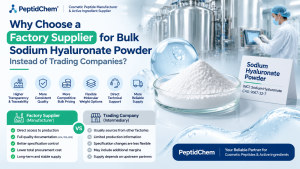
How Can Cosmetic Brands Compare Bulk Sodium Hyaluronate Suppliers Before Purchasing?
Price is important, but the lowest price per kilogram does not necessarily represent the best purchasing decision.
A meaningful comparison should consider technical quality, formulation performance, documentation and long-term supply reliability.
Use the following supplier evaluation framework.
| Evaluation criterion | Questions to ask |
|---|---|
| Product quality | Does the grade meet the approved specification? |
| Molecular weight | Is the numerical MW range disclosed and controlled? |
| Purity | Is the assay supported by batch-specific results? |
| Impurities | Are biological and chemical impurities controlled? |
| Microbiology | Are agreed microbial criteria met? |
| Documentation | Is the COA complete and traceable? |
| Manufacturing | Is the production process documented and controlled? |
| Consistency | Can multiple batches meet the same specification? |
| Packaging | Is the product adequately protected during shipment? |
| Commercial terms | Are MOQ, lead time and bulk pricing clearly defined? |
Should brands request a sample before ordering in bulk?
Yes. A representative sample should be evaluated before approving a commercial order.
The sample should be assessed for:
- Appearance and physical characteristics.
- Dissolution and dispersion behavior.
- Viscosity under standardized test conditions.
- Compatibility with the intended formulation.
- Stability in the proposed formulation.
- Consistency with the supplier’s COA and TDS.
Where possible, the approved sample should be retained as a reference for evaluating subsequent commercial batches.
This process helps cosmetic brands reduce the risk of receiving bulk material that performs differently from the sample used during product development.
What Should a Bulk Sodium Hyaluronate Powder Specification Sheet Include?
Before issuing a purchase order, cosmetic manufacturers should establish an agreed specification sheet with the supplier.
The following is a practical RFQ template.
| Parameter | Required information |
|---|---|
| Product name | Sodium Hyaluronate |
| INCI name | Sodium Hyaluronate |
| CAS number | 9067-32-7 |
| Grade | Cosmetic grade, subject to qualification |
| Manufacturing origin | Fermentation or other declared source |
| Molecular weight | Agreed numerical range |
| Assay | Agreed purity limit and analytical method |
| Appearance | Approved physical description |
| pH | Defined concentration and test method |
| Moisture | Agreed maximum limit |
| Viscosity | Defined concentration and temperature |
| Protein | Agreed impurity limit |
| Nucleic acid | Where relevant to manufacturing origin |
| Endotoxin | Risk-based requirement |
| Microbial limits | Agreed acceptance criteria |
| Heavy metals | Individual and/or total limits |
| Residual solvents | As applicable to the manufacturing process |
| Packaging | Approved moisture-protective packaging |
| Shelf life | Supported by stability information |
| Documentation | COA, TDS and SDS |
| Batch traceability | Unique lot identification |
Important: This is a purchasing template, not an official universal sodium hyaluronate standard. Numerical acceptance limits should be agreed between the buyer and supplier according to the intended application, analytical methods, risk assessment and destination-market requirements.
Which Sodium Hyaluronate Powder Should Cosmetic Brands Buy in Bulk?
Choosing the right sodium hyaluronate powder requires a systematic evaluation of technical specifications, manufacturing quality and supplier reliability.
Cosmetic brands should prioritize:
- A clearly defined molecular weight range.
- Verified sodium hyaluronate assay and purity.
- Controlled moisture content.
- Appropriate microbiological quality.
- Documented heavy metal and chemical impurity limits.
- Controlled residual proteins and other biological impurities.
- Consistent viscosity and dissolution characteristics.
- Complete batch-specific COA and technical documentation.
- Reliable manufacturing traceability.
- Suitable packaging and long-term supply consistency.
Ultimately, the best bulk ingredient is not necessarily the cheapest or the one with the highest advertised purity. It is the grade that consistently meets the formulation’s technical requirements and the manufacturer’s quality and regulatory expectations.
Looking for a Reliable Cosmetic Peptide Supplier?
In addition to established cosmetic ingredients such as sodium hyaluronate, cosmetic brands increasingly work with specialized active ingredient manufacturers to develop differentiated skincare formulations.
If your sourcing requirements include cosmetic peptides, Peptidchem is specializes in the manufacture of synthetic peptide ingredients for cosmetic and personal care applications.📩Contact our technical and commercial team to discuss available peptide ingredients, product specifications, technical documentation and bulk sourcing requirements.
Also See
How to Choose the Right Sodium Hyaluronate Powder Supplier for Cosmetic Brands
What Are the Key Specifications of Cosmetic Grade D-Panthenol Powder
How Can Cosmetic Brands Use Hydrolyzed Collagen Peptide Powder in Serums, Creams, and Masks
FAQs:
Q1. What is the best molecular weight for cosmetic-grade sodium hyaluronate?
There is no single best molecular weight for every cosmetic formulation. High molecular weight grades are commonly selected for surface hydration and film-forming properties, while lower molecular weight grades offer different skin-distribution characteristics. The choice should depend on the formulation’s intended performance.
Q2. What purity should bulk sodium hyaluronate powder have?
Buyers should establish a clearly defined assay requirement with their supplier. The specification should identify the analytical method and whether purity is reported on a dry basis or as received. A general claim of high purity is insufficient without batch-specific test results.
Q3. Is fermentation-derived sodium hyaluronate better than animal-derived material?
Fermentation-derived sodium hyaluronate offers a non-animal manufacturing route and can support vegan-oriented sourcing requirements. However, quality depends on purification, impurity control and manufacturing consistency. Buyers should evaluate the actual test results rather than relying on the manufacturing origin alone.
Q4. What is the difference between hyaluronic acid and sodium hyaluronate?
Hyaluronic acid is a glycosaminoglycan, whereas sodium hyaluronate is its sodium salt. Both are used in cosmetic formulations, but they have different chemical identities and should be identified correctly in ingredient specifications and documentation.
Q5. What should a sodium hyaluronate COA include?
A COA should include the product name, grade, batch number, test dates, acceptance criteria, actual results, analytical methods and quality-release approval. Depending on the agreed specification, it should cover assay, molecular weight, moisture, pH, microbial quality and relevant impurities.
Q6. Is cosmetic-grade sodium hyaluronate suitable for all skincare products?
Not automatically. Suitability depends on molecular weight, purity, formulation compatibility, impurity profile, intended use and applicable regulatory requirements. Each finished product requires its own formulation and safety assessment.
Q7. How should bulk sodium hyaluronate powder be stored?
It should be kept in the original sealed packaging under the storage conditions specified by the manufacturer. Moisture, contamination and unsuitable temperature conditions should be avoided. The supplier’s TDS should be used to establish the correct storage and shelf-life requirements.
Cosmetic Ingredient Review. (2023). Safety assessment of hyaluronates as used in cosmetics. Final report, July 7, 2023.
Bravo, B., Correia, P., Gonçalves Junior, J. E., Sant’Anna, B., & Kerob, D. (2022). Benefits of topical hyaluronic acid for skin quality and signs of skin aging: From literature review to clinical evidence. Dermatologic Therapy, 35(12), e15903.
International Organization for Standardization. (2026). ISO 17516:2026—Cosmetics—Microbiology—Microbiological limits.
International Organization for Standardization. (2007). ISO 22716:2007—Cosmetics—Good manufacturing practices (GMP)—Guidelines on good manufacturing practices.
European Commission. Cosmetic ingredient database (CosIng).
European Parliament and Council. (2009). Regulation (EC) No 1223/2009 on cosmetic products.