





Choose a cosmetic-grade sodium hyaluronate supplier by checking molecular weight, purity, COA, microbial controls, traceability and formulation support.
How to Choose the Right Sodium Hyaluronate Powder Supplier for Cosmetic Brands
Cosmetic Grade Sodium Hyaluronate Powder Bulk Supplier is an important decision for cosmetic brands developing skincare serums, moisturizers, creams, lotions, and other hydration-focused formulations. Although sodium hyaluronate is widely used in the cosmetics industry, differences in molecular weight, purity, manufacturing processes, microbiological quality, and batch consistency can significantly influence raw-material performance and formulation development.For cosmetic manufacturers, choosing a supplier should involve more than comparing prices. A reliable supplier should provide clearly defined product specifications, a batch-specific Certificate of Analysis (COA), appropriate quality documentation, traceability, and technical support.
What Is Sodium Hyaluronate Powder and Why Is It Used in Cosmetics?
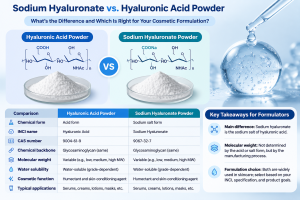
Sodium hyaluronate is the sodium salt of hyaluronic acid, a naturally occurring glycosaminoglycan found in human tissues, including the skin. It is a water-soluble cosmetic ingredient commonly used for its moisture-binding, skin-conditioning, and formulation-enhancing properties.
Its ability to retain water makes it particularly valuable in:
- Hydrating facial serums.
- Moisturizing creams and lotions.
- Anti-aging skincare formulations.
- Facial gels and masks.
- Eye-care formulations.
- Hair-care and scalp-care products.
Sodium hyaluronate is commonly identified by the INCI name Sodium Hyaluronate and CAS number 9067-32-7.
The Cosmetic Ingredient Review (CIR) Expert Panel has evaluated sodium hyaluronate and related hyaluronate ingredients and concluded that they are safe in cosmetics under the present practices of use and concentrations described in its assessment. This assessment does not replace the need for appropriate raw-material quality control or finished-product safety substantiation.
For cosmetic brands, therefore, selecting a supplier with documented quality controls is essential.
How Do You Evaluate the Quality of a Sodium Hyaluronate Powder Supplier?
The first step is to examine the supplier’s quality assurance system and technical documentation.
A professional cosmetic ingredient supplier should be able to provide evidence of product identity, purity, manufacturing consistency, and contaminant control.
Before placing an order, request the following documents:
Certificate of Analysis (COA): A batch-specific document showing the tested results against the product specifications.
Technical Data Sheet (TDS): Information covering molecular weight, appearance, solubility, viscosity, pH, recommended handling, and storage.
Safety Data Sheet (SDS): Relevant safety, handling, storage, and transportation information.
Manufacturing and origin information: Details of the production method, raw-material source, and manufacturing location.
Quality certifications: Applicable manufacturing and quality-management certifications, with their validity and scope.
A COA should provide actual analytical results rather than simply stating that a product meets specifications.
For example, buyers should examine identity, assay or purity, molecular-weight characteristics, moisture content, relevant impurity levels, and microbiological results.
A supplier that cannot provide reliable batch documentation should not be considered a preferred long-term sourcing partner.
Why Is Molecular Weight Important When Choosing Sodium Hyaluronate Powder?
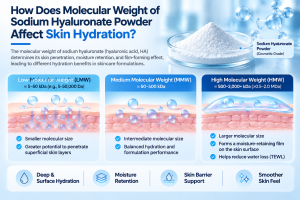
Molecular weight is one of the most important characteristics to evaluate when purchasing sodium hyaluronate for cosmetic formulations.
Different molecular-weight ranges can produce different physical and formulation properties.
High Molecular Weight (HMW) Sodium Hyaluronate
High-molecular-weight sodium hyaluronate is commonly used for surface hydration, film formation, viscosity modification, and moisture retention.
It can form a hydrophilic film on the skin surface, helping reduce transepidermal water loss.
Low Molecular Weight (LMW) Sodium Hyaluronate
Low-molecular-weight hyaluronate is investigated for its ability to penetrate skin more readily than larger HA molecules. Its performance depends on the actual molecular-weight distribution and finished formulation.
Medium Molecular Weight (MMW) Sodium Hyaluronate
Intermediate molecular-weight grades can offer different rheological and hydration characteristics and may be selected according to the intended formulation.
Importantly, molecular-weight classifications are not universally standardized. For example, a 2025 review used different molecular-weight categories to distinguish low-, medium-, and high-molecular-weight hyaluronic acid.
Therefore, cosmetic brands should not rely exclusively on broad labels such as low molecular weight or high molecular weight.
Instead, ask the manufacturer to specify:
- Exact molecular-weight range.
- Average or nominal molecular weight.
- Molecular-weight distribution.
- Analytical testing method.
- Batch-to-batch molecular-weight consistency.
For advanced skincare formulations, suppliers offering clearly characterized molecular-weight options can provide greater flexibility during product development.
What Purity and Testing Standards Should Cosmetic Brands Check?
Purity is an important purchasing consideration, but a high purity percentage alone does not establish the overall quality of sodium hyaluronate powder.
A reliable supplier should have a defined testing programme covering relevant physicochemical and microbiological characteristics.
Consider the following quality parameters:
| Quality parameter | Why it matters |
|---|---|
| Identification | Confirms ingredient identity |
| Assay/purity | Establishes the specified ingredient content |
| Molecular weight | Helps predict formulation characteristics |
| Loss on drying | Evaluates moisture content |
| pH | Supports formulation compatibility |
| Viscosity | Helps characterize solution behaviour |
| Residual protein | Helps assess biological impurities |
| Heavy metals | Supports contaminant control |
| Microbial limits | Helps assess microbiological quality |
| Specified pathogens | Supports microbiological safety |
The testing methods and acceptance limits should be appropriate to the product grade and intended application.
Where relevant, buyers should also request information on residual nucleic acids, fermentation-related impurities, and bacterial endotoxins.
The 2023 CIR safety assessment specifically highlights the importance of controlling biologically derived impurities and heavy metals in hyaluronate ingredients.
Consequently, a supplier’s quality should be evaluated through documented testing, not promotional descriptions such as ultra-pure or premium grade alone.
Does the Manufacturing Process Affect Sodium Hyaluronate Quality?
Yes. The manufacturing process can influence purity, molecular-weight characteristics, and batch consistency.
Commercial sodium hyaluronate is produced using different manufacturing approaches, including microbial fermentation and, historically, animal-derived sources.
Microbial fermentation is an established industrial production route. Improvements in fermentation and downstream purification processes have helped manufacturers improve product yield, purity, and control over molecular weight.
When evaluating a supplier, cosmetic brands should ask:
- Is the product produced through microbial fermentation or obtained from an animal-derived source?
- Is the material non-animal-derived?
- Which microorganism or production platform is used?
- What purification and quality-control processes are implemented?
- How are residual proteins and other biological impurities controlled?
- Is the production process consistent between batches?
For brands developing vegan, non-animal-derived, or internationally marketed skincare products, source transparency can be particularly important.
Do not assume that all fermentation-derived products have identical purity or quality. Manufacturing controls and analytical verification remain essential.
What Certifications and Regulatory Documents Should a Supplier Provide?
A supplier’s quality-management system should support consistent production, documentation, storage, and distribution.
One relevant international reference is ISO 22716:2007, which provides guidelines for Good Manufacturing Practices (GMP) in cosmetics.
The standard addresses the production, control, storage, and shipment of cosmetic products.
When assessing a supplier, request information about:
- Applicable GMP arrangements.
- ISO 22716 alignment or certification, where applicable.
- Quality-management certifications.
- Manufacturing-site documentation.
- Product specifications and COAs.
- SDS and relevant regulatory declarations.
- Traceability and batch-release procedures.
- Change-control and complaint-management systems.
Importantly, certification should be checked against the actual facility and activities covered. An ISO certificate should not automatically be treated as proof that every supplied ingredient has been independently approved by a regulatory authority.
For brands selling internationally, the supplier should also be able to support the documentation requirements relevant to the destination market.
For example, the US FDA does not generally provide premarket approval for cosmetic ingredients, with color additives being an important exception. Cosmetic businesses remain responsible for the safety and proper labeling of their products and ingredients.
How Can You Check Batch Consistency and Supply Reliability?
A good sodium hyaluronate powder supplier should demonstrate that product specifications remain consistent across multiple production batches.
Inconsistent molecular weight, viscosity, moisture content, or impurity levels can create difficulties during formulation and manufacturing.
Before entering into a long-term purchasing agreement, request:
- COAs from multiple production batches.
- Batch identification and traceability information.
- Defined product specifications.
- Shelf-life and storage information.
- Packaging specifications.
- Manufacturing lead times.
- Available production capacity.
- Procedures for handling out-of-specification batches.
It is also useful to understand how the supplier manages changes to raw materials, manufacturing processes, and product specifications.
For established cosmetic brands, supply continuity is just as important as the initial product quality.
A supplier should be able to explain its production capacity, order fulfilment arrangements, and procedures for communicating potential supply disruptions.
Why Should Cosmetic Brands Request Samples Before Bulk Purchasing?
Requesting a sample is an important part of the supplier qualification process.
Even when a supplier provides a satisfactory COA, the material should be evaluated in the buyer’s actual formulation.
A practical evaluation should consider:
- Powder appearance and handling characteristics.
- Dissolution and hydration behaviour.
- Solution clarity.
- Viscosity development.
- Compatibility with other formulation ingredients.
- Stability under the intended formulation and storage conditions.
- Reproducibility across different batches.
For example, a sodium hyaluronate grade intended for a lightweight facial serum may not deliver the same sensory or rheological characteristics desired in a thicker moisturizing cream.
Therefore, selecting the right grade should be based on formulation requirements rather than molecular weight or price alone.
A qualified supplier should be willing to discuss technical specifications and provide relevant application guidance.
How Do You Compare Sodium Hyaluronate Powder Prices and Wholesale Suppliers?
Price comparison should be conducted only after confirming that the products being compared have equivalent specifications.
A lower-priced material may have a different molecular-weight range, purity specification, moisture content, or microbiological profile.
Before accepting a quotation, compare the following:
| Purchasing consideration | What to confirm |
|---|---|
| Unit price | Price per kilogram or agreed unit |
| Minimum order quantity | Supplier’s actual MOQ |
| Product grade | Cosmetic suitability and specification |
| Molecular weight | Defined range and testing method |
| Purity | Agreed assay specification |
| Documentation | COA, TDS, SDS and relevant declarations |
| Packaging | Packaging material and available sizes |
| Delivery | Production and shipping lead times |
| Shelf life | Supported expiry and storage conditions |
| Technical support | Assistance with product evaluation |
For long-term procurement, consider the total cost of ownership, including shipping, quality verification, formulation adjustments, and potential batch rejection.
A dependable wholesale supplier should offer transparent commercial terms and consistent product specifications.
What Are the Warning Signs of an Unreliable Sodium Hyaluronate Supplier?
Cosmetic brands should be cautious when a supplier:
- Cannot provide a batch-specific COA.
- Does not disclose the molecular-weight range.
- Uses vague descriptions such as pharmaceutical quality without supporting specifications.
- Cannot explain the manufacturing or raw-material source.
- Provides no microbiological testing information.
- Makes unsupported claims about regulatory approval.
- Cannot demonstrate batch traceability.
- Refuses reasonable technical questions.
- Offers unusually low prices without explaining differences in grade or specification.
A professional supplier should be transparent about both product capabilities and technical limitations.
What Makes a Reliable Cosmetic Ingredient Supplier a Long-Term Partner?
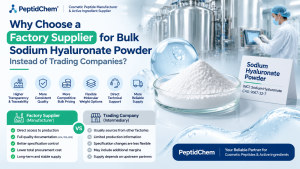
The best supplier is not necessarily the one offering the lowest quotation. It is the supplier that can consistently meet the buyer’s technical specifications, provide reliable documentation, maintain supply continuity, and support product development.
For cosmetic brands, an effective supplier relationship should include:
- Consistent product specifications.
- Verified analytical testing.
- Transparent manufacturing information.
- Reliable batch traceability.
- Appropriate quality-management practices.
- Technical communication.
- Dependable order fulfilment.
These factors help cosmetic manufacturers reduce raw-material sourcing risks and establish more reliable production processes.
Looking for a Reliable Supplier of Synthetic Cosmetic Peptide Ingredients?
In addition to hydration-focused cosmetic ingredients, modern skincare formulations increasingly incorporate peptide-based actives.
Peptidchem is specializes in the manufacture of synthesized peptide ingredients for cosmetic applications.
We focus on supplying peptide ingredients to businesses developing cosmetic and skincare formulations.
For information about our synthetic peptide ingredient portfolio, product specifications, and commercial supply arrangements, contact our team. 📩Contact us o request a quotation or discuss your specific requirements. Let’s build a strong partnership supply for your anti-aging cosmetics product line
Also See
What Is SNAP-8 Peptide Made From and How Is It Manufactured for Cosmetic Use
What Are the Benefits of SNAP-8 Peptide Powder for Cosmetic Formulations
How Does SNAP-8 Peptide Compare with Other Cosmetic Peptides for Wrinkle Reduction
How to Import SNAP-8 Peptide Powder for Cosmetic Manufacturing in the USA and EU
FAQs:
Q1. What is the best sodium hyaluronate powder supplier for cosmetic brands?
The best supplier is one that provides clearly defined molecular-weight specifications, batch-specific COAs, appropriate purity and microbiological testing, manufacturing traceability, and reliable technical support.
Q2. What is the difference between cosmetic-grade and pharmaceutical-grade sodium hyaluronate?
The grades may differ in their specifications, manufacturing controls, intended applications, and documentation requirements. Buyers should compare the actual analytical specifications rather than assuming that one grade automatically meets the requirements of another.
Q3. What molecular weight of sodium hyaluronate is best for skincare?
The appropriate molecular weight depends on the intended formulation. High-molecular-weight grades are commonly used for surface film formation and hydration, while lower-molecular-weight grades are investigated for greater skin penetration. Formulation testing is necessary to determine suitability.
Q4. What documents should I request from a sodium hyaluronate manufacturer?
Request a batch-specific Certificate of Analysis, Technical Data Sheet, Safety Data Sheet, manufacturing and origin information, relevant quality certificates, and supporting microbiological and impurity test results.
Q5. Is sodium hyaluronate suitable for facial serums and moisturizers?
Yes. Sodium hyaluronate is commonly used in cosmetic serums, moisturizers, creams, lotions, gels, and facial masks because of its moisture-binding and skin-conditioning properties.
Q6. Is sodium hyaluronate FDA-approved?
Cosmetic ingredients generally do not require FDA premarket approval in the United States, except for color additives. Brands should therefore evaluate ingredient quality and substantiate the safety of their finished cosmetic products.
References
Zanchetta, C., Scandolera, A., & Reynaud, R. (2025). Hyaluronic Acid in Topical Applications: The Various Forms and Biological Effects of a Hero Molecule in the Cosmetics Industry. Biomolecules, 15(12), 1656.
Cosmetic Ingredient Review (2023). Safety Assessment of Hyaluronates as Used in Cosmetics.
Becker, L. C., et al. (2009). Final report of the safety assessment of hyaluronic acid, potassium hyaluronate, and sodium hyaluronate. International Journal of Toxicology, 28(4 Suppl), 5–67.
International Organization for Standardization. (2007). ISO 22716:2007 – Cosmetics: Good Manufacturing Practices (GMP).
U.S. Food and Drug Administration. Cosmetic Ingredients.