





Discover 7 essential cosmetic peptide ingredients for anti-aging skincare, including signal, neuropeptide, carrier, and advanced peptides. Source synthesized peptide ingredients for serums, creams, and professional formulations.
7Essential Peptide Ingredients for Skincare Manufacturers Developing Anti-Aging Products?
For skincare manufacturers, peptides have become important active ingredients for developing modern anti-aging serums, creams, eye products, masks, and professional skincare formulations. But choosing the right peptide is not simply about selecting the ingredient with the most popular marketing name. Different peptides are designed around different mechanisms, including signaling, expression-line appearance, skin conditioning, extracellular-matrix support, and targeted cosmetic functions.
This guide covers seven peptide ingredients and ingredient families that manufacturers can consider when developing anti-aging skincare products.Important formulation note: Peptide efficacy depends on the specific peptide sequence, purity, concentration, formulation system, stability, delivery conditions, and substantiation of the finished product. Ingredient-level evidence should not automatically be presented as proof of a finished cosmetic product’s performance.
Why Are Peptides Important for Anti-Aging Skincare Formulation?
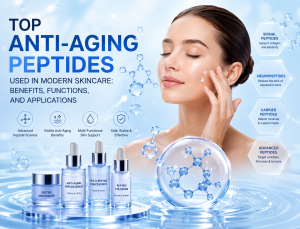
Peptides are short chains of amino acids connected by peptide bonds. In cosmetic science, topical peptides are commonly discussed according to functional categories such as signal peptides, carrier peptides, enzyme-inhibitor peptides, and neurotransmitter-inhibitor peptides.
Their appeal to skincare manufacturers comes from their ability to support different formulation concepts rather than relying on one single anti-aging mechanism.
A 2026 systematic review and meta-analysis evaluated 19 randomized controlled trials involving 1,341 participants and reported that peptide interventions were generally well tolerated, although the researchers emphasized that effects varied and that larger, standardized clinical studies are still needed.
For B2B formulators, this means peptide selection should be based on:
- Target skin concern
- Peptide sequence and identity
- Purity and analytical specification
- Recommended use level
- Solubility and formulation compatibility
- Stability requirements
- Supporting efficacy data
- Regulatory status in the target market
- Batch-to-batch consistency
- Documentation from the cosmetic peptidchem supplier
What Are the 7 Essential Peptide Ingredients for Anti-Aging Skincare?
The following seven ingredients represent useful categories for manufacturers developing different anti-aging product concepts.
| Peptide Ingredient | Peptide Category | Main Formulation Focus | Typical Product Applications |
|---|---|---|---|
| Palmitoyl Pentapeptide-4 | Signal peptide | Fine lines, skin appearance, firmness | Serums, creams |
| Palmitoyl Tripeptide-1 | Signal peptide | Collagen-support positioning, skin firmness | Serums, moisturizers |
| Palmitoyl Tetrapeptide-7 | Signal peptide | Skin conditioning and anti-aging formulations | Creams, eye products |
| Acetyl Hexapeptide-8 | Neurotransmitter-related peptide | Expression-line appearance | Serums, eye creams |
| Copper Tripeptide-1 | Carrier/copper peptide | Skin conditioning and repair-oriented formulations | Serums, creams |
| Tetrapeptide-68 | Advanced anti-aging peptide | Wrinkle and skin-surface appearance | Eye creams, anti-aging creams |
| Customized Synthetic Peptides | Customized peptide platform | Target-specific cosmetic concepts | Custom formulations |
Palmitoyl Pentapeptide-4: A Classic Signal Peptide for Anti-Aging Formulas
What makes Palmitoyl Pentapeptide-4 important?
Palmitoyl Pentapeptide-4, commonly associated with the sequence Pal-KTTKS, is one of the better-known synthetic peptide ingredients used in anti-aging skincare.
Its importance comes partly from clinical evidence. A double-blind, placebo-controlled, split-face study involving 93 women aged 35–55 evaluated a moisturizer containing 3 ppm Pal-KTTKS over 12 weeks. The study reported statistically significant improvements in facial wrinkles and fine lines compared with the control formulation.
For manufacturers, this makes Palmitoyl Pentapeptide-4 particularly relevant for:
- Anti-wrinkle serums
- Firming creams
- Premium facial moisturizers
- Neck-care products
- Mature-skin formulations
- Professional skincare products
Why should manufacturers source it from a specialized cosmetic peptide supplier?
Because the commercial value of a peptide depends on more than the ingredient name.
Manufacturers should evaluate:
- Peptide purity
- Identity confirmation
- Molecular weight
- Residual solvents
- Water content
- Heavy metals
- Microbiological specifications
- Batch consistency
- Recommended storage conditions
- Technical documentation
For brands developing premium anti-aging products, synthesized peptide ingredients can provide a more controlled starting point for formulation than poorly characterized raw materials.
 Palmitoyl Tripeptide-1: A Versatile Signal Peptide for Skin Firming Products
Palmitoyl Tripeptide-1 belongs to the signal-peptide category. It is frequently incorporated into formulations designed around skin firmness, texture, and visible signs of aging.
Signal peptides are particularly interesting to formulators because their cosmetic positioning can be connected with extracellular-matrix and skin-structure research.
A broader scientific review of topical peptides identified signal peptides as one of the principal categories investigated for aging skin, alongside carrier, enzyme-inhibitor, and neurotransmitter-inhibitor peptides.
What products can contain Palmitoyl Tripeptide-1?
Manufacturers can consider it for:
- Anti-aging face serums
- Firming moisturizers
- Eye creams
- Neck creams
- Luxury skincare
- Multi-peptide formulations
For B2B development, Palmitoyl Tripeptide-1 can also be considered as part of a multi-peptide anti-aging system, where different peptide mechanisms are selected according to the intended product positioning.
Palmitoyl Tetrapeptide-7: A Useful Complementary Peptide
Palmitoyl Tetrapeptide-7 is another palmitoylated peptide commonly used in cosmetic peptide systems.
Its value for formulators is particularly relevant when developing multi-peptide products rather than relying on one active ingredient.
The scientific literature supports the broader concept that cosmetic peptides can be categorized according to different biological targets and mechanisms, although evidence strength differs substantially between individual peptide sequences.
How can manufacturers formulate around Palmitoyl Tetrapeptide-7?
Potential applications include:
- Anti-aging serums
- Firming creams
- Eye-care formulas
- Facial moisturizers
- Neck and décolletage products
- Multi-peptide concentrates
A manufacturer may combine complementary peptides when the formulation strategy is designed to address several visible signs of aging simultaneously.
Acetyl Hexapeptide-8: A Popular Peptide for Expression-Line Products
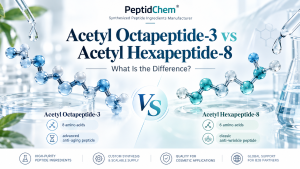
Acetyl Hexapeptide-8 is widely associated with cosmetic formulations targeting the appearance of expression lines and wrinkles.
Recent clinical research provides additional evidence for peptide-containing anti-aging formulations. A 2026 study evaluated a serum containing Acetyl Hexapeptide-8 together with other active ingredients in ex-vivo and clinical studies. The clinical program included 50 participants in one study and 42 in another, with reported improvements in several wrinkle and skin-quality parameters after continued use.
The important qualification is that this study evaluated a multi-ingredient finished formula, not Acetyl Hexapeptide-8 in isolation.
That distinction matters for responsible B2B marketing.
What products can manufacturers develop with Acetyl Hexapeptide-8?
- Expression-line serums
- Eye serums
- Eye creams
- Premium anti-aging emulsions
- Concentrated peptide treatments
- Multi-peptide facial products
Manufacturers should avoid automatically converting ingredient mechanisms into drug-like claims. In the United States, FDA states that cosmetic claims must be truthful and not misleading, and claims that a product affects the structure or function of the body can change its regulatory classification.
Copper Tripeptide-1: A Carrier Peptide for Advanced Skincare
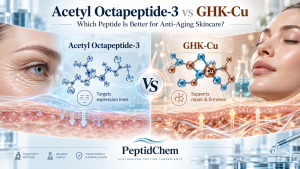
Copper Tripeptide-1, commonly known as GHK-Cu in cosmetic discussions, is a carrier-type peptide associated with copper.
Carrier peptides are one of the established categories described in the topical peptide literature.
Research has also investigated the retention and penetration characteristics of copper tripeptide in human skin models.
For formulators, Copper Tripeptide-1 can be particularly interesting for premium formulations positioned around:
- Skin conditioning
- Firmness
- Mature-skin care
- Recovery-oriented skincare
- Advanced peptide serums
- Multi-active anti-aging formulas
What should manufacturers consider before purchasing Copper Tripeptide-1?
Copper-containing peptides require careful formulation and analytical control.
A B2B buyer should request:
- Identity and purity specifications
- Copper content or relevant assay information
- Batch-specific Certificate of Analysis
- Stability information
- Recommended pH range
- Storage conditions
- Solubility information
- Microbiological specifications
- Heavy-metal specifications
- Regulatory documentation for the target market
This is particularly important when sourcing bulk cosmetic peptides for commercial production.
Tetrapeptide-68: An Emerging Option for Wrinkle-Focused Products
Tetrapeptide-68 represents a newer option for manufacturers looking beyond the most established cosmetic peptide ingredients.
A randomized, double-blind, placebo-controlled study investigated a formulation containing 100 ppm Tetrapeptide-68 in 25 women aged 30–65 over 12 weeks. The researchers reported significant improvements in several wrinkle-related measurements and skin-surface parameters.
Although the study was relatively small, it provides useful human clinical evidence for continued development and evaluation.
Where could Tetrapeptide-68 fit?
Potential applications include:
- Eye creams
- Periorbital wrinkle products
- Anti-aging creams
- Premium peptide serums
- Targeted wrinkle treatments
- Multi-peptide formulations
For manufacturers, an ingredient with human-use data can provide a stronger starting point for product substantiation than an ingredient supported only by theoretical mechanisms.
Customized Synthetic Peptides: The Next Step for Cosmetic Ingredient Development
Not every skincare brand wants another standard peptide serum.
Ingredient manufacturers increasingly need peptide solutions that can be designed around a particular formulation concept, target market, product format, or proprietary active system.
This is where custom peptide synthesis for cosmetics becomes valuable.
A specialized peptide manufacturer can potentially support development around:
- Custom peptide sequences
- Modified peptide structures
- Palmitoylated peptides
- Short-chain peptides
- Multi-peptide systems
- Cosmetic-grade synthetic peptides
- Research-to-commercial scale-up
- Custom analytical specifications
Modern peptide research increasingly explores sequence design and non-natural amino acids to optimize molecular properties, demonstrating the broader potential of synthetic peptide chemistry.
For cosmetic manufacturers, however, customized peptide development should remain focused on validated cosmetic applications, safety, regulatory requirements, formulation compatibility, and evidence-based claims.
How Should Skincare Manufacturers Choose a Cosmetic Peptide Supplier?
Choosing a cosmetic peptidchem supplier should involve more than comparing price per kilogram.
A qualified B2B supplier should be able to provide clear information about the identity, quality, manufacturing controls, and documentation of the peptide ingredient.
1. Verify peptide identity
Ask for:
- INCI name where applicable
- Chemical name
- Sequence
- CAS number where applicable
- Molecular weight
- Structural information
The European Commission’s CosIng database provides information on cosmetic ingredients and common ingredient names, but the Commission specifically notes that inclusion in CosIng does not itself mean an ingredient is approved for cosmetic use. Regulatory requirements must therefore be checked separately.
2. Check purity and analytical data
For synthesized peptide ingredients, request appropriate analytical documentation, such as:
- HPLC
- Mass spectrometry
- Assay/purity
- Water content
- Residual solvents
- Elemental or heavy-metal testing where applicable
- Microbial testing where relevant
3. Evaluate manufacturing consistency
For commercial skincare production, the supplier should demonstrate consistent batch specifications rather than relying only on one laboratory sample.
4. Ask about formulation support
A strong peptide ingredients manufacturer should be able to provide technical information related to:
- Solubility
- pH compatibility
- Recommended handling
- Storage
- Formulation stability
- Packaging
- Recommended incorporation procedure
5. Check scalability
A laboratory sample is not enough for a commercial skincare brand.
Ask whether the supplier can support:
Sample → Pilot Batch → Bulk Production → Repeat Orders
This is particularly important for brands planning long-term anti-aging product lines.
What Makes Synthesized Peptide Ingredients Different?
For B2B cosmetic manufacturers, synthetic peptide production offers controlled chemical synthesis and the ability to define a specific peptide sequence.
Compared with generic descriptions such as “peptide complex” or “protein extract,” a defined synthesized peptide can offer manufacturers a clearer chemical identity and analytical target.
The key purchasing criteria should include:
Identity + Purity + Consistency + Stability + Documentation + Supply Capability
A reputable synthesized peptide ingredients supplier should be able to communicate these parameters clearly.
How Can Manufacturers Build a Multi-Peptide Anti-Aging Formula?
Rather than choosing seven peptides simply because they are popular, manufacturers should develop the formula around a specific consumer problem.
Example formulation strategy
Fine-line focused serum
→ Palmitoyl Pentapeptide-4
→ Palmitoyl Tripeptide-1
→ Supporting hydrating ingredients
Expression-line focused serum
→ Acetyl Hexapeptide-8
→ Complementary signal peptide
→ Humectants and skin-conditioning ingredients
Premium firmness serum
→ Palmitoyl Tripeptide-1
→ Palmitoyl Tetrapeptide-7
→ Copper Tripeptide-1
→ Hydrating and barrier-supporting ingredients
Advanced peptide concept
→ Selected signal peptide
→ Selected carrier peptide
→ Tetrapeptide-68
→ Customized synthesized peptide
The exact concentrations and combinations should be determined through formulation development, stability testing, compatibility testing, and finished-product efficacy work rather than copied from ingredient marketing materials.
What Claims Can Cosmetic Manufacturers Make About Peptides?
Manufacturers need to distinguish between cosmetic appearance claims and claims about modifying biological structure or function.
In the United States, FDA explains that a product marketed simply to improve appearance may fall within cosmetics, while claims that a product affects the structure or function of the body can make the product subject to drug regulation.
Therefore, B2B brands should develop claims around substantiated cosmetic benefits such as:
- Helps improve the appearance of fine lines
- Helps skin look firmer
- Supports a smoother-looking complexion
- Helps improve the appearance of skin texture
- Provides conditioning benefits
- Helps maintain a youthful-looking appearance
Claims should be reviewed for the specific market where the finished product will be sold.
Cosmetic Peptide Supplier Checklist for B2B Buyers
Before purchasing wholesale cosmetic peptides, manufacturers should ask:
- Is the peptide chemically identified?
- Is the sequence clearly defined?
- What is the specification for purity?
- Is HPLC data available?
- Is mass spectrometry available?
- Is a batch-specific COA provided?
- What are the storage requirements?
- What is the shelf life?
- What is the minimum order quantity?
- Can the supplier provide samples?
- Can the supplier support bulk production?
- Is custom synthesis available?
- Can the supplier provide technical documentation?
- Can the supplier support international shipments?
- Are regulatory documents available for the target market?
These questions can help manufacturers distinguish a genuine cosmetic peptide manufacturer from a reseller with limited technical control.
Why Choose a Synthesized Peptide Ingredient Manufacturer?
For brands developing peptide-based skincare, supplier selection directly influences product consistency and development efficiency.
A specialized synthesized peptide manufacturer can support the ingredient-development process from peptide selection through sample evaluation and commercial production.
Key advantages can include:
Controlled peptide identity
Defined peptide sequences provide a clear starting point for analytical characterization.
High-purity ingredient options
Purity specifications allow formulators to establish more consistent raw-material standards.
Custom peptide synthesis
Brands with proprietary concepts can explore customized peptide sequences or modifications.
B2B bulk supply
Commercial-scale production supports skincare manufacturers moving from R&D to regular manufacturing.
Technical documentation
Analytical and technical documents help formulators evaluate the ingredient before incorporation.
Long-term supply continuity
Consistent manufacturing and batch specifications are important for finished-product reproducibility.
Conclusion:
Anti-aging peptides are becoming valuable ingredients in modern skincare because they offer diverse approaches to improving the appearance of fine lines, wrinkles, firmness, and skin texture. For skincare manufacturers, selecting the right peptide requires considering scientific evidence, purity, stability, formulation compatibility, and supplier reliability. Working with a qualified synthesized peptide ingredient manufacturer can help brands develop consistent, high-quality, and innovative anti-aging skincare products,📩 Contact us to request a quotation or discuss your specific requirements. Let’s build a strong partnership supply for your anti-aging cosmetics product line.
Also See
What Is Palmitoyl Pentapeptide-4 Powder and Why Is It Used in Advanced Anti-Aging Skincare
What Is Palmitoyl Oligopeptide and Why Is It Used in Anti-Aging Skincare Formulas
FAQs:
Q1:What are the best peptide ingredients for anti-aging skincare?
There is no single best peptide for every product. Palmitoyl Pentapeptide-4, Palmitoyl Tripeptide-1, Palmitoyl Tetrapeptide-7, Acetyl Hexapeptide-8, Copper Tripeptide-1, and Tetrapeptide-68 are among the peptide ingredients manufacturers may evaluate for different anti-aging product concepts. Evidence strength varies by peptide and finished formulation.
Q2:What is a cosmetic peptide supplier?
A cosmetic peptide supplier provides peptide raw materials intended for cosmetic formulation and may provide specifications, analytical data, samples, technical information, and bulk supply. Manufacturers should verify the supplier’s documentation and manufacturing capability before purchasing.
Q3:Are synthetic peptides suitable for skincare products?
Synthetic peptides can be used as cosmetic ingredients when they meet the applicable safety, quality, regulatory, and formulation requirements for the target market. The specific peptide and finished-product claims must be evaluated individually.
Q4:What is the difference between a peptide supplier and a peptide manufacturer?
A supplier may source ingredients from another producer, while a manufacturer controls or directly operates the production process. For high-value cosmetic peptides, buyers may prefer a manufacturer that can provide direct technical documentation, batch specifications, and production support.
Q5:Can cosmetic peptides be customized?
Yes. Custom peptide synthesis can be used to develop defined peptide sequences or modified peptides for specific research and cosmetic-development objectives. Commercial feasibility, safety, stability, regulatory status, and efficacy substantiation should be evaluated before commercialization.
Q7:What documents should a skincare manufacturer request from a peptide supplier?
Common documents may include a Certificate of Analysis, specification sheet, identity/purity data, safety information, storage conditions, technical data, and relevant regulatory documentation. Requirements vary by peptide and target market.
References
Gorouhi, F., & Maibach, H. I. (2009). Role of topical peptides in preventing or treating aged skin. International Journal of Cosmetic Science, 31(5), 327–345. DOI: 10.1111/j.1468-2494.2009.00490.x.
Robinson, L. R., Fitzgerald, N. C., Doughty, D. G., Dawes, N. C., Berge, C. A., & Bissett, D. L. Topical palmitoyl pentapeptide provides improvement in photoaged human facial skin. International Journal of Cosmetic Science. DOI: 10.1111/j.1467-2494.2005.00261.x.
Abu Samah, N. H., & Heard, C. M. (2011). Topically applied KTTKS: a review. International Journal of Cosmetic Science, 33(6), 483–490. DOI: 10.1111/j.1468-2494.2011.00657.x.
Nukaly, H. Y., et al. (2026). Oral and topical peptides for skin aging: systematic review and meta-analysis of randomized controlled trials. Frontiers in Medicine, 13, 1618306. DOI: 10.3389/fmed.2026.1618306.
Zhu, M., et al. (2026). The effect of a serum containing acetyl hexapeptide-8, dipeptide diaminobutyroyl benzylamide diacetate and gluconolactone on skin biomarkers, wrinkles and skin texture: Ex vivo and clinical studies. International Journal of Cosmetic Science. DOI: 10.1111/ics.70087.
Wrinkle Reduction Using Tetrapeptide-68 Contained in an O/W Formulation: A Randomized Double-Blind Placebo-Controlled Study. Pharmaceutics, 16(8), 987. DOI: 10.3390/pharmaceutics16080987.
Wang, L., et al. (2025). Overview of Peptides and Their Potential Roles in Skin Health and Beauty. Peptide Science, 31(2), e3668. DOI: 10.1002/psc.3668.
U.S. Food and Drug Administration. Wrinkle Treatments and Other Anti-aging Products. FDA.
U.S. Food and Drug Administration. Cosmetics Labeling Claims. FDA.
European Commission. Cosmetic Ingredient Database (CosIng). European Commission.