





Compare Acetyl Octapeptide-3 and Palmitoyl Pentapeptide-4 for wrinkle-care formulations. Learn their mechanisms, applications, formulation considerations, and how to source cosmetic peptide ingredients in bulk.
Why Compare Acetyl Octapeptide-3 and Palmitoyl Pentapeptide-4?
Peptides have become important functional ingredients in modern anti-aging skincare because different peptide structures can support different cosmetic objectives, including the appearance of wrinkles, skin smoothness, firmness, and overall skin conditioning.
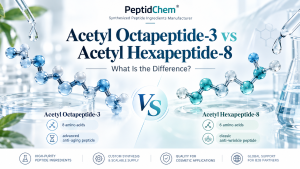
Two ingredients frequently considered for advanced wrinkle-care formulations are Acetyl Octapeptide-3 and Palmitoyl Pentapeptide-4. Although both are synthetic cosmetic peptides, they are not interchangeable. Their molecular structures, proposed biological mechanisms, formulation positioning, and available supporting evidence are different.
For cosmetic brands, formulators, distributors, and ingredient buyers, understanding these differences can help determine whether a formulation should use one peptide independently or combine complementary peptide technologies.
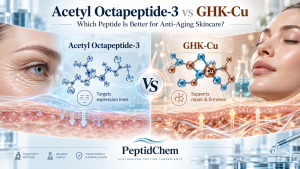
Acetyl Octapeptide-3 is generally positioned around expression-line and wrinkle-care applications associated with neurotransmitter-related signaling, while Palmitoyl Pentapeptide-4 is better known as a signaling peptide associated with extracellular-matrix and collagen-related skin-support concepts.
What Is Acetyl Octapeptide-3?
Acetyl Octapeptide-3, commonly known as SNAP-8, is a synthetic cosmetic peptide derived from the peptide sequence development associated with Argireline technology.
Recent scientific reviews describe Acetyl Octapeptide-3 as a peptide designed to interfere with processes involved in neurotransmitter release. The proposed cosmetic rationale is that reducing signaling associated with repetitive facial contraction may help reduce the visible appearance of expression lines over time.
From a formulation perspective, Acetyl Octapeptide-3 is therefore particularly interesting for products positioned around:
- Expression-line care
- Fine-line appearance
- Anti-aging serums
- Eye-area formulations
- Premium wrinkle-care creams
- Facial treatment products
- Multi-peptide anti-aging formulas
However, formulators should distinguish between ingredient mechanism claims and clinical claims for a finished cosmetic product. Performance depends on concentration, delivery system, formulation, stability, application frequency, and the complete product matrix.
Why is Acetyl Octapeptide-3 attractive to cosmetic brands?
Its major commercial advantage is its positioning as a modern expression-line-focused cosmetic peptide. This gives brands an alternative to conventional collagen-focused anti-aging ingredients and allows formulators to build differentiated peptide complexes.
What Is Palmitoyl Pentapeptide-4?
Palmitoyl Pentapeptide-4, also known as palmitoyl-KTTKS, is a synthetic lipopeptide widely associated with Matrixyl-type cosmetic peptide technology.
Unlike a peptide designed primarily around neurotransmitter-related pathways, Palmitoyl Pentapeptide-4 is generally discussed as a signal peptide that can support processes associated with the extracellular matrix and collagen-related skin appearance.
A peer-reviewed clinical study evaluated topical palmitoyl pentapeptide in 93 women aged 35–55 in a 12-week, double-blind, placebo-controlled, split-face study. The formulation containing 3 ppm pal-KTTKS showed significant improvements in facial wrinkles and fine lines compared with the control formulation. The ingredient was also reported to be well tolerated in the study.
Palmitoyl Pentapeptide-4 is therefore commonly considered for:
- Anti-aging creams
- Firming formulations
- Fine-line care
- Collagen-support positioning
- Facial serums
- Premium skincare
- Skin-conditioning formulations
The ingredient is also listed in cosmetic ingredient inventories with a skin-conditioning function.
What Is the Difference Between Acetyl Octapeptide-3 and Palmitoyl Pentapeptide-4?
The most important difference is their intended functional positioning.
| Feature | Acetyl Octapeptide-3 | Palmitoyl Pentapeptide-4 |
|---|---|---|
| Common name | SNAP-8 | Palmitoyl-KTTKS |
| Peptide type | Acetylated synthetic peptide | Palmitoylated synthetic peptide |
| Main cosmetic positioning | Expression-line / wrinkle appearance | Skin conditioning / wrinkle and firmness care |
| Proposed mechanism | Neurotransmitter-related signaling | Signal-peptide / extracellular-matrix-related activity |
| Typical formulation role | Dynamic-expression-line focused | Overall anti-aging and skin-support focused |
| Common products | Serums, eye products, wrinkle treatments | Creams, serums, anti-aging treatments |
| B2B interest | High-performance peptide complexes | Established anti-aging peptide formulations |
| Evidence profile | Emerging and formulation-dependent | Human clinical evidence for topical pal-KTTKS |
| Combination potential | Can complement matrix-support peptides | Can complement expression-line-focused peptides |
The comparison should not be interpreted as meaning that one ingredient is universally “better.” They address different biological and cosmetic pathways.
Which Peptide Is Better for Wrinkle Care?
Acetyl Octapeptide-3 is particularly relevant when a brand wants to formulate around expression-related wrinkles and fine lines.
A recent review reports a study involving an anti-aging microneedle patch containing Acetyl Octapeptide-3 and hyaluronic acid. In 24 healthy volunteers, application around the eye area for 28 days was associated with improvements in eye wrinkles, transepidermal water loss, and skin elasticity, although this type of delivery system should not be directly equated with conventional topical formulations.
Is Palmitoyl Pentapeptide-4 better for collagen-support positioning?
Palmitoyl Pentapeptide-4 has stronger historical clinical support for topical wrinkle improvement. In the 93-subject study, 12 weeks of use of a moisturizer containing pal-KTTKS produced statistically significant improvements in wrinkles and fine lines versus the control product.
Which should a cosmetic manufacturer choose?
A practical approach is:
Choose Acetyl Octapeptide-3 when:
The product concept emphasizes expression lines, eye-area wrinkles, and advanced peptide technology.
Choose Palmitoyl Pentapeptide-4 when:
The product concept emphasizes overall anti-aging, skin conditioning, firmness, and collagen-related cosmetic positioning.
Consider combining them when:
The formulation strategy is designed to address multiple aspects of visible skin aging rather than relying on a single peptide mechanism.
How Does the Scientific Evidence Compare?
Scientific evidence should be assessed carefully because peptide studies can differ substantially in peptide concentration, vehicle, delivery method, study duration, population, and whether the study evaluates an isolated ingredient or a finished formulation.
Evidence for Palmitoyl Pentapeptide-4
The strongest directly relevant evidence identified for Palmitoyl Pentapeptide-4 is the randomized, double-blind, placebo-controlled split-face study involving 93 women. The 12-week trial found significant improvements in wrinkles and fine lines using a formulation containing pal-KTTKS.
Evidence for Acetyl Octapeptide-3
The scientific literature supports a plausible mechanism and emerging topical application evidence, but the amount of independent clinical evidence should not be overstated. A recent review summarizes research involving Acetyl Octapeptide-3 and reports improvements in several skin-aging parameters in a small microneedle-patch study.
Therefore, B2B buyers should avoid marketing language suggesting that either peptide produces Botox-equivalent effects. Cosmetic peptides should be positioned according to the evidence available for the actual ingredient and finished formulation.
How Should Cosmetic Brands Select a Cosmetic Peptide Supplier?
For brands purchasing Acetyl Octapeptide-3 powder, Palmitoyl Pentapeptide-4 powder, or other synthetic peptide ingredients, ingredient quality is as important as the peptide name.
A professional cosmetic peptidchem supplier should be able to provide appropriate technical documentation and quality information for commercial evaluation.
What should buyers check?
1. Peptide identity
Confirm the exact INCI name and peptide sequence where applicable.
2. Purity specification
Request an analytical specification and appropriate chromatographic data.
3. Batch consistency
A reliable peptide ingredient manufacturer should maintain consistent quality between production batches.
4. Analytical documentation
Depending on the ingredient and buyer requirements, documentation may include HPLC, MS, moisture/water, residual solvents, and microbiological specifications.
5. Stability information
Storage conditions, packaging, light exposure, temperature, and formulation compatibility should be evaluated.
6. Manufacturing capability
For B2B buyers, scalable production is important when moving from laboratory samples to commercial quantities.
7. Technical support
A supplier should provide useful information for formulation development, handling, storage, and quality control.
For companies looking for bulk cosmetic peptides, working directly with a manufacturer of synthesized peptide ingredients can simplify technical communication and supply-chain management.
Why Source Acetyl Octapeptide-3 and Palmitoyl Pentapeptide-4 as Synthetic Peptide Ingredients?
The growing demand for high-performance anti-aging skincare is creating opportunities for brands to differentiate products through targeted peptide combinations.
A manufacturer specializing in synthesized peptide ingredients can support B2B customers seeking cosmetic peptide raw materials for:
- Private-label skincare
- Anti-aging serum development
- Wrinkle-care creams
- Eye-area products
- Professional skincare formulations
- Cosmetic peptide blends
- Research and formulation development
- Bulk ingredient procurement
- Wholesale cosmetic ingredient supply
For ingredient buyers, the ideal supplier relationship extends beyond simply purchasing a powder. Consistent quality, technical documentation, production scalability, packaging, and responsive communication can all influence successful product development.
Acetyl Octapeptide-3 vs Palmitoyl Pentapeptide-4: Which Is the Right Ingredient for Your Product?
There is no universal winner.
The best choice depends on the product positioning, target wrinkle type, formulation architecture, supporting ingredients, desired claims, and available evidence.
For an expression-line-focused serum, Acetyl Octapeptide-3 can provide a differentiated peptide story.
For an overall anti-aging or skin-conditioning product, Palmitoyl Pentapeptide-4 offers a well-established signaling-peptide positioning and has published human topical clinical evidence.
For premium multi-peptide products, formulators may evaluate both ingredients as complementary technologies.
Quick decision guide
For expression-line care: Acetyl Octapeptide-3
For established palmitoyl signal-peptide technology: Palmitoyl Pentapeptide-4
For broad anti-aging positioning: Consider a peptide combination
For B2B raw-material sourcing: Compare purity, specifications, documentation, consistency, MOQ, packaging, and manufacturing capacity—not only price.
Conclusion:
Acetyl Octapeptide-3 and Palmitoyl Pentapeptide-4 are complementary rather than identical cosmetic peptide technologies.
Acetyl Octapeptide-3 is particularly attractive for formulations focused on the visible appearance of expression lines, while Palmitoyl Pentapeptide-4 has a longer-established signal-peptide positioning and published human evidence supporting topical wrinkle improvement.
For cosmetic brands, the most effective ingredient-selection strategy is not simply to ask which peptide is “stronger.” Instead, formulators should evaluate mechanism, evidence quality, formulation compatibility, product positioning, analytical specifications, and supplier reliability.📩 Contact us to request a quotation or discuss your specific requirements. Let’s build a strong partnership supply for your anti-aging cosmetics product line.
Also See
Top Anti-Aging Peptides Used in Modern Skincare: Benefits, Functions, and Applications
How Cosmetic Peptides Support Skin Renewal: Science Behind Advanced Peptide Ingredients
FAQs:
Q1:Is Acetyl Octapeptide-3 the same as Palmitoyl Pentapeptide-4?
No. They are different synthetic peptides with different structures and proposed cosmetic mechanisms. Acetyl Octapeptide-3 is associated with expression-line-focused cosmetic applications, while Palmitoyl Pentapeptide-4 is a palmitoylated signal peptide commonly used in anti-aging and skin-conditioning formulations.
Q:2Which is better, Acetyl Octapeptide-3 or Palmitoyl Pentapeptide-4?
Neither is universally better. Acetyl Octapeptide-3 may be more appropriate for expression-line positioning, whereas Palmitoyl Pentapeptide-4 has particularly relevant clinical evidence for topical wrinkle improvement. The finished formulation ultimately determines cosmetic performance.
Q3:Is Palmitoyl Pentapeptide-4 a synthetic peptide?
Yes. Palmitoyl Pentapeptide-4 is a synthetic lipopeptide based on a short peptide sequence modified with a palmitoyl group.
Q4:Is Acetyl Octapeptide-3 suitable for anti-aging skincare?
It is commonly used and researched as a cosmetic anti-aging peptide, particularly for products targeting the appearance of expression lines and wrinkles. Evidence should be interpreted according to the specific formulation and delivery system.
Q5:Can Acetyl Octapeptide-3 and Palmitoyl Pentapeptide-4 be used together?
They can be evaluated together in a multi-peptide formulation because they have different functional positioning. Compatibility, stability, concentration, pH, preservation system, and the overall formulation should be assessed during development.
References
Wang, Y., Wang, M., Xiao, S., Pan, P., Li, P., & Huo, J. (2013). The anti-wrinkle efficacy of argireline, a synthetic hexapeptide, in Chinese subjects: A randomized, placebo-controlled study. American Journal of Clinical Dermatology, 14(2), 147–153. DOI: 10.1007/s40257-013-0009-9.
Wang, Y., Wang, M., Xiao, X. S., Pan, P., Li, P., & Huo, J. (2013). The anti wrinkle efficacy of synthetic hexapeptide (Argireline) in Chinese subjects. Journal of Cosmetic and Laser Therapy. DOI: 10.3109/14764172.2012.759234.
Robinson, L. R., Fitzgerald, N. C., Doughty, D. G., Dawes, N. C., Berge, C. A., & Bissett, D. L. (2005). Topical palmitoyl pentapeptide provides improvement in photoaged human facial skin. International Journal of Cosmetic Science. DOI: 10.1111/j.1467-2494.2005.00261.x.
Current Approaches in Cosmeceuticals: Peptides, Biotics and Marine Biopolymers. Recent review of cosmetic peptide technologies, including Acetyl Octapeptide-3 and peptide-based anti-aging applications.
EU CosIng ingredient information for Palmitoyl Pentapeptide-4, including its cosmetic ingredient listing and skin-conditioning function.