





Discover what Palmitoyl Pentapeptide-4 powder is, how it supports collagen production and anti-aging skincare, and why cosmetic brands choose reliable peptide suppliers for bulk OEM manufacturing.
What Is Palmitoyl Pentapeptide-4 Powder and Why Is It Used in Advanced Anti-Aging Skincare?
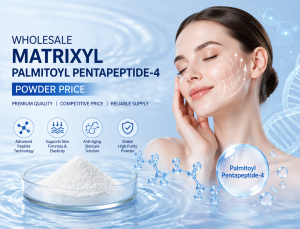
As consumer demand for scientifically validated anti-aging ingredients continues to grow, cosmetic manufacturers are increasingly incorporating Wholesale Matrixyl Palmitoyl Pentapeptide-4 Powder Price into premium skincare formulations. This synthetic cosmetic peptide has become one of the industry’s most recognized bioactive ingredients due to its excellent compatibility, stability, and effectiveness in reducing visible signs of skin aging.
For skincare brands, OEM manufacturers, and cosmetic ingredient distributors, selecting a high-quality Palmitoyl Pentapeptide-4 powder supplier is essential for developing competitive anti-aging creams, serums, eye creams, masks, and repair formulations.
What Is Palmitoyl Pentapeptide-4 Powder?
Palmitoyl Pentapeptide-4 is a synthetic signaling peptide consisting of five amino acids attached to a palmitic acid chain. The palmitoyl group enhances skin penetration, allowing the peptide to reach deeper layers of the epidermis where it can interact with skin cells.
Unlike exfoliating acids or retinoids that stimulate skin renewal through controlled irritation, Palmitoyl Pentapeptide-4 works by sending biological signals that encourage fibroblasts to synthesize structural proteins naturally.
Its INCI name is:
Palmitoyl Pentapeptide-4
Typical cosmetic appearance:
-
White powder
-
High purity synthetic peptide
-
Water soluble after formulation
-
Excellent compatibility with cosmetic ingredients
-
Suitable for sensitive skin formulations
Why Is Palmitoyl Pentapeptide-4 Used in Anti-Aging Skincare?
The primary function of Palmitoyl Pentapeptide-4 is to promote the skin’s natural repair process.
Instead of forcing rapid cell turnover, it communicates with skin cells through peptide signaling pathways.
Major skincare benefits include:
-
Supports collagen synthesis
-
Encourages elastin production
-
Improves skin firmness
-
Reduces wrinkle depth
-
Smooths fine lines
-
Improves skin elasticity
-
Enhances skin barrier recovery
-
Helps maintain youthful skin appearance
These properties make it one of the most widely used cosmetic peptides in luxury skincare.
How Does Palmitoyl Pentapeptide-4 Work?
The peptide mimics fragments naturally produced during collagen breakdown.
When fibroblasts recognize these peptide fragments, they interpret them as signals indicating that skin repair is needed.
The biological response includes:
-
Increased collagen production
-
Enhanced extracellular matrix synthesis
-
Improved elastin support
-
Increased glycosaminoglycan production
-
Better dermal structure
As collagen density gradually improves, wrinkles become less visible while skin appears smoother and firmer.
What Makes Palmitoyl Pentapeptide-4 Different from Traditional Anti-Aging Ingredients?
| Ingredient | Primary Mechanism | Irritation Potential | Suitable for Sensitive Skin |
|---|---|---|---|
| Retinol | Cell turnover | Moderate to High | Limited |
| AHAs | Chemical exfoliation | Moderate | Limited |
| Vitamin C | Antioxidant | Low | Yes |
| Niacinamide | Barrier repair | Very Low | Yes |
| Palmitoyl Pentapeptide-4 | Cell signaling peptide | Very Low | Excellent |
Because it works through biological signaling rather than exfoliation, it is often preferred in formulations targeting sensitive or mature skin.
Which Cosmetic Products Commonly Contain Palmitoyl Pentapeptide-4?
The peptidchem is suitable for numerous premium cosmetic formulations:
-
Anti-aging facial serums
-
Firming creams
-
Anti-wrinkle creams
-
Eye creams
-
Neck creams
-
Sleeping masks
-
Moisturizers
-
Luxury facial lotions
-
Peptide ampoules
-
Professional spa products
It also performs well in formulations containing:
-
Hyaluronic Acid
-
Ceramides
-
Madecassoside
-
Copper Peptides
-
Acetyl Hexapeptide-8
-
Palmitoyl Tripeptide-1
-
Niacinamide
-
Panthenol
Why Are Cosmetic Brands Choosing Synthetic Palmitoyl Pentapeptide-4 Powder?
Global cosmetic manufacturers increasingly prefer synthetic peptides because they offer:
Consistent Purity
Chemical synthesis delivers high batch-to-batch consistency.
Better Stability
Synthetic peptides generally maintain high stability during storage and formulation.
High Safety Profile
Manufactured under strict quality systems with controlled impurities.
Excellent Scalability
Suitable for industrial production from laboratory scale to metric-ton quantities.
Global Regulatory Compatibility
Widely used in cosmetic formulations across major international markets, subject to local cosmetic regulations.
What Should Buyers Look for When Choosing a Palmitoyl Pentapeptide-4 Powder Supplier?
Professional cosmetic ingredient purchasers usually evaluate suppliers based on:
Manufacturing Capability
-
Synthetic peptide expertise
-
GMP-compliant production systems
-
Advanced peptide synthesis technology
Product Quality
-
High purity
-
Low residual solvents
-
Stable peptide sequence
-
Reliable analytical testing
Documentation
-
COA
-
MSDS
-
TDS
-
HPLC chromatogram
-
Stability data
-
Technical support
Supply Capacity
-
Bulk production
-
Stable inventory
-
Fast delivery
-
OEM support
-
Global export experience
Product Specification Sheet
| Item | Specification |
|---|---|
| Product Name | Palmitoyl Pentapeptide-4 Powder |
| INCI Name | Palmitoyl Pentapeptide-4 |
| CAS | Available upon request |
| Appearance | White Powder |
| Purity | ≥95% (Typical HPLC) |
| Molecular Type | Synthetic Cosmetic Peptide |
| Solubility | Water Compatible After Formulation |
| Recommended Use | Anti-aging Cosmetics |
| Storage | 2–8°C, Dry & Protected from Light |
| Shelf Life | 24 Months |
| Packaging | 1g, 10g, 100g, 1kg, Bulk Packaging |
| Application | Serum, Cream, Lotion, Eye Cream, Mask |
 Why Choose Our Cosmetic Peptide Manufacturing Services?
As a professional synthetic peptide ingredient manufacturer, we specialize in supplying high-purity cosmetic peptides for global skincare brands.
Our advantages include:
-
Advanced solid-phase peptide synthesis (SPPS)
-
High-purity cosmetic-grade peptide production
-
Strict quality control with HPLC and mass spectrometry
-
OEM and ODM support
-
Bulk supply for cosmetic manufacturers
-
Flexible packaging options
-
Custom peptide synthesis services
-
Technical formulation support
-
International export experience
-
Reliable lead times for commercial orders
Whether you are developing a new anti-aging serum or expanding an existing skincare line, our manufacturing capabilities help accelerate product development while maintaining consistent quality.📩 Contact us to request a quotation or discuss your specific requirements. Let’s build a strong partnership supply for your anti-aging cosmetics product line.
Also See
What Is Copper Tripeptide Powder and Why Is It a Leading Ingredient in Anti-Aging Skincare
How Does Palmitoyl Oligopeptide Support Collagen Production and Skin Renewal Applications
FAQs:
Q1:Is Palmitoyl Pentapeptide-4 safe for cosmetic formulations?
Yes. It is widely used in cosmetic products and is generally regarded as having a favorable safety profile when formulated and used according to applicable cosmetic regulations.
Q2:What concentration is commonly used?
Finished cosmetic formulations often use low concentrations, typically in the parts-per-million to low percentage range depending on the formulation goals and supplier recommendations.
Q3:Can it be combined with Hyaluronic Acid?
Yes. It is commonly formulated together with Hyaluronic Acid to provide hydration alongside peptide-based anti-aging support.
Q4:Is it compatible with Vitamin C?
Yes. In well-designed formulations, it is generally compatible with Vitamin C and other common cosmetic actives, though formulators should verify stability under their specific conditions.
References
Katayama, K., Armendariz-Borunda, J., Raghow, R., Kang, A. H., & Seyer, J. M. (1993). A pentapeptide from type I procollagen promotes extracellular matrix production. Journal of Biological Chemistry, 268(14), 9941–9944.
Robinson, L. R., Fitzgerald, N. C., Doughty, D. G., Dawes, N. C., Berge, C. A., & Bissett, D. L. (2005). Topical palmitoyl pentapeptide provides improvement in photoaged human facial skin. International Journal of Cosmetic Science, 27(3), 155–160.
Lintner, K., & Peschard, O. (2000). Biologically active peptides: From a laboratory bench curiosity to a functional skin care product. International Journal of Cosmetic Science, 22(3), 207–218.
International Nomenclature of Cosmetic Ingredients (INCI). Personal Care Products Council. Ingredient listing for Palmitoyl Pentapeptide-4.
Cosmetic Ingredient Review (CIR) Expert Panel. Safety assessments of cosmetic peptides and peptide-derived ingredients used in cosmetics.