




Discover how Palmitoyl Pentapeptide-4 stimulates collagen synthesis, reduces wrinkles, and improves anti-aging skincare formulations. Bulk cosmetic peptide supplier.
How Does Palmitoyl Pentapeptide-4 Support Collagen Synthesis and Wrinkle Reduction Formulas?
As consumers increasingly seek scientifically validated anti-aging skincare, cosmetic brands are turning to Wholesale Matrixyl Palmitoyl Pentapeptide-4 Powder Price, one of the industry’s most established signal peptides. Originally commercialized as Matrixyl, this synthetic peptide has gained worldwide recognition for its ability to stimulate collagen production, improve skin elasticity, and visibly reduce wrinkles without the irritation commonly associated with retinoids.
What Is Palmitoyl Pentapeptide-4?
Palmitoyl Pentapeptide-4 is a synthetic bioactive peptidchem consisting of five amino acids linked to a palmitic acid chain. The lipid modification significantly enhances skin penetration compared to non-lipid peptides.
The peptide sequence mimics fragments naturally produced during extracellular matrix remodeling, allowing skin cells to recognize it as a “repair signal.”
Rather than acting as an exfoliating agent, it functions as a cell-signaling peptide, encouraging fibroblasts to synthesize essential structural proteins.
These include:
- Type I collagen
- Type III collagen
- Fibronectin
- Hyaluronic acid-related extracellular matrix components
Why Is Collagen Synthesis Important for Anti-Aging Skincare?
Collagen accounts for approximately 75% of the skin’s dry weight, providing firmness, elasticity, and structural integrity.
Unfortunately, collagen production declines naturally with age.
Research suggests:
| Age | Estimated Collagen Loss |
|---|---|
| After age 25 | ~1% per year |
| Age 40–50 | Significant reduction |
| Menopause | Up to 30% collagen loss within five years |
Reduced collagen contributes to:
- Fine lines
- Deep wrinkles
- Skin laxity
- Rough texture
- Decreased elasticity
- Thinner dermis
Palmitoyl Pentapeptide-4 helps counter these changes by stimulating fibroblast activity.
How Does Palmitoyl Pentapeptide-4 Stimulate Collagen Production?
Unlike exfoliating acids or vitamin A derivatives, Palmitoyl Pentapeptide-4 works through biological signaling.
Step 1: Skin Recognition
Fibroblasts recognize the peptide fragment as a natural extracellular matrix messenger.
↓
Step 2: Cellular Activation
Fibroblast activity increases.
↓
Step 3: Protein Synthesis
Production of:
- Collagen I
- Collagen III
- Fibronectin
- Glycosaminoglycans
↓
Step 4: Dermal Repair
The extracellular matrix becomes denser and stronger.
↓
Step 5: Visible Improvement
Users typically observe:
- Reduced wrinkle depth
- Improved firmness
- Better elasticity
- Smoother skin texture
- Enhanced hydration retention
What Scientific Evidence Supports Palmitoyl Pentapeptide-4?
Palmitoyl Pentapeptide-4 is among the most extensively researched cosmetic peptides.
Published studies have demonstrated:
Increased Collagen Production
Laboratory studies report significant stimulation of collagen synthesis in cultured fibroblasts after peptide treatment.
Clinical Improvement in Wrinkles
Controlled cosmetic studies have shown measurable reductions in wrinkle depth after several weeks of topical application.
Improved Skin Elasticity
Participants exhibited increased skin firmness and elasticity following continuous use.
Better Skin Texture
Clinical evaluations also reported improvements in:
- Smoothness
- Hydration
- Overall skin appearance
These findings support its widespread use in premium anti-aging formulations.
Why Do Cosmetic Brands Choose Palmitoyl Pentapeptide-4 Over Traditional Anti-Aging Ingredients?
| Palmitoyl Pentapeptide-4 | Retinol | AHAs |
|---|---|---|
| Promotes collagen synthesis | Yes | Limited |
| Low irritation | Excellent | Moderate |
| Suitable for sensitive skin | Yes | Sometimes |
| Daytime compatibility | Yes | Limited |
| Long-term anti-aging support | Excellent | Excellent |
For consumers seeking effective anti-aging benefits with improved tolerability, peptide-based formulations are an attractive option.
Which Cosmetic Products Commonly Contain Palmitoyl Pentapeptide-4?
The peptide is highly versatile and compatible with many skincare categories.
Popular applications include:
- Anti-aging serums
- Firming creams
- Eye creams
- Neck creams
- Facial masks
- Moisturizers
- Luxury skincare
- Professional aesthetic skincare
- Sensitive skin formulations
- Post-procedure skincare (subject to formulation and regulatory requirements)
How Can Formulators Maximize Palmitoyl Pentapeptide-4 Performance?
Experienced formulators often combine Palmitoyl Pentapeptide-4 with complementary cosmetic ingredients.
Hyaluronic Acid
Provides hydration while supporting the appearance of plumper skin.
Niacinamide
Improves barrier function and skin tone.
Ceramides
Strengthen the skin barrier.
Panthenol
Enhances moisture retention and soothes the skin.
Copper Peptides
May provide complementary skin repair benefits, though compatibility and stability should be evaluated during formulation.
Antioxidants
Such as Vitamin E and Coenzyme Q10 to help defend against oxidative stress.
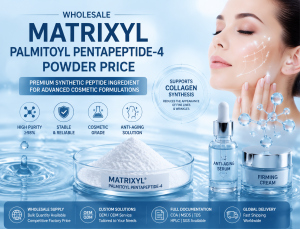
Typical Product Specifications
| Item | Specification |
|---|---|
| Product Name | Palmitoyl Pentapeptide-4 Powder |
| Appearance | White to off-white powder |
| Purity | ≥98% (HPLC) |
| Molecular Type | Synthetic cosmetic peptide |
| Solubility | Water-soluble (depending on formulation system) |
| Recommended Use | Cosmetic formulations only |
| Storage | 2–8°C, protected from light and moisture |
| Shelf Life | 24 months under recommended storage |
 Why Choose a Professional Cosmetic Peptide Manufacturer?
Reliable manufacturers provide more than peptide synthesis.
Look for suppliers offering:
- High-purity peptide synthesis
- GMP-compliant manufacturing
- Advanced peptide purification
- Batch-to-batch consistency
- HPLC purity testing
- LC-MS identification
- OEM and ODM support
- Bulk packaging
- Technical documentation
- Global export experience
- Stable supply chain
- Custom peptide synthesis services
These capabilities help cosmetic brands develop consistent, high-quality anti-aging formulations.📩 Contact us to request a quotation or discuss your specific requirements. Let’s build a strong partnership supply for your anti-aging cosmetics product line.
Also See
What Is Palmitoyl Pentapeptide-4 Powder and Why Is It Used in Advanced Anti-Aging Skincare
How Does Madecassoside Support Skin Repair, Hydration, and Anti-Inflammatory Skincare Applications
Why Are Brands Choosing Hydrolyzed Collagen Peptide Powder for Private Label Supplements
FAQs:
Q1:Is Palmitoyl Pentapeptide-4 the same as Matrixyl®?
Matrixyl is a trademarked commercial ingredient based on Palmitoyl Pentapeptide-4 technology. Many cosmetic raw material suppliers manufacture equivalent high-purity peptide ingredients for formulation.
Q2:How long does it take to see visible improvements?
Visible cosmetic improvements are commonly reported after 4–12 weeks of consistent topical use, depending on the overall formulation, concentration, and individual skin condition.
Q3:Is it suitable for sensitive skin?
Yes. Palmitoyl Pentapeptide-4 is generally regarded as a well-tolerated cosmetic peptide and is frequently used in formulations intended for sensitive skin, although compatibility should always be assessed in the finished product.
Q4:Can it be combined with retinol?
Yes. Many advanced formulations combine peptides with retinol to target multiple aspects of skin aging. Stability and compatibility testing should be performed during product development.
Q5:What purity is recommended?
For cosmetic manufacturing, high-purity material (commonly ≥98% by HPLC) is preferred to ensure quality and batch consistency.
Q6:Is Palmitoyl Pentapeptide-4 suitable for OEM cosmetic manufacturing?
Yes. It is widely used by OEM and private-label cosmetic manufacturers in anti-aging serums, creams, lotions, eye care products, and premium skincare formulations.