



Discover how Madecassoside supports skin repair, hydration, and anti-inflammatory skincare. OEM cosmetic ingredient supplier offering bulk Madecassoside powder worldwide.
How Does Madecassoside Support Skin Repair, Hydration, and Anti-Inflammatory Skincare Applications?
Modern consumers increasingly demand skincare products that not only improve appearance but also restore skin health through scientifically validated ingredients. Among botanical active ingredients, Wholesale Madecassoside Powder Bulk Supplier has become one of the most widely recognized compounds for repairing damaged skin, reducing irritation, strengthening the skin barrier, and improving hydration.
Derived from Centella asiatica, Madecassoside is extensively incorporated into premium facial serums, barrier creams, medical skincare products, sensitive skin formulations, post-procedure treatments, and anti-aging cosmetics.
What Is Madecassoside?
Madecassoside is a highly purified triterpenoid glycoside extracted from Centella asiatica, a medicinal plant used in traditional Asian medicine for thousands of years.
Unlike crude Centella extracts, purified Madecassoside offers:
- Higher biological activity
- Better formulation consistency
- Excellent safety profile
- Superior stability
- Standardized concentration
Its multifunctional properties make it one of today’s most valuable cosmetic active ingredients.
Why Is Madecassoside Popular in Modern Skincare?
The global sensitive skin market continues to grow rapidly as consumers experience increasing skin barrier damage caused by pollution, UV radiation, over-exfoliation, cosmetic procedures, and environmental stress.
Madecassoside addresses several major skincare concerns simultaneously:
- Skin barrier repair
- Anti-inflammatory protection
- Moisture retention
- Redness reduction
- Antioxidant defense
- Anti-aging support
This multifunctionality allows formulators to reduce ingredient complexity while improving product efficacy.
How Does Madecassoside Promote Skin Repair?
Skin repair depends on rebuilding damaged epidermal structures while minimizing inflammatory responses.
Scientific studies demonstrate that Madecassoside supports repair through multiple biological pathways.
1. Stimulates Fibroblast Activity
Fibroblasts produce collagen and extracellular matrix proteins essential for healthy skin.
Madecassoside encourages fibroblast proliferation, accelerating tissue regeneration.
2. Supports Collagen Synthesis
Research indicates that Madecassoside can promote:
- Type I collagen
- Type III collagen
- Dermal matrix rebuilding
Improved collagen production contributes to:
- Firmer skin
- Better elasticity
- Reduced fine lines
- Faster recovery
3. Accelerates Epidermal Healing
Madecassoside assists damaged skin by supporting:
- Keratinocyte migration
- Epidermal regeneration
- Barrier restoration
These effects explain why it is widely used after:
- Laser treatments
- Chemical peels
- Microneedling
- Sun exposure
How Does Madecassoside Improve Skin Hydration?
Healthy skin requires an intact barrier to prevent excessive water loss.
Madecassoside enhances hydration through several mechanisms.
Strengthens Skin Barrier
The ingredient supports the formation of structural lipids that reduce transepidermal water loss (TEWL).
A stronger barrier helps retain moisture for longer periods.
Enhances Moisture Retention
Clinical formulations containing Madecassoside have demonstrated improvements in skin hydration when combined with:
- Hyaluronic acid
- Ceramides
- Panthenol
- Glycerin
These synergistic combinations provide immediate and long-term moisturization.
Reduces Water Loss
Barrier recovery minimizes evaporation, allowing the skin to remain soft, smooth, and resilient.
How Does Madecassoside Reduce Skin Inflammation?
Inflammation is responsible for redness, irritation, sensitivity, and premature aging.
Madecassoside exhibits powerful anti-inflammatory activity by regulating inflammatory mediators.
Research suggests it can help reduce:
- IL-1β
- IL-6
- TNF-α
- COX-2 expression
Consequently, Madecassoside is widely used in products targeting:
- Sensitive skin
- Rosacea-prone skin
- Post-treatment recovery
- Dry skin
- Barrier dysfunction
Can Madecassoside Help Reduce Signs of Aging?
Yes.Skin aging is influenced by chronic inflammation, oxidative stress, collagen degradation, and impaired repair mechanisms.
Madecassoside addresses multiple aging pathways simultaneously.
Benefits include:
- Improved elasticity
- Increased collagen production
- Reduced wrinkle formation
- Enhanced antioxidant defense
- Better skin resilience
Because of these properties, it is frequently incorporated into:
- Anti-aging serums
- Eye creams
- Night creams
- Repair ampoules
- Luxury skincare
Which Cosmetic Products Commonly Contain Madecassoside?
Madecassoside has excellent compatibility with numerous cosmetic formulations.
Common applications include:
| Product Type | Benefits |
|---|---|
| Facial Serum | Skin repair |
| Moisturizer | Hydration |
| Barrier Cream | Barrier restoration |
| Sleeping Mask | Overnight repair |
| Toner | Soothing |
| Sheet Mask | Moisturizing |
| Eye Cream | Anti-aging |
| Baby Skincare | Gentle soothing |
| Sunscreen | Post-UV calming |
| Medical Skincare | Recovery support |
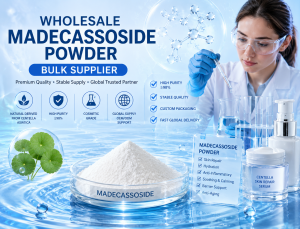
Why Do Cosmetic Manufacturers Choose High-Purity Madecassoside Powder?
Professional cosmetic manufacturers prioritize ingredients with:
- High purity
- Stable quality
- Excellent batch consistency
- Low impurity profile
- International compliance
High-purity Madecassoside offers:
- Easier formulation
- Better efficacy
- Improved product stability
- Lower formulation risk
For premium skincare brands, selecting a trusted raw material supplier is essential for maintaining product performance and regulatory confidence.
Product Specification Sheet
| Item | Specification |
|---|---|
| Product Name | Madecassoside Powder |
| INCI Name | Madecassoside |
| CAS Number | 34540-22-2 |
| Appearance | White to off-white powder |
| Purity | ≥95%, ≥98%, ≥99% (customizable) |
| Solubility | Water-soluble |
| Molecular Formula | C48H78O20 |
| Molecular Weight | 975.12 g/mol |
| Recommended Dosage | 0.05–0.5% |
| Shelf Life | 24 Months |
| Storage | Cool, dry place away from sunlight |
| Packaging | 1kg, 5kg, 25kg |
| Grade | Cosmetic Grade |
Why Choose Our Madecassoside Powder?
As a professional cosmetic peptidchem supplier and manufacturer of synthesized peptide ingredients, we provide high-quality cosmetic actives designed for global skincare brands, OEM manufacturers, and formulation laboratories.
Our advantages include:
- High-purity cosmetic-grade Madecassoside
- Strict quality control and batch consistency
- Stable global supply chain
- Custom packaging solutions
- OEM and private label ingredient support
- Technical formulation assistance
- Documentation support (COA, MSDS, TDS)
- Fast worldwide shipping
- Competitive wholesale pricing
- Bulk manufacturing capability
Whether you are developing barrier repair creams, anti-aging serums, moisturizing emulsions, or sensitive skin products, our ingredient solutions help support reliable formulation performance.📩 Contact us to request a quotation or discuss your specific requirements. Let’s build a strong partnership supply for your anti-aging cosmetics product line.
Also See:
What Is Madecassoside Powder and Why Is It Used in Sensitive Skin Care Formulas
Copper Tripeptide-1 (GHK-Cu): Cosmetic Formulation Guide | Peptidchem
How Does Palmitoyl Oligopeptide Support Collagen Production and Skin Renewal Applications
FAQs:
Q1:Is Madecassoside suitable for sensitive skin?
Yes. Madecassoside is widely recognized for its soothing properties and is commonly used in formulations for sensitive, reactive, and compromised skin.
Q2:Can Madecassoside be combined with Hyaluronic Acid?
Yes. It works synergistically with hyaluronic acid to improve hydration while supporting barrier repair and reducing irritation.
Q3:Does Madecassoside support collagen production?
Studies suggest that Madecassoside can promote fibroblast activity and collagen synthesis, contributing to improved skin firmness and elasticity.
Q4:Is Madecassoside safe for daily skincare products?
When formulated within recommended cosmetic use levels and applicable regulations, Madecassoside has demonstrated a favorable safety profile and is suitable for daily-use products.
Q5:What concentration is typically used in cosmetic formulations?
Common use levels range from 0.05% to 0.5%, depending on the product type and desired performance.
Q6:Can Madecassoside be used after cosmetic procedures?
Yes. It is frequently included in post-procedure skincare products intended to soothe the skin and support barrier recovery after treatments such as laser procedures or chemical peels.
Q7:Is Madecassoside compatible with other cosmetic actives?
Yes. It is often formulated alongside ingredients such as niacinamide, ceramides, panthenol, hyaluronic acid, peptides, and botanical extracts.
Q8:Do you offer bulk Madecassoside powder for OEM cosmetic manufacturing?
Yes. We supply cosmetic-grade Madecassoside powder in bulk quantities and support OEM/ODM manufacturers, skincare brands, and formulation companies with documentation and customized packaging.
References:
Bonte, F., Dumas, M., Chaudagne, C., & Meybeck, A. (1994). Influence of Asiatic Acid, Madecassic Acid, and Madecassoside on human collagen synthesis. Planta Medica, 60(2), 133–135.
Bylka, W., Znajdek-Awiżeń, P., Studzińska-Sroka, E., & Danczak-Pazdrowska, A. (2014). Centella asiatica in dermatology: An overview. Phytotherapy Research, 28(8), 1117–1124.
James, J. T., & Dubery, I. A. (2009). Pentacyclic triterpenoids from Centella asiatica and their biological activities. Molecules, 14(10), 3922–3941.
European Scientific Committee on Consumer Safety (SCCS). Opinions on cosmetic ingredient safety and consumer exposure.
International Organization for Standardization. ISO 16128: Guidelines on natural and organic cosmetic ingredients.
Journal of Ethnopharmacology. Multiple studies on the pharmacological properties and dermatological applications of Centella asiatica triterpenoids.