





Discover how private label skincare brands select effective anti-aging peptide ingredients. Learn peptide types, benefits, sourcing, and how cosmetic peptide suppliers support product innovation.
How Can Private Label Skincare Brands Choose the Right Anti-Aging Peptide Ingredients?
The global skincare industry is shifting from traditional moisturizing products toward science-driven formulations containing bioactive ingredients. Among these innovations, cosmetic peptides have become one of the most researched and commercially valuable anti-aging ingredients because of their ability to support collagen synthesis, improve skin firmness, enhance barrier function, and reduce visible signs of aging.
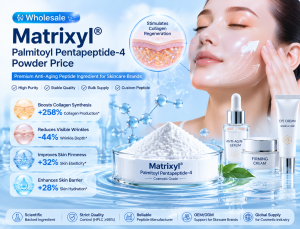
For private Wholesale Matrixyl Palmitoyl Pentapeptide-4 Powder is not simply about choosing a popular ingredient name. Successful product development requires understanding peptide structure, biological function, formulation compatibility, stability, supplier quality, and regulatory requirements.
Scientific reviews indicate that cosmetic peptides can influence multiple skin-aging pathways, including collagen production, extracellular matrix remodeling, antioxidant defense, and skin repair mechanisms.
What Are Cosmetic Peptides and Why Are They Used in Anti-Aging Products?
Cosmetic peptides are short chains of amino acids designed to mimic natural biological signaling molecules in the skin. Unlike large proteins, peptides have smaller molecular structures that allow them to interact with skin pathways related to repair, regeneration, and extracellular matrix maintenance.
In anti-aging skincare formulations, peptides are mainly used because they may:
- Support collagen and elastin production
- Improve skin elasticity and firmness
- Reduce the appearance of fine lines and wrinkles
- Strengthen the skin barrier
- Promote skin recovery after environmental stress
Dermatology research identifies peptides as promising cosmetic actives because different peptide sequences perform different biological functions rather than providing a single universal effect.
What Types of Anti-Aging Peptides Should Private Label Brands Consider?
Choosing the right peptide depends on the product positioning and consumer target.
1. Signal Peptides – For Collagen Support and Firmness
Function:
Signal peptides communicate with skin cells and encourage extracellular matrix production.
Common Examples:
| Peptide Ingredient | Primary Cosmetic Benefit |
|---|---|
| Palmitoyl Pentapeptide-4 | Supports collagen-related pathways |
| Palmitoyl Tripeptide-1 | Helps improve firmness and wrinkle appearance |
| Palmitoyl Tripeptide-38 | Supports collagen, laminin, and hyaluronic acid pathways |
Signal peptides are widely used in premium anti-aging serums and wrinkle-care formulations.
Best for:
- Anti-wrinkle creams
- Luxury facial serums
- Mature skin products
2. Copper Peptides – For Skin Repair and Regeneration
Copper peptides, especially GHK-Cu, are among the most recognized cosmetic peptides.
Benefits:
- Supports skin renewal processes
- Helps maintain extracellular matrix components
- Improves skin resilience
Copper peptide formulations are commonly positioned in professional skincare and advanced anti-aging products.
Best for:
- Premium rejuvenating serums
- Post-procedure skincare
- Repair-focused formulations
3. Neurotransmitter-Inhibiting Peptides – For Expression Lines
These peptides are designed to reduce the appearance of expression wrinkles by influencing muscle contraction signaling pathways.
Examples:
- Acetyl Hexapeptide-8 (Argireline type)
- Acetyl Octapeptide-3
Best for:
- Eye creams
- Forehead wrinkle products
- Anti-expression-line serums
4. Carrier Peptides – For Mineral Delivery
Carrier peptides transport essential minerals to the skin.
Example:
GHK-Cu
Function:
- Copper delivery
- Skin conditioning
- Repair support
How Should Private Label Brands Select a Cosmetic Peptide Supplier?
Selecting a reliable peptide supplier is one of the most important decisions in product development.
A professional synthesized peptide manufacturer should provide:
1. High Purity Peptide Raw Materials
Brands should verify:
- HPLC purity testing
- Mass spectrometry confirmation
- Certificate of Analysis (COA)
- Batch-to-batch consistency
High-quality synthesized peptides reduce formulation risks and improve product performance.
2. Custom Peptide Synthesis Capability
A strong supplier should support:
- Custom peptide sequences
- Scale-up production
- Research and development assistance
- Cosmetic-grade documentation
Private label brands increasingly require customized peptide blends instead of generic ingredients.
3. Regulatory Compliance
Before purchasing peptide ingredients, brands should confirm:
- INCI name availability
- Safety documentation
- Heavy metal testing
- Microbial testing
- Stability information
4. Technical Formulation Support
A professional supplier should help brands understand:
- Recommended usage concentration
- pH compatibility
- Solubility
- Preservation requirements
- Compatibility with retinol, vitamin C, niacinamide, and hyaluronic acid
How Can Brands Match Peptide Ingredients With Product Goals?
Anti-Aging Serum
Recommended peptide strategy:
- Signal peptide + copper peptide combination
- Supports firmness and skin renewal positioning
Eye Cream
Recommended peptides:
- Neurotransmitter peptides
- Signal peptides
Target benefits:
- Fine line reduction
- Improved smoothness
Skin Barrier Repair Cream
Recommended peptides:
- Repair peptides
- Carrier peptides
Target benefits:
- Skin recovery
- Improved resilience
Premium Luxury Anti-Aging Product
Recommended approach:
Multi-peptide complex containing:
- Collagen-supporting peptides
- Copper peptides
- Barrier-support peptides
A multi-functional peptide system allows brands to create differentiated products rather than competing only on price.
Why Should Brands Choose Synthesized Peptide Ingredients?
Synthetic peptide production provides advantages compared with traditional extraction methods.
Benefits of Synthesized Cosmetic Peptides:
Higher Purity
Controlled synthesis enables consistent peptide structures.
Better Quality Control
Manufacturers can verify every production batch.
Customization
Specific peptide sequences can be developed for targeted cosmetic applications.
Scalability
Synthetic manufacturing supports global skincare production requirements.
The cosmetic peptide synthesis sector continues expanding due to increased demand for biotechnology-based skincare solutions.
What Mistakes Should Private Label Brands Avoid When Choosing Peptides?
Mistake 1: Selecting Peptides Only Based on Marketing Trends
A popular ingredient does not automatically guarantee product success.
Brands should evaluate:
- Scientific evidence
- Stability
- Application suitability
- Consumer expectations
Mistake 2: Ignoring Peptide Stability
Peptides may be affected by:
- Extreme pH
- Oxidation
- Heat exposure
- Incompatible ingredients
Supplier technical support is essential.
Mistake 3: Buying Without Quality Documentation
Brands should avoid suppliers without:
- COA
- Purity analysis
- Manufacturing standards
- Traceability
How Can a Cosmetic Peptide Supplier Help Build a Successful Skincare Brand?
A specialized peptide manufacturer can support brands through:
Ingredient Development
- Custom synthesized peptide production
- New peptide screening
- Functional peptide combinations
Product Differentiation
Develop unique formulations such as:
- Multi-peptide anti-aging serum
- Copper peptide repair cream
- Advanced wrinkle-control solutions
Market Positioning
Scientific peptide technology allows brands to create:
- Premium skincare lines
- Dermatology-inspired products
- Professional beauty solutions
Why Choose a Professional Synthesized Peptide Ingredient Manufacturer?
For skincare brands seeking competitive advantages, choosing the right peptide partner determines product quality and market credibility.
A reliable cosmetic peptide supplier provides:
✔ High-purity synthesized peptides
✔ Customized peptide development
✔ Technical documentation
✔ Consistent manufacturing quality
✔ Support for private label skincare innovation
By combining advanced peptide synthesis technology with cosmetic science expertise, brands can develop next-generation anti-aging products designed for global markets.📩 Contact us to request a quotation or discuss your specific requirements. Let’s build a strong partnership supply for your anti-aging cosmetics product line.
Also See
How Can Brands Source High-Quality Palmitoyl Pentapeptide-4 Powder for Skincare Development
Cosmetic Peptides Manufacturing Standards: Ensuring Safety, Purity, and Product Consistency
How to Select the Right Cosmetic Peptide Blend for Anti-Aging Serum and Cream Formulations
FAQs:
Q1. What are the best peptides for anti-aging skincare?
The most commonly used anti-aging peptides include signal peptides such as Palmitoyl Pentapeptide-4, copper peptides such as GHK-Cu, and neurotransmitter peptides such as Acetyl Hexapeptide-8.
Q2. How do cosmetic peptides reduce wrinkles?
Cosmetic peptides may help reduce visible wrinkles by supporting collagen-related pathways, improving skin firmness, and maintaining extracellular matrix components.
Q3. Are synthetic peptides safe for skincare products?
Cosmetic-grade synthesized peptides are widely used in skincare when produced according to appropriate quality and safety standards.
Q4. What should brands check before buying peptide ingredients?
Brands should check:
- Purity percentage
- COA documentation
- Testing methods
- Regulatory compliance
- Supplier manufacturing capability
Q5. Can peptide suppliers customize ingredients?
Yes. Professional peptide manufacturers can provide custom peptide synthesis, modified peptide structures, and application-specific solutions.
References
Pintea, A. et al. (2025). Peptides: Emerging Candidates for the Prevention and Treatment of Skin Aging. Cosmetics.
Tang, Y. et al. (2025). Peptides in Cosmetics: From Pharmaceutical Development to Cosmetic Applications. Cosmetics.
Schagen, S.K. (2017). Topical Peptide Treatments with Effective Anti-Aging Results. Cosmetics.
Robinson, L.R. et al. (2020). A serum containing vitamins C & E and a matrix-repair tripeptide reduces facial signs of aging. Journal of Cosmetic Dermatology.
Cosmetic peptide manufacturing and synthesis market analysis.