





Discover how cosmetic peptide manufacturers synthesize, purify, test, and supply premium peptide ingredients for skincare. Learn what to evaluate when choosing a cosmetic peptide supplier.
From Laboratory to Skincare Bottle: How Cosmetic Peptide Manufacturers Create Premium Ingredients
What turns a peptide from a laboratory molecule into a reliable cosmetic ingredient?
For skincare brands, formulators, distributors, and cosmetic ingredient buyers, the answer goes far beyond peptide synthesis. A premium cosmetic peptide requires controlled chemical synthesis, purification, analytical characterization, quality control, documentation, and formulation support.This is particularly important because the scientific literature shows that cosmetic peptides represent a diverse ingredient category. A 2025 review identified 102 commercially available cosmetic peptides, with reported applications including signaling pathways, pigmentation-related activity, antioxidant activity, enzyme inhibition, cellular defense, and other cosmetic functions. The review also notes that cosmetic peptides can be produced through chemical synthesis or biotechnology.For manufacturers specializing in synthesized peptide ingredients, the objective is therefore not simply to produce a peptide sequence. It is to consistently deliver an ingredient with defined identity, purity, quality, and documentation that can move efficiently from R&D to commercial skincare production.
What Are Cosmetic Peptides?
Cosmetic peptidchem are short chains of amino acids used as functional ingredients in skincare formulations.
Unlike proteins, which can contain hundreds or thousands of amino acids, peptides are comparatively small molecular structures. Their sequence, terminal groups, modifications, purity, and formulation environment can influence their properties and intended cosmetic application.
Commercial cosmetic peptides include several functional categories, such as:
- Signal peptides
- Carrier peptides
- Enzyme-inhibitory peptides
- Neurotransmitter-related peptides
- Antioxidant peptides
- Peptide derivatives
- Custom-designed synthetic peptides
The 2025 review of commercially available cosmetic peptides found that many are inspired by naturally occurring biological molecules, including sequences associated with extracellular-matrix molecules.
For ingredient buyers, this means the peptide sequence alone is not enough. Manufacturing quality and analytical verification are equally important.
How Does a Cosmetic Peptide Manufacturer Produce a Premium Ingredient?
A professional manufacturing process generally moves through several interconnected stages:
Peptide design → synthesis → cleavage/deprotection → purification → analytical characterization → quality control → packaging → technical documentation → customer delivery
Each stage can influence the final quality of the cosmetic peptide.
Peptide Design and Raw Material Selection
Before synthesis begins, the manufacturer establishes the required peptide sequence and specifications.
Depending on the ingredient, this may include:
- Amino acid sequence
- N-terminal modification
- C-terminal modification
- Molecular weight
- Target purity
- Salt or counter-ion form
- Solubility requirements
- Packaging requirements
- Intended cosmetic application
For a B2B cosmetic ingredient, the specification should be established before production rather than determined after the batch is manufactured.
This is especially important for custom peptide projects because even relatively small structural changes can affect analytical behavior, stability, solubility, and formulation performance.
How Are Synthetic Cosmetic Peptides Manufactured?
In SPPS, the growing peptide chain is attached to a solid resin. Amino acids are added sequentially through controlled coupling and deprotection cycles. After the desired sequence has been assembled, the peptide is cleaved from the resin and subjected to subsequent processing.
The SPPS approach was developed following Bruce Merrifield’s pioneering work and became an important platform for synthetic peptide production. Reviews describe its advantages in automation, sequence flexibility, and scalability.
A simplified manufacturing pathway is:
Protected amino acid → coupling → deprotection → next amino acid → repeated elongation → cleavage → crude peptide
For manufacturers of synthesized cosmetic peptide ingredients, process control during each coupling cycle is critical because incomplete reactions can generate deletion sequences and other impurities.
Why Is Purification So Important for Cosmetic Peptides?
Because the crude product can contain process-related impurities.
After synthesis and cleavage, a peptide mixture may contain:
- Desired peptide
- Deletion sequences
- Truncated peptides
- Modified products
- Residual reagents
- Side products
- Other process-related impurities
Therefore, purification is a critical step in converting a synthesized peptide into a commercial-grade ingredient.
Reversed-phase high-performance liquid chromatography (RP-HPLC) is widely used for peptide purification because of its ability to separate closely related peptide components. Scientific literature identifies HPLC as an important tool for both purification and peptide characterization.
For a premium cosmetic peptide supplier, purification is therefore not simply about achieving a high percentage on a certificate. It is part of the overall process used to establish ingredient consistency.
How Do Manufacturers Confirm Peptide Identity?
Analytical characterization provides the answer.
Common analytical approaches for synthetic peptides include:
- HPLC: evaluates chromatographic purity and product profile
- Mass spectrometry (MS): confirms molecular mass and supports structural identification
- LC-MS: combines chromatographic separation with mass analysis
- Other analytical methods: selected according to peptide structure and specification
Scientific references emphasize the importance of combining chromatographic and mass-spectrometric techniques when characterizing synthetic peptides.
What Quality Documents Should a Cosmetic Peptide Supplier Provide?
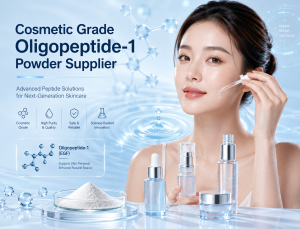
As Cosmetic Grade Oligopeptide-1 Powder professional supplier should be prepared to provide appropriate technical and quality documentation for the specific ingredient and market.
Depending on the product and customer requirements, documentation may include:
| Document / Information | Purpose |
|---|---|
| Certificate of Analysis (CoA) | Confirms batch-specific test results |
| HPLC chromatogram | Supports purity assessment |
| MS / LC-MS data | Supports molecular identity |
| Specification sheet | Defines quality requirements |
| Molecular formula / molecular weight | Supports identification and formulation |
| Appearance | Defines physical characteristics |
| Storage conditions | Supports product stability |
| Batch / lot information | Enables traceability |
| Safety-related documentation | Supports responsible handling and formulation |
| Technical data | Supports R&D and formulation development |
What Makes a Cosmetic Peptide Ingredient Premium?
For B2B cosmetic ingredient purchasing, premium quality is better understood as a combination of:
Identity + purity + consistency + analytical evidence + traceability + documentation + technical support
A peptide with excellent HPLC purity but inadequate identity confirmation or inconsistent batch performance may not provide the same commercial value as a fully characterized ingredient.
A strong cosmetic peptide manufacturer should therefore focus on batch-to-batch reproducibility, not merely a single impressive laboratory result.
Why Does Batch Consistency Matter for Skincare Brands?
Because the peptide is only one component of the finished formulation.
A skincare manufacturer needs raw materials that behave predictably during:
- Formula development
- Pilot production
- Stability testing
- Scale-up
- Commercial manufacturing
- Quality-control testing
Consistent raw materials make it easier for formulators to maintain the intended characteristics of the finished product.
For this reason, buyers evaluating a cosmetic peptide supplier should ask about specifications, analytical methods, batch traceability, storage, packaging, and quality-control procedures rather than evaluating a supplier solely by price.
How Do Cosmetic Peptide Manufacturers Support Formulators?
The ingredient must ultimately work within a cosmetic formulation.
Depending on the peptide, formulators may need information concerning:
- Recommended use level
- Solubility
- Recommended pH range
- Temperature sensitivity
- Compatibility with other ingredients
- Recommended addition stage
- Storage conditions
- Packaging
- Stability considerations
Not every peptide behaves the same way. A professional synthetic cosmetic peptide supplier should therefore provide technical information appropriate to the specific molecule rather than applying one generic formulation recommendation to every peptide.
Why Is Regulatory Compliance Important for Cosmetic Peptide Suppliers?
In the United States, cosmetics and most cosmetic ingredients generally do not require FDA premarket approval, except for color additives subject to applicable approval requirements. However, companies marketing cosmetics are responsible for ensuring product safety under labeled or customary conditions of use.
This distinction is important for cosmetic ingredient suppliers.
A supplier should not describe an ingredient as “FDA approved” simply because it is supplied for cosmetic use. FDA specifically states that cosmetic labeling must not falsely imply FDA approval.
For international brands, regulatory considerations also differ by market.
In the European Union, cosmetic claims must be supported by adequate and verifiable evidence. EU rules also state that ingredient properties should not automatically be presented as properties of the finished cosmetic product unless the relevant evidence supports the claim.
What does this mean for peptide manufacturers?
It means a professional supplier should help customers obtain accurate ingredient information while avoiding unsupported therapeutic or drug-like claims.
How Should Brands Choose a Cosmetic Peptide Supplier?
A useful supplier evaluation framework includes seven questions:
1. Can the supplier synthesize the required peptide?
Look for demonstrated capability in synthetic peptide manufacturing, including custom sequences where applicable.
2. Can the supplier control purity?
Ask for the specification and the analytical method used to determine purity.
3. Can the supplier verify molecular identity?
Mass spectrometry or appropriate complementary analytical data can help establish identity.
4. Is batch consistency controlled?
Ask about batch specifications, testing, traceability, and quality-control procedures.
5. Can the supplier provide technical documentation?
A professional B2B supplier should be able to provide appropriate CoAs and technical information.
6. Can the supplier support custom requirements?
For brands developing differentiated products, custom synthesis and specification development can be important.
7. Can the supplier support commercial scale?
A laboratory sample is different from a reliable commercial supply chain. Buyers should evaluate manufacturing capacity, lead times, packaging, and scalability.
What Is the Difference Between a Cosmetic Peptide Manufacturer and a Peptide Trading Company?
A manufacturer controls or directly manages critical parts of the production process, whereas a trading company may primarily source finished materials from another producer.
For buyers seeking long-term supply, direct manufacturing capability can offer advantages such as:
- Better communication with technical teams
- Greater control over specifications
- Improved traceability
- Custom synthesis possibilities
- More direct quality discussions
- Potentially more predictable supply
For companies purchasing bulk cosmetic peptides, understanding who actually manufactures the ingredient can therefore be an important part of supplier qualification.
From Peptide Molecule to Finished Skincare Product?
The journey from laboratory chemistry to a skincare bottle can be summarized as:
1. Molecular design
Define the peptide sequence and specifications.
2. Chemical synthesis
Build the peptide through controlled synthesis cycles.
3. Cleavage and deprotection
Release the target peptide and remove protecting groups.
4. Purification
Separate the desired peptide from process-related impurities.
5. Analytical characterization
Use techniques such as HPLC and MS to evaluate purity and identity.
6. Quality control
Confirm the batch against defined specifications.
7. Documentation and packaging
Prepare the ingredient for controlled B2B distribution.
8. Formulation
The cosmetic manufacturer incorporates the peptide into a serum, cream, essence, lotion, mask, or other formulation.
9. Finished-product testing and claim substantiation
The final product must be evaluated according to its intended market and claims.
This is why premium peptide ingredients are fundamentally a quality-engineering and manufacturing process, not simply a chemical formula.
Why Synthetic Peptide Manufacturing Is Becoming More Sophisticated?
Synthetic peptide technology continues to evolve.
Recent literature describes SPPS as a predominant peptide manufacturing platform while also highlighting environmental challenges associated with solvent and reagent consumption. Researchers and manufacturers are therefore investigating solvent reduction, recycling, alternative synthesis methods, and greener peptide-processing strategies.
This development matters for the cosmetic ingredient industry because future peptide suppliers will increasingly need to balance:
Purity + scalability + cost + reproducibility + sustainability
A modern cosmetic peptide manufacturer should therefore think beyond synthesis yield and consider the complete manufacturing process.
Why Choose a Manufacturer of Synthesized Peptide Ingredients?
For skincare brands, cosmetic laboratories, distributors, and ingredient importers, working directly with a manufacturer of synthesized peptide ingredients can simplify technical communication and supply-chain qualification.
A capable manufacturer can support the process from:
Peptide sequence → synthesis → purification → analytical testing → quality documentation → bulk ingredient supply
This model can be particularly useful for customers seeking:
- Standard cosmetic peptide ingredients
- Bulk synthetic peptides
- Custom peptide synthesis
- Research-to-commercial scale-up
- Private-label cosmetic ingredient programs
- OEM/ODM formulation projects
- Long-term B2B peptide supply
Conclusion
Premium cosmetic peptides begin with precise synthesis, effective purification, rigorous testing, and consistent quality control. Choosing a reliable cosmetic peptide manufacturer ensures brands receive high-quality, well-characterized synthesized peptide ingredients with the documentation and supply consistency needed for modern skincare formulations. For bulk or custom peptide requirements, partnering directly with an experienced cosmetic peptide supplier can provide greater flexibility, quality assurance, and long-term supply support.📩 Contact us to request a quotation or discuss your specific requirements. Let’s build a strong partnership supply for your anti-aging cosmetics product line.
Also See
Top Anti-Aging Peptides Used in Modern Skincare: Benefits, Functions, and Applications
How Cosmetic Peptides Support Skin Renewal: Science Behind Advanced Peptide Ingredients
FAQs:
Q1:What is a cosmetic peptide manufacturer?
A cosmetic peptide manufacturer produces peptide-based raw materials intended for use in cosmetic and personal-care formulations. Manufacturing may involve chemical peptide synthesis, purification, analytical characterization, quality control, and bulk packaging.
Q2:What are synthetic cosmetic peptides?
Synthetic cosmetic peptides are peptide ingredients produced through controlled chemical synthesis rather than extracted directly from a biological source. Their sequences and chemical structures can be designed or selected for specific cosmetic applications.
Q3:How are cosmetic peptides synthesized?
Solid-phase peptide synthesis is a major method. Amino acids are sequentially coupled to a growing peptide chain attached to a solid support, followed by deprotection, cleavage, purification, and analytical characterization.
Q4:How is cosmetic peptide purity tested?
HPLC is commonly used to assess chromatographic purity, while mass spectrometry can support molecular-weight and identity confirmation. Depending on the peptide, additional analytical methods may be appropriate.
Q5:Can cosmetic peptide manufacturers provide custom peptides?
Yes. Synthetic peptide manufacturing can accommodate customized sequences and structural modifications, subject to technical feasibility, regulatory requirements, and the manufacturer’s capabilities.
Q6:What documents should I request from a cosmetic peptide supplier?
Common documents include a Certificate of Analysis, product specification, analytical data, molecular information, storage recommendations, batch information, and applicable safety or technical documentation.
Q7:Can cosmetic peptides be used in anti-aging skincare?
Cosmetic peptides are widely investigated and used in skincare products positioned around cosmetic benefits. However, claims must be appropriate for the intended market and supported by relevant evidence. In the U.S., claims that imply treatment or alteration of the structure or function of the body can cause a product to fall under drug requirements.
References
van Walraven, N., FitzGerald, R. J., Danneel, H.-J., & Amigo-Benavent, M. (2025). Bioactive peptides in cosmetic formulations: Review of current in vitro and ex vivo evidence. Peptides, 193, 171440.
Ashaolu, T. J. (2025). Applications of bioactive peptides in cosmeceuticals: A review. Journal of Zhejiang University-SCIENCE B, 26(6), 527–545.
Useful for supporting sections discussing peptide applications in cosmetics and skincare.
European Peptide Society (2025). Overview of Peptides and Their Potential Roles in Skin Health and Beauty.
This review provides background on peptide structures, classifications, cosmetic applications, and skin-health research.
U.S. Food and Drug Administration (FDA). Cosmetic Ingredients.
Useful for explaining the regulatory responsibilities surrounding cosmetic ingredients in the United States.
U.S. Food and Drug Administration (FDA). Cosmetics Labeling Claims.
This source supports your discussion of cosmetic claims, including the requirement that cosmetic claims be truthful and not misleading.
U.S. Food and Drug Administration (FDA). Summary of Cosmetics Labeling Requirements.
Useful for discussing ingredient declaration, labeling, and regulatory requirements for cosmetics sold in the United States.