





Peptidchem provides cosmetic peptide ingredient solutions for global skincare brands, OEM manufacturers, and cosmetic laboratories.
Matrixyl 3000 vs Retinol: The Next Generation of Anti-Aging Skincare Science
The anti-aging skincare market has historically been dominated by retinoids. For decades, retinol has been considered one of the most researched cosmetic ingredients for improving wrinkles, uneven texture, and photoaging.
However, modern cosmetic science is shifting toward a more sophisticated approach: biomimetic peptides that communicate with skin cells instead of aggressively stimulating turnover.
Among these peptide technologies, Matrixyl 3000 has become one of the most recognized collagen-supporting ingredients.
Matrixyl 3000 combines two powerful matrikine peptides:
- Palmitoyl Tripeptide-1 (Pal-GHK)
- Palmitoyl Tetrapeptide-7 (Pal-GQPR)
Together, these peptides work as skin signaling molecules that support extracellular matrix proteins including collagen and elastin.
Unlike retinol, which works primarily through vitamin A receptor pathways, Matrixyl 3000 focuses on restoring the skin’s structural communication system.
For cosmetic brands developing premium anti-aging products, the question is no longer simply:
“Is Matrixyl 3000 better than retinol?”
The more important question is:
“How can peptide technology and retinoids work together to create better-performing anti-aging formulas?”
Retinol: The Traditional Anti-Aging Gold Standard
Retinol is a vitamin A derivative widely used in skincare formulations.
After topical application, retinol is converted into retinaldehyde and eventually retinoic acid, the biologically active form responsible for many anti-aging effects.
Retinol supports:
- Increased epidermal renewal
- Collagen synthesis stimulation
- Reduced collagen degradation
- Improved skin texture
- Reduction of uneven pigmentation
Because of its strong biological activity, retinol remains one of the most clinically studied anti-aging ingredients.
However, retinol also creates formulation challenges.
Common consumer concerns include:
- Skin dryness
- Redness
- Peeling
- Increased sensitivity
- Long adjustment periods
For cosmetic manufacturers, retinol formulas require careful optimization of:
- Encapsulation technology
- Antioxidant protection
- Packaging systems
- Compatibility with other actives
What Is Matrixyl 3000?
Matrixyl 3000 is a peptide-based anti-aging ingredient developed from biomimetic matrikines.
It contains:
Palmitoyl Tripeptide-1
CAS: 147732-56-7
Also known as:
- Pal-GHK
- Palmitoyl Oligopeptide
Palmitoyl Tripeptide-1 mimics fragments generated during collagen breakdown.
These fragments act as “repair signals,” encouraging fibroblasts to support collagen production.
Potential cosmetic benefits:
- Supports collagen synthesis
- Improves firmness
- Helps reduce visible wrinkles
- Enhances skin smoothness
Palmitoyl Tetrapeptide-7
CAS: 221227-05-0
Also known as:
- Pal-GQPR
Palmitoyl Tetrapeptide-7 is associated with controlling inflammatory signaling related to skin aging.
Benefits:
- Supports skin resilience
- Helps reduce signs of chronic stress
- Complements collagen-supporting peptides
Together, these two peptides create a multi-pathway anti-aging approach.
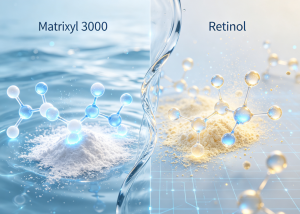
Matrixyl 3000 vs Retinol: Scientific Comparison
| Feature | Matrixyl 3000 | Retinol |
|---|---|---|
| Ingredient type | Biomimetic peptide complex | Vitamin A derivative |
| Main mechanism | Cellular signaling | Retinoid receptor activation |
| Primary target | Collagen & extracellular matrix | Cell turnover & collagen renewal |
| Skin irritation | Very low | Moderate to high |
| Sensitive skin suitability | Excellent | Limited |
| Pregnancy compatibility | Generally preferred alternative (consult healthcare professional) | Not recommended |
| Daytime use | Suitable | Usually nighttime use |
| Formulation difficulty | Moderate | Higher stability requirements |
| Best application | Firmness, wrinkles, mature skin | Texture, pigmentation, photoaging |
Which Ingredient Stimulates Collagen Better?
Aging skin loses collagen because:
- Fibroblast activity decreases
- Collagen breakdown increases
- Inflammation accelerates extracellular matrix degradation
Retinol stimulates collagen indirectly by activating retinoid pathways.
Matrixyl 3000 works differently.
It provides peptide signals that mimic natural repair messages.
Think of the difference:
Retinol:
“Increase skin renewal activity.”
Matrixyl 3000:
“Send repair signals to rebuild structural proteins.”
This difference explains why many modern luxury skincare brands combine peptides and retinoids instead of choosing only one.
Why Cosmetic Brands Are Combining Matrixyl 3000 + Retinol?
The strongest anti-aging formulas increasingly use combination strategies.
A premium formula may include:
| Ingredient | Function | Dosage |
|---|---|---|
| Matrixyl 3000 | Collagen support | 1–5% |
| Niacinamide | Barrier support | 2–5% |
| Hyaluronic Acid | Hydration | 0.1–1% |
| Vitamin C Derivative | Antioxidant | 2–10% |
Night Anti-Aging Formula
| Ingredient | Function | Dosage |
|---|---|---|
| Retinol | Cell renewal | 0.1–0.5% |
| Matrixyl 3000 | Collagen signaling | 1–5% |
| Ceramide | Barrier repair | 0.5–3% |
| Peptides | Skin remodeling | 1–5% |
What Peptides are similar to Matrixyl 3000?
Popular alternatives include:
- Palmitoyl Pentapeptide-4
- Copper Tripeptide-1
- Acetyl Hexapeptide-8
- Palmitoyl Tripeptide-38
Peptidchem: Professional Matrixyl 3000 & Cosmetic Peptide Ingredient Solutions
For cosmetic manufacturers, ingredient selection is not only about purchasing powder.
Reliable peptide supply requires:
- Identity verification
- Purity testing
- Batch consistency
- Heavy metal control
- Microbial testing
- Technical documentation
Our peptide portfolio includes:
- Palmitoyl Tripeptide-1
- Palmitoyl Tetrapeptide-7
- Palmitoyl Pentapeptide-4
- Copper Tripeptide-1 (GHK-Cu)
- Acetyl Hexapeptide-8 (Argireline)
- Acetyl Octapeptide-3 (SNAP-8)
- Acetyl Tetrapeptide-5
Peptidchem supports brands with:
✓ Cosmetic-grade peptide powders
✓ COA & specification documents
✓ Bulk export supply
✓ OEM formulation guidance
✓ Small MOQ customization
✓ Global logistics support
For brands developing next-generation anti-aging skincare, peptide technology provides a scalable solution between traditional actives and advanced biotechnology.
📩 Contact us to request a quotation or discuss your specific requirements. Let’s build a strong partnership supply for your anti-aging cosmetics product line.
FAQs:
Q1:Does Matrixyl 3000 replace retinol?
For people who cannot tolerate retinol or are pregnant, Matrixyl 3000 is a strong replacement that works through collagen stimulation. For everyone else, it works best alongside retinol, not instead of it.
Q2:How long does Matrixyl 3000 take to work?
Clinical studies report measurable collagen density and wrinkle improvements at 8–12 weeks of twice-daily use, with continued improvement through 6 months.3 Be patient and consistent.
Q3:Is Matrixyl 3000 safe for pregnancy?
Peptides are generally considered lower-risk during pregnancy than retinoids, but always consult your OBGYN before introducing any active ingredient during pregnancy or breastfeeding.
Q4:Is Matrixyl 3000 safe for sensitive skin?
Yes. Clinical studies consistently report excellent tolerability across skin types, with minimal reported irritation or sensitization.1 Patch test any new product before full-face application.
Q5:What concentration of Matrixyl 3000 is effective?
Matrixyl 3000 is typically used at manufacturer-recommended concentrations (usually 3–8% of the Matrixyl 3000 complex in finished formulations). Because peptide activity depends on formulation stability, look for products from brands that specify their concentration and ship in opaque, airless packaging.
References
Sederma. Matrixyl® 3000 peptide technology and cosmetic applications.
Kang S, et al. Retinoids and skin aging: mechanisms and clinical applications.
Leyden J, et al. Retinoid efficacy in photoaged skin.
Cosmetic Ingredient Review (CIR). Safety assessment of cosmetic peptides.
Asterwood. Matrixyl 3000 vs Retinol comparison article.