



Learn how to formulate hydrolyzed collagen peptide powder in serums, creams and masks, with use-level testing, stability tips and supplier checks from PeptidChem.
How Can Cosmetic Brands Use Hydrolyzed Collagen Peptide Powder in Serums, Creams, and Masks?
Hydrolyzed collagen peptide powder can be incorporated into cosmetic serums, creams, sheet masks, and other skincare formulations as a skin-conditioning ingredient that helps improve the feel and appearance of dry skin. For cosmetic brands, successful formulation depends on selecting an appropriate ingredient grade, understanding its molecular-weight distribution, determining the right concentration, and validating stability and compatibility.
For product developers sourcing peptide ingredients, PeptidChem provides a starting point for exploring peptide ingredient options, bulk sourcing requirements, and custom synthesized cosmetic peptides.
This guide explains how to formulate hydrolyzed collagen peptide powder in different skincare products, what benefits formulators can reasonably expect, and what to verify before purchasing from a cosmetic peptide supplier.
How Can Hydrolyzed Collagen Be Used in Skincare?
Hydrolyzed collagen peptide powder is generally considered for its skin-conditioning, moisture-supporting, and film-forming properties. Depending on the ingredient specification and finished formulation, cosmetic brands can use it in:
- Serums: Water-based products designed to leave skin feeling hydrated and smooth.
- Creams: Moisturizing emulsions intended to improve softness and skin feel.
- Face masks: Sheet-mask essences, gel masks, and rinse-off treatments that leave skin feeling supple.
- Other personal-care products: Selected lotions and related formulations, provided the ingredient is suitable for the intended application.
The most important distinction is that topical hydrolyzed collagen should not automatically be marketed as an ingredient that rebuilds dermal collagen or stimulates the skin’s natural collagen production. Its actual performance depends on the material, concentration, formulation, and supporting evidence.
The 2022 Cosmetic Ingredient Review assessment discusses hydrolyzed collagen among skin- and connective-tissue-derived ingredients used in cosmetics. A separate 2020 review examines the moisturizing properties and scientific limitations of topical collagen hydrolysates.
What Is Hydrolyzed Collagen Peptide Powder?
Hydrolyzed collagen is collagen that has been broken down through hydrolysis into shorter peptide chains. Depending on the manufacturing process, the resulting ingredient contains a distribution of peptides with different molecular weights.
It is commonly derived from animal sources such as bovine materials, porcine materials, or fish. Source, processing method, purity, odor, solubility, and molecular-weight distribution can vary between suppliers and grades.
In cosmetic ingredient documentation, the relevant INCI name is generally Hydrolyzed Collagen. Buyers should confirm the exact INCI name and specification for the material being purchased.
Why does molecular weight matter?
Molecular weight can influence solubility, film formation, sensory properties, and other formulation characteristics. However, a lower molecular weight alone does not prove that an ingredient penetrates deeply into the skin or produces superior anti-aging results.
The 2020 review Collagen Hydrolysates for Skin Protection: Oral Administration and Topical Formulation discusses hydrolyzed collagen and the differences between topical and oral applications. Findings associated with oral collagen supplementation should not automatically be applied to a topical serum or cream.
For cosmetic brands, the practical approach is to assess the supplier’s molecular-weight distribution alongside solubility, performance, stability, and finished-product testing.
What Benefits Can Hydrolyzed Collagen Provide in Cosmetic Formulations?
Hydrolyzed collagen is commonly considered for the following cosmetic functions.
Skin conditioning
The ingredient can help improve the feel of the skin, making a finished product more suitable for formulations designed to leave skin feeling soft and smooth.
Moisture-supporting properties
Depending on the specific ingredient and formula, hydrolyzed collagen can contribute to a moisturized skin feel. Its performance should be evaluated alongside other humectants and moisturizing ingredients.
Film formation
Some hydrolyzed collagen materials form a film on the skin’s surface. This can contribute to a smoother finish and a more conditioned feel.
Improved formulation experience
When appropriately selected, the ingredient can complement the sensory profile of serums, creams, and masks. The final result depends on concentration, molecular-weight distribution, the other ingredients, and the intended product format.
Important: These are formulation-oriented benefits, not a guarantee of clinical anti-aging efficacy. Cosmetic claims should reflect evidence for the specific ingredient and finished product.
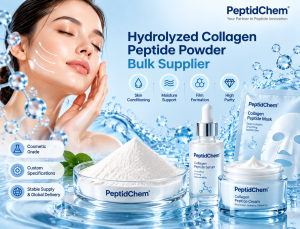
How Can Cosmetic Brands Use Hydrolyzed Collagen in Serums?
Serums are suitable candidates for hydrolyzed collagen when the selected grade is compatible with the product’s aqueous phase and the intended sensory profile.
Potential formulation approach
A hydrating serum may combine hydrolyzed collagen with:
- Glycerin: A widely used humectant that supports skin hydration.
- Panthenol: A skin-conditioning ingredient commonly used in moisturizing products.
- Sodium hyaluronate: A water-binding ingredient used in hydrating formulations.
- Suitable solvents and preservatives: Selected according to the formula, product type, and applicable regulations.
These ingredients have different functions and should not be assumed to be interchangeable.
How should formulators add the powder?
- Review the supplier’s technical data sheet for recommended processing conditions and solubility.
- Determine whether the material should be dissolved in the water phase or incorporated during a designated cool-down stage.
- Add it using a controlled mixing process that supports uniform dispersion or dissolution.
- Check the formula for clarity, color, odor, viscosity, and tackiness.
- Evaluate pH compatibility, preservative performance, and stability before finalizing the formula.
The correct addition method depends on the ingredient’s actual specification. A powder’s general water solubility does not establish its stability under every manufacturing condition.
What should brands test?
For a lightweight serum, pay particular attention to residue, tackiness, drying time, and the feel of the product after application. Test the finished formula rather than evaluating the raw ingredient in isolation.
How Can Hydrolyzed Collagen Be Used in Face Creams?
Hydrolyzed collagen can be considered for moisturizing creams and lotions where the formulation objective includes skin conditioning and a smooth finish.
Formulation considerations
Water phase: If the selected material is water-soluble, it may be suitable for incorporation into the aqueous phase. Follow the supplier’s instructions for addition, hydration, and temperature.
Emulsion compatibility: In an emulsion, assess whether the ingredient affects viscosity, appearance, odor, or physical stability.
Sensory profile: Evaluate whether the cream feels smooth and comfortable after application. Excessive tackiness or residue may require adjustments to the ingredient level or the broader formulation.
Moisturizer combination: Hydrolyzed collagen may be evaluated alongside glycerin, panthenol, and other compatible moisturizing ingredients. Compatibility must be confirmed in the actual formula.
What is the main formulation objective?
The goal is to produce a stable cream with the intended moisturizing performance and sensory characteristics. Hydrolyzed collagen should be selected because it contributes a useful function to that formulation, not simply because collagen appears on the product label.
How Can Hydrolyzed Collagen Be Used in Face Masks?
Hydrolyzed collagen may be considered for several mask formats, subject to ingredient-grade and compatibility requirements.
Sheet masks
In a sheet-mask essence, the ingredient can contribute to the conditioning properties of the liquid applied to the sheet. Formulators should evaluate wetting, liquid retention, residue, and the feel of the skin after the mask is removed.
Gel masks
For gel masks, assess the ingredient’s effect on texture, viscosity, spreadability, and drying behavior. A formula that performs well in a thin serum may not provide the same sensory result in a gel.
Rinse-off masks
In rinse-off products, evaluate the ingredient in the context of the product’s contact time, removal process, and intended skin feel. Do not assume that a benefit demonstrated in a leave-on product will be identical in a rinse-off formulation.
What makes a collagen mask effective?
The ingredient alone does not determine the performance of the mask. The complete formula, delivery format, contact time, and consumer use conditions all matter. Finished-product testing should support any specific performance claims.
What Concentration of Hydrolyzed Collagen Should Formulators Use?
There is no single concentration that is appropriate for every hydrolyzed collagen material or finished cosmetic product.
A practical starting point is to review the supplier’s recommended use level and then conduct controlled bench trials within the permitted range.
For example, if the supplier’s documentation allows it, a formulator might screen 0.2%, 0.5%, 1.0%, and 2.0% to compare performance. These are illustrative screening levels, not a universal recommendation or a validated optimum for every grade.
During testing, compare:
- Solubility and ease of processing.
- Appearance, odor, and color.
- Viscosity and overall texture.
- Tackiness and residue after application.
- Physical and microbiological stability.
- Finished-product performance and cost.
The final concentration should be based on technical documentation, formulation results, applicable safety requirements, and the commercial brief.
What Should Brands Check Before Buying Hydrolyzed Collagen Peptide Powder in Bulk?
Selecting a supplier involves more than comparing the price per kilogram. A material suitable for nutritional applications is not automatically documented or qualified for topical cosmetic use.
Before purchasing, request and review the following information.
| Supplier document or specification | Why it matters |
|---|---|
| Exact INCI name and grade | Confirms the intended ingredient identity and use |
| Source and traceability | Establishes whether the material is bovine, porcine, marine, or another specified source |
| Molecular-weight distribution | Helps assess whether the material fits the formulation brief |
| Certificate of Analysis (CoA) | Provides lot-specific results against the agreed specification |
| Technical Data Sheet (TDS) | Describes relevant physical properties, solubility, and recommended processing |
| Safety Data Sheet (SDS) | Provides applicable handling and safety information |
| Microbiological and contaminant data | Helps evaluate suitability for the intended application |
| Stability and storage information | Supports formulation development and raw-material handling |
| Regulatory documentation | Helps the brand assess market-specific requirements |
| Commercial terms | Clarifies minimum order quantity, packaging, lead time, and pricing |
Brands should also verify whether the supplier can provide samples, technical support, and consistent specifications across batches.
A supplier’s general certification claims do not replace verification of the specific product, manufacturing site, applicable scope, and batch documentation.
Hydrolyzed Collagen vs. Synthesized Cosmetic Peptides: What Is the Difference?
This distinction is important when selecting a cosmetic peptide supplier.
Hydrolyzed collagen is a mixture of shorter peptide chains produced by breaking down collagen. Its composition and molecular-weight distribution depend on the starting material and hydrolysis process.
Synthesized cosmetic peptides are produced by assembling defined amino-acid sequences through chemical synthesis. Their identity, sequence, modifications, and purity can be specified according to the intended application.
| Consideration | Hydrolyzed collagen | Synthesized cosmetic peptides |
|---|---|---|
| Production approach | Hydrolysis of collagen | Controlled synthesis of specified peptide sequences |
| Composition | Distribution of peptide chains | Defined sequence, subject to product specification |
| Main selection criteria | Source, molecular weight, solubility, and conditioning performance | Sequence identity, purity, modifications, stability, and intended function |
| Best selection approach | Match the material to the formulation’s conditioning requirements | Match the specific peptide to the formulation brief and supporting evidence |
Neither category is automatically superior in every formulation. The appropriate choice depends on the intended cosmetic function, evidence, formulation constraints, and budget.
For brands exploring synthesized cosmetic peptides, PeptidChem focuses on cosmetic peptide ingredients, custom peptide synthesis, and peptide manufacturing capabilities. If the project specifically requires hydrolyzed collagen powder, confirm that the offered product has a specification and documentation suitable for topical cosmetic use.
How Does PeptidChem Support Cosmetic Ingredient Sourcing?
PeptidChem core specialization is synthesized peptide ingredients. Its published manufacturing and quality information describes peptide synthesis, purification, scale-up, and analytical quality-control capabilities.
For cosmetic brands developing new products, the sourcing process should begin with a clear technical brief.
Before requesting a quotation, define:
- The intended application: serum, cream, mask, or another format.
- The required ingredient identity and INCI name.
- Target purity and relevant analytical specifications.
- Required source, molecular-weight range, or peptide sequence, as applicable.
- Intended sales markets and documentation requirements.
- Estimated order volume, sample needs, and target delivery schedule.
PeptidChem can be approached to discuss ingredient requirements and whether a synthesized cosmetic peptide or a suitably documented hydrolyzed collagen material is the more appropriate option.📩 Contact us to request a quotation or discuss your specific requirements. Let’s build a strong partnership supply for your anti-aging cosmetics product line.
Also See
What Types of Skincare Products Can Use Hydrolyzed Collagen Peptides
How Does Copper Tripeptide GHK-Cu Support Skin Repair, Collagen Synthesis, and Hair Care Formulas
Why Are Skincare Brands Choosing Palmitoyl Tetrapeptide-7 Powder for Premium Anti-Aging Products
How Does Palmitoyl Tetrapeptide-7 Support Skin Firmness and Advanced Peptide Cosmetic Applications
FAQs:
Q1.Is hydrolyzed collagen peptide powder suitable for cosmetic serums?
It can be suitable when the specific ingredient is intended for topical cosmetic use and is compatible with the serum’s pH, solvent system, preservative system, and processing conditions. Verify the grade and technical documentation before formulation.
Q2.Can hydrolyzed collagen be used in both creams and face masks?
Yes, it can be considered for both formats. However, the optimal concentration and processing method may differ because creams, sheet masks, gel masks, and rinse-off masks have different formulation requirements.
Q3.Does topical hydrolyzed collagen stimulate natural collagen production?
Do not assume that it does. Hydrolyzed collagen is commonly used for skin-conditioning and moisture-supporting properties. Claims that a cosmetic increases the skin’s production of collagen require appropriate substantiation and regulatory review.
Q4.Is hydrolyzed collagen the same as a synthetic cosmetic peptide?
No. Hydrolyzed collagen contains a distribution of peptide chains obtained by hydrolysis, while a synthesized cosmetic peptide is produced to obtain a specified amino-acid sequence. They should be evaluated according to their distinct specifications and intended functions.
Q5.Is food-grade hydrolyzed collagen automatically suitable for skincare?
No. Food-grade status does not, by itself, establish suitability for topical cosmetics. Confirm the intended grade, ingredient identity, microbiological quality, contaminant specifications, technical documentation, and applicable regulatory requirements.
Q6.How do I choose a hydrolyzed collagen peptide supplier?
Compare product specifications, traceability, source, molecular-weight distribution, lot-specific CoA, TDS, SDS, quality controls, regulatory support, minimum order quantity, and lead time. Request a sample and conduct formulation testing where appropriate.
Q7.Can hydrolyzed collagen be combined with other cosmetic peptides?
Potentially, yes, but compatibility must be established for the specific ingredients and finished formula. Check pH requirements, processing conditions, solubility, stability, and the recommended use levels of each ingredient.
Q8.What information should I provide when requesting a bulk quotation?
Provide the ingredient name, intended cosmetic application, required grade, source preferences, target specifications, estimated quantity, destination market, and required documentation. These details help the supplier determine whether the available material meets your needs.
References
Burnett, C. L., et al. (2022). Safety Assessment of Skin and Connective Tissue-Derived Proteins and Peptides as Used in Cosmetics. International Journal of Toxicology.
Gómez-Guillén, M. C., et al. (2020). Collagen Hydrolysates for Skin Protection: Oral Administration and Topical Formulation. Antioxidants, 9(2), 181.
U.S. Food and Drug Administration. Wrinkle Treatments and Other Anti-aging Products.
Google Search Central. Creating Helpful, Reliable, People-First Content.