





Compare Copper Tripeptide-1 vs Retinol for anti-aging skincare, including mechanisms, benefits, formulation considerations, evidence, and sourcing from cosmetic peptide suppliers.
Copper Tripeptide-1 vs Retinol: Comparing Modern Anti-Aging Skincare Ingredients
Copper Tripeptide-1 vs Retinol is an increasingly relevant comparison for cosmetic formulators, skincare brands, and ingredient buyers developing modern anti-aging products. Both ingredients are associated with improving the visible signs of skin aging, but they belong to different ingredient families and have different formulation characteristics.
Copper Tripeptide-1, commonly associated with the GHK-Cu complex, is a copper-containing peptide ingredient investigated for skin repair, extracellular-matrix-related activity, and cosmetic anti-aging applications. Retinol is a vitamin A derivative with a substantially larger body of clinical literature supporting its use for photoaged skin.
What Is Copper Tripeptide-1?
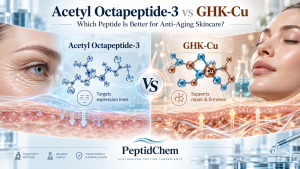
Copper Tripeptide-1 is commonly used to describe the copper complex of the tripeptide GHK, also known as GHK-Cu. GHK is a short peptide composed of glycine, histidine, and lysine, while the copper complex contains Cu²⁺.
GHK-Cu has attracted interest in cosmetic research because of its relationship with skin repair and extracellular-matrix processes. Research has investigated its physicochemical properties, dermal delivery, wound healing, and potential anti-wrinkle applications.
Importantly, the scientific evidence should be interpreted carefully. A recent review noted that although GHK-Cu and related peptides are widely used in cosmetic anti-wrinkle products, clinical evidence specifically demonstrating their anti-wrinkle effectiveness and skin permeability remains comparatively limited.
This distinction is important for cosmetic peptide suppliers: cellular, biochemical, preclinical, and clinical evidence should not be presented as equivalent levels of proof.
Why Is Copper Tripeptide-1 Used in Anti-Aging Formulations?
Copper Tripeptide-1 is attractive to formulators because peptide-based skincare can provide a different product-development direction from conventional vitamin A products.
Potential formulation positioning includes:
- Anti-aging skincare
- Skin-conditioning formulations
- Firming and elasticity-focused products
- Post-treatment skincare concepts
- Repair-oriented cosmetic formulations
- Premium peptide serums
- Multi-peptide anti-aging formulas
Research has also investigated copper tripeptide complexes in wound-healing models. However, results from animal or wound-healing studies should not automatically be interpreted as evidence for cosmetic wrinkle reduction in humans.
What Is Retinol?
Retinol is a vitamin A derivative belonging to the retinoid family. Unlike prescription tretinoin, retinol is widely incorporated into over-the-counter cosmetic and skincare products.
The American Academy of Dermatology identifies retinol as a retinoid used for concerns including uneven skin tone, pigmentation, texture, and fine lines and wrinkles. Retinoids can increase skin-cell turnover and influence processes associated with collagen and photoaging.
Retinol therefore has an important advantage in ingredient selection: there is substantial clinical and dermatological literature supporting the broader retinoid category and specific topical retinol formulations.
For example, an eight-week randomized, double-blind clinical study of a stabilized 0.1% retinol moisturizer reported improvements in lines and wrinkles, pigmentation, elasticity, firmness, and overall photodamage compared with vehicle.
Copper Tripeptide-1 vs Retinol: What Is the Main Difference?
The most important difference is their chemical class and biological role.
| Feature | Copper Tripeptide-1 / GHK-Cu | Retinol |
|---|---|---|
| Ingredient family | Copper-containing peptide | Vitamin A derivative |
| Main development interest | Peptide-based skin conditioning and repair-related applications | Photoaging, texture, pigmentation and wrinkle care |
| Ingredient format | Synthesized peptide/copper complex | Small-molecule vitamin A derivative |
| Anti-aging research | Growing but comparatively limited clinical evidence specifically for GHK-Cu | Extensive retinoid literature and clinical research |
| Formulation focus | Peptide purity, copper complexation, stability and compatibility | Oxidation protection, concentration, packaging and tolerability |
| Typical product positioning | Premium peptide serum and anti-aging formulations | Retinol creams, serums and treatment-oriented skincare |
| Irritation considerations | Generally positioned as an alternative peptide active, but formulation-specific tolerance must be assessed | Irritation, dryness and erythema can occur |
| Supplier requirements | Peptide synthesis, purification, characterization and quality control | Raw-material purity and stabilization |
This means the two ingredients should not necessarily be treated as direct substitutes. They can instead represent different approaches to anti-aging formulation design.
Which Has More Scientific Evidence: Copper Tripeptide-1 or Retinol?
Retinol and retinoids currently have a larger clinical evidence base for photoaging than Copper Tripeptide-1.
A PubMed-indexed clinical study evaluated topical 0.1% retinol in women with moderate facial photodamage and reported significant improvements compared with vehicle in several photoaging parameters after eight weeks.
Another study evaluated 0.3% and 1% retinol in photoaged skin. The study found similar effects between the two concentrations for several experimental markers, while 0.3% retinol was better tolerated during the six-week in-use phase.
By comparison, research on GHK-Cu includes promising mechanistic, physicochemical, wound-healing, and cosmetic studies, but a 2025 review specifically highlighted the relative lack of clinical studies directly evaluating GHK-Cu for wrinkle prevention or reduction.
For cosmetic brands, this means retinol has stronger established clinical positioning, while Copper Tripeptide-1 offers an opportunity for peptide-centered formulation development and differentiation.
Does Copper Tripeptide-1 Cause Less Irritation Than Retinol?
It is tempting to make a simple statement that Copper Tripeptide-1 is “non-irritating” and retinol is “irritating,” but this would be too broad.
Retinoids can cause dryness and irritation, particularly when consumers begin using them or use stronger formulations. The American Academy of Dermatology recommends introducing retinoids gradually and using sun protection because retinoids can increase skin sensitivity to sunlight.
For Copper Tripeptide-1, tolerance depends on the complete formulation, concentration, delivery system, purity, accompanying ingredients, and individual skin characteristics.
How Do Their Mechanisms Differ?
GHK-Cu is associated with biological processes involving skin repair and extracellular-matrix components. Research has examined its interaction with collagen-related processes, wound healing, and dermal delivery.
A physicochemical study specifically investigated GHK-Cu’s solubility, distribution characteristics, stressed-condition stability, and compatibility with potential formulation components, highlighting why ingredient characterization is important when developing topical peptide products.
For manufacturers, this makes peptide purity, identity, copper complexation, stability, and formulation compatibility important quality considerations.
Retinol: Vitamin A-Derived Approach
Retinol is converted within the skin through metabolic steps toward retinoic acid-related activity. Retinoid signaling influences epidermal differentiation and cellular processes relevant to photoaging.
Clinical literature supports the use of topical retinoid formulations for improving visible photoaging. The AAD also recognizes retinoids as established skincare ingredients for concerns such as fine lines, wrinkles, pigmentation irregularities, and acne.
Which Ingredient Is Better for Modern Anti-Aging Skincare?
Instead, brands should select the ingredient according to the formulation objective, target consumer, product positioning, regulatory market, supporting evidence, and desired sensory experience.
Copper Tripeptide-1 may be attractive when a brand wants:
- A peptide-centered anti-aging formula
- A premium cosmetic peptide story
- A synthesized peptide active
- A multi-peptide serum
- A skin-conditioning and repair-oriented positioning
- Ingredient differentiation from conventional retinol products
Retinol may be attractive when a brand wants:
- A familiar vitamin A active
- Established photoaging research
- Fine-line and wrinkle positioning
- Texture and pigmentation positioning
- A large body of consumer and dermatological awareness
Can Copper Tripeptide-1 and Retinol Be Used in the Same Skincare Formula?
Potentially, but compatibility should be determined through formulation testing rather than assumed from ingredient descriptions.
A published clinical study evaluated a formulation containing 0.2% pure retinol and 2.5% tripeptide concentrate, together with other formulation components, and reported clinical and histologic improvements after three months.
However, this does not establish that every Copper Tripeptide-1 + retinol combination will be stable or equally effective.
Formulators should evaluate:
- pH compatibility
- Ingredient concentration
- Copper-peptide stability
- Retinol oxidation
- Light and oxygen exposure
- Packaging compatibility
- Preservative compatibility
- Accelerated stability
- Appearance and color changes
- Finished-product assay
This is where an experienced cosmetic peptide supplier can contribute beyond simply providing a raw material.
What Should Cosmetic Brands Look for in a Copper Tripeptide-1 Supplier?
For brands developing Copper Tripeptide-1 skincare products, supplier evaluation should go beyond price.
A qualified Copper Tripeptide-1 supplier should be able to provide appropriate technical documentation and quality information, such as:
| Supplier Evaluation Item | Why It Matters |
|---|---|
| Chemical identity | Confirms the intended peptide ingredient |
| Purity specification | Helps maintain batch consistency |
| Peptide characterization | Supports ingredient identity and quality control |
| Copper content/complexation information | Important for GHK-Cu quality |
| HPLC testing | Supports purity assessment |
| Mass spectrometry | Helps confirm molecular identity |
| Batch COA | Provides lot-specific quality information |
| Stability information | Supports formulation development |
| Manufacturing documentation | Supports supplier qualification |
| Packaging information | Helps protect peptide quality |
| Custom synthesis capability | Useful for specialized peptide projects |
| Technical support | Helps with formulation and scale-up |
Why Choose a Synthesized Peptide Ingredient Manufacturer?
Brands sourcing synthesized peptide ingredients typically need reliable control over peptide identity, purity, batch consistency, and production specifications.
A synthesized peptide manufacturer can support cosmetic ingredient development through controlled peptide synthesis followed by purification and analytical characterization.
For Copper Tripeptide-1 projects, buyers can specifically discuss:
- Target purity
- Peptide sequence
- Copper complex specifications
- HPLC purity
- LC-MS/MS or MS confirmation
- Batch-to-batch consistency
- Packaging requirements
- Custom specifications
- Sample development
- Bulk manufacturing
- Documentation for formulation development
This supplier-oriented approach is particularly relevant for skincare companies developing private-label anti-aging serums, professional skincare, peptide creams, facial treatments, and premium cosmetic formulations.
Copper Tripeptide-1 Supplier: What Product Specifications Should Buyers Request?
A commercial product specification sheet for Copper Tripeptide-1 should clearly communicate the technical parameters relevant to cosmetic formulation.
Example B2B Specification Framework
| Specification | Recommended Supplier Information |
|---|---|
| Product name | Copper Tripeptide-1 / GHK-Cu |
| Ingredient category | Cosmetic peptide ingredient |
| Peptide type | Copper-containing tripeptide |
| Physical form | Powder or supplier-specified form |
| Purity | Supplier-defined specification |
| Molecular identity | Confirmed by analytical testing |
| HPLC | Batch purity profile |
| MS | Molecular-weight/identity confirmation |
| Copper content | Specification and test method |
| Appearance | Supplier-defined |
| Storage | Based on validated stability data |
| Packaging | Sealed moisture/light-protective packaging as appropriate |
| Documentation | COA and technical specification |
| Supply model | Sample, small batch, bulk and custom supply |
Important: Actual purity, storage temperature, assay, molecular-weight data, and shelf-life should be supplied according to the manufacturer’s validated specification rather than using generic numbers.
Copper Tripeptide-1 vs Retinol for Cosmetic Product Development
The comparison can be summarized through the following formulation-development framework:
| Development Factor | Copper Tripeptide-1 | Retinol |
|---|---|---|
| Product differentiation | High peptide positioning potential | High consumer recognition |
| Anti-aging positioning | Strong cosmetic peptide positioning | Strong established positioning |
| Clinical evidence | More limited specifically for GHK-Cu | Substantially broader |
| Formulation challenge | Peptide/copper stability and compatibility | Oxidation and irritation management |
| Supplier expertise | Peptide synthesis and characterization | Vitamin A raw-material quality and stabilization |
| Premium serum potential | High | High |
| Multi-active formulation | Potentially useful | Commonly used |
| B2B ingredient opportunity | Cosmetic peptide market | Established skincare active market |
What Does the Research Actually Tell Us?
The current evidence supports a nuanced conclusion.
Retinol has stronger direct clinical support for visible photoaging benefits. Randomized and controlled studies have demonstrated improvements in parameters such as wrinkles, pigmentation, elasticity, firmness, and overall photodamage with specific retinol formulations.
Copper Tripeptide-1 has biologically interesting and commercially relevant evidence, but the clinical evidence specifically for wrinkle reduction remains less extensive. Research has examined GHK-Cu’s physicochemical properties, wound-healing effects, and cosmetic applications, while recent reviews have emphasized the need for more clinical research on its anti-wrinkle effectiveness and skin permeability.
Therefore, cosmetic brands should avoid treating Copper Tripeptide-1 as a clinically proven replacement for retinol. Instead, it can be positioned as a specialized synthesized peptide ingredient for modern cosmetic formulation development.
Why Are Cosmetic Peptides Becoming Important for Anti-Aging Formulas?
The cosmetic peptide category allows brands to differentiate products beyond traditional vitamin-based actives.
Peptides can be incorporated into:
- Anti-aging serums
- Firming creams
- Eye creams
- Neck creams
- Professional skincare
- Post-treatment skincare
- Premium facial treatments
- Multi-peptide formulations
- Private-label skincare products
Research on topical tripeptide/hexapeptide formulations has also investigated their use alongside nonablative fractional laser resurfacing. In a randomized split-face study involving 20 subjects, the peptide-containing regimen produced greater improvements across several clinical measures of photodamage at 30 and 60 days, although this study involved a peptide combination rather than Copper Tripeptide-1 alone.
That distinction is important when creating evidence-based B2B marketing content.
How Can Brands Source Copper Tripeptide-1 in Bulk?
Brands looking for Copper Tripeptide-1 bulk supply should evaluate the supplier according to technical quality, manufacturing capability, documentation, and consistency.
Useful commercial search terms include:
- Buy Copper Tripeptide-1
- Copper Tripeptide-1 supplier
- Copper Tripeptide-1 manufacturer
- Copper Tripeptide-1 bulk supplier
- GHK-Cu supplier
- GHK-Cu wholesale
- GHK-Cu peptide manufacturer
- Cosmetic peptide supplier
- Cosmetic peptide manufacturer
- Synthesized peptide ingredient supplier
- Anti-aging peptide raw material supplier
- Peptide powder manufacturer
- Custom synthesized peptide supplier
Conclusion
Copper Tripeptide-1 vs Retinol is not simply a comparison between two competing anti-aging ingredients. Retinol represents a well-established vitamin A-derived active with substantial clinical evidence for photoaging, while Copper Tripeptide-1 represents a peptide-focused ingredient opportunity with growing scientific interest and strong potential for differentiated cosmetic formulations.📩 Contact us to request a quotation or discuss your specific requirements. Let’s build a strong partnership supply for your anti-aging cosmetics product line.
Also see
Copper Tripeptide-1 (GHK-Cu): Cosmetic Formulation Guide | Peptidchem
How Does Copper Tripeptide GHK-Cu Support Skin Repair, Collagen Synthesis, and Hair Care Formulas
Why Are Cosmetic Brands Choosing Copper Tripeptide Powder for Premium Regenerative Skincare Products
FAQs:
Q1.Is Copper Tripeptide-1 better than retinol?
Copper Tripeptide-1 and retinol have different mechanisms and evidence profiles. Retinol has more extensive clinical evidence for photoaging, while Copper Tripeptide-1 provides a peptide-based approach for cosmetic formulation development.
Q2.Can Copper Tripeptide-1 replace retinol?
It should not automatically be considered a one-to-one replacement for retinol. Formulators should select the active according to the intended claims, formulation requirements, evidence, and target market.
Q3.What is Copper Tripeptide-1 also called?
Copper Tripeptide-1 is commonly associated with the copper complex of GHK, known as GHK-Cu.
Q4.Is Copper Tripeptide-1 a synthesized peptide?
Copper Tripeptide-1 can be manufactured as a synthesized peptide ingredient followed by appropriate purification, characterization, and copper-complex processing.
Q5.What should I ask a Copper Tripeptide-1 supplier for?
B2B buyers should request a specification sheet, COA, purity data, identity confirmation, analytical methods, copper-content information, storage conditions, packaging information, and stability documentation.
Q6.Can Copper Tripeptide-1 be combined with retinol?
Combination formulations are possible in principle, but compatibility and stability must be validated for the specific formula. A published clinical study has evaluated a product containing retinol and a tripeptide concentrate, but that does not establish universal compatibility for every formulation.
References
American Academy of Dermatology. Retinoid or retinol?
Kafi, R., et al. Improvement of naturally aged skin with vitamin A (retinol). Archives of Dermatology.
Kong, R., et al. A stabilized 0.1% retinol facial moisturizer improves the appearance of photodamaged skin in an eight-week, double-blind, vehicle-controlled study.
Farris, P., et al. Multifaceted amelioration of cutaneous photoageing by (0.3%) retinol.
Wang, J. V., et al. Tripeptide and hexapeptide topical as adjunct to nonablative fractional resurfacing for photodamage: A randomized split-face trial. Journal of Cosmetic Dermatology, 2020. DOI: 10.1111/jocd.13795.
Miller, T. R., et al. Effects of topical copper tripeptide complex on CO2 laser-resurfaced skin. Archives of Facial Plastic Surgery, 2006. DOI: 10.1001/archfaci.8.4.252.
Badenhorst, T., Svirskis, D., & Wu, Z. Physicochemical characterization of native glycyl-L-histidyl-L-lysine tripeptide for wound healing and anti-aging: a preformulation study for dermal delivery.
Topically applied GHK as an anti-wrinkle peptide: Advantages, problems and prospective. PubMed-indexed review.