





Compare cosmetic peptides with retinol, vitamin C, AHAs and hyaluronic acid. Discover synthesized anti-aging peptides from a cosmetic peptide supplier.
Cosmetic Peptides vs Traditional Anti-Aging Ingredients: Why Peptides Are Driving Skincare Innovation
Cosmetic peptides are driving skincare innovation because they give formulators a highly customizable class of active ingredients that can be designed around specific cosmetic objectives, including smoother-looking skin, improved hydration, better-looking firmness, and support for an improved appearance of aging skin.Traditional ingredients such as retinoids, vitamin C, alpha-hydroxy acids (AHAs), niacinamide, and hyaluronic acid remain important. Peptides are not necessarily replacements for these ingredients. Their commercial advantage is that synthetic peptide chemistry expands the formulation toolbox, allowing skincare brands to develop differentiated, targeted and multi-active products.Scientific interest is substantial but should not be overstated. A 2026 systematic review and meta-analysis evaluated 19 randomized controlled trials involving 1,341 participants. Peptide interventions produced statistically significant improvements in several skin-aging parameters, including hydration, brightness and wrinkle outcomes. However, only two of the included trials evaluated topical peptides, and the researchers highlighted considerable heterogeneity between studies.For cosmetic formulators, therefore, the opportunity is not that peptides have made traditional ingredients obsolete. It is that they provide a versatile platform for next-generation cosmetic formulation and product differentiation.
What Are Cosmetic Peptides?
Cosmetic peptidchem are short sequences of amino acids used as active ingredients in skincare and personal-care formulations.
Peptides can be classified according to their proposed cosmetic or biochemical function. Common categories discussed in scientific literature include:
| Peptide Category | Formulation Interest | Examples |
|---|---|---|
| Signal peptides | Firmness, texture and visible aging concepts | Palmitoyl Pentapeptide-4, Palmitoyl Tripeptide-1 |
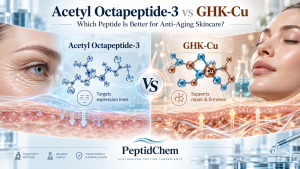
| Carrier peptides | Delivery or complexation of trace elements | Copper Tripeptide-1 / GHK-Cu |
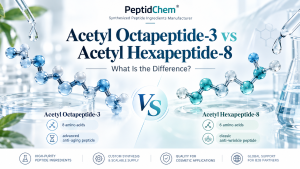
| Neurotransmitter-related peptides | Expression-line and smoothing concepts | Acetyl Hexapeptide-8 |
| Enzyme-modulating peptides | Protection-oriented anti-aging concepts | Various oligopeptides |
| Multifunctional peptides | Combined cosmetic benefits | Custom or modified peptide sequences |
Scientific reviews commonly classify cosmetic peptides into signal, carrier, enzyme-inhibitory and neurotransmitter-related groups.
This diversity is one reason peptide technology has become attractive to both formulators and brands.
Why Are Peptides Different From Traditional Anti-Aging Ingredients?
Changing the amino-acid sequence, terminal groups, lipid modification, molecular size or other structural characteristics can create peptides with substantially different physical and functional properties.For a Nonapeptide-1 Powder Bulk Supplier Manufacturer, this creates an important innovation opportunity: peptide ingredients can potentially be synthesized and optimized according to a client’s formulation and product-development objectives.This differs from established actives such as niacinamide or glycolic acid, where formulators generally work with an already-defined molecule.
Peptides can complement established skincare actives
An effective anti-aging formula does not necessarily require choosing between peptides and traditional ingredients.
Modern formulas may combine compatible ingredients to address different aspects of skin appearance.
For example:
Peptide + Hyaluronic Acid
A formulation may combine a peptide-centered anti-aging positioning with hydration. Reviews of topical hyaluronic acid support its role in improving hydration and visible skin quality.
Peptide + Niacinamide
This creates opportunities for products positioned around skin conditioning, barrier-focused care, tone and visible signs of aging.
Peptide + Vitamin C
The concept combines peptide technology with an established antioxidant ingredient. Topical vitamin C has been extensively investigated for skin applications, although formulation stability and delivery remain important considerations.
Peptide + Retinoid
This provides a route to multi-active anti-aging formulations, provided stability, compatibility, tolerability and finished-product performance are properly evaluated.
The innovation opportunity is therefore ingredient complementarity, not simply peptide-versus-retinol competition.
Cosmetic Peptides vs Retinol: Which Is Better?
Retinoids remain among the most extensively studied topical interventions for photoaged skin. Systematic-review evidence supports topical tretinoin for improvements in visible photoaging, including fine wrinkles.
However, tolerability can influence product design and consumer use.
Peptides provide formulators with another route for creating premium anti-aging products, particularly when the desired concept involves targeted cosmetic functionality, sophisticated ingredient storytelling, combination formulations or gentler product positioning.
| Feature | Cosmetic Peptides | Retinoids |
| Ingredient family | Very broad | Vitamin A derivatives |
| Structural customization | High | Relatively limited |
| Mechanism diversity | High | More established pathway |
| Anti-aging evidence | Growing; varies substantially by peptide | Strong, particularly for tretinoin |
| Formulation opportunity | High | High |
| Differentiation potential | Very high | Moderate |
| Irritation considerations | Depends on peptide/formulation | Retinoids may cause irritation |
| Custom synthesis opportunities | Yes | Limited |
Key takeaway: Retinoids have stronger historical clinical evidence, while peptides offer manufacturers a particularly attractive innovation and differentiation platform.
Cosmetic Peptides vs Vitamin C
Vitamin C is an established antioxidant ingredient with evidence supporting applications in photoaging and skin appearance.
Its challenges are different from those of peptides.
Formulation scientists must consider factors such as oxidation, ingredient form, pH, packaging and formulation environment.
Peptides introduce different formulation opportunities because different sequences or chemical modifications can be selected according to the desired product concept.
Rather than asking:
“Should we use vitamin C or peptides?”
A more useful formulation question is:
“What function should each active contribute to the finished product?”
This approach can lead to more differentiated multi-active skincare systems.
Cosmetic Peptides vs AHAs
AHAs such as glycolic acid and lactic acid are primarily associated with exfoliation and improvement in surface texture and photoaged appearance.
They remain useful cosmetic ingredients.
However, irritation and photosensitivity considerations can influence formulation strategy. FDA research reported that after four weeks of AHA application, participants showed an approximately 18% increase in sensitivity to UV-induced skin reddening, while sensitivity to UV-induced cellular damage approximately doubled on average.
Peptides represent a fundamentally different formulation category.
They enable brands to develop non-exfoliation-centered anti-aging concepts rather than relying only on acids to improve visible texture.
Cosmetic Peptides vs Hyaluronic Acid
Hyaluronic acid is highly valuable for hydration-focused products.
Scientific literature supports topical HA for improving skin hydration and visible signs associated with skin quality.
Peptides address a different formulation opportunity.
Where HA is primarily associated with hydration and plumping appearance, peptide ingredients allow brands to create additional positioning around firmness, smoothing, conditioning and age-support concepts.
Consequently, HA and peptides are often complementary rather than competing technologies.
What Does the Scientific Evidence Say About Peptides and Skin Aging?
The peptidchem category has generated significant scientific attention.
A systematic review and meta-analysis published in Frontiers in Medicine in March 2026 analyzed 19 randomized controlled trials and 1,341 participants.
The analysis reported:
- statistically significant overall wrinkle improvement, with a mean difference of 0.27;
- improvement in hydration;
- improvement in skin brightness;
- a near-significant reduction in roughness;
- minimal overall change in elasticity;
- no severe adverse events in the included trials.
However, an important qualification is necessary.
Seventeen studies investigated oral peptides and only two investigated topical peptides. The researchers also reported high heterogeneity among studies and warned that differences in peptide type, dosage and measurement methods limit definitive conclusions.
This distinction is commercially important.
A responsible cosmetic peptide supplier should not treat evidence for every peptide as interchangeable. Evidence should be evaluated at the individual ingredient, formulation and finished-product level.
Why Are Synthesized Peptides Important for Cosmetic Innovation?
Yes. Synthetic peptide technology can offer a high degree of control over molecular design.
Depending on the peptide and manufacturing process, synthesis can allow control over characteristics such as:
- amino-acid sequence;
- peptide length;
- terminal modification;
- acetylation or amidation;
- lipid modification such as palmitoylation;
- complexation;
- purity specification;
- batch characterization;
- scale required for R&D or commercial production.
For cosmetic brands, this creates an opportunity to move from using only conventional commodity ingredients toward more differentiated active systems.
For manufacturers, it creates a platform for both standard peptide production and potentially custom cosmetic peptide synthesis.
Why Is Peptide Modification Important?
One challenge associated with topical peptide development is delivery across the skin barrier.
For example, Cosmetic Ingredient Review documentation discussing Palmitoyl Pentapeptide-4 reports experimental evidence demonstrating differences between unmodified Pentapeptide-4 and its palmitoylated counterpart in skin retention and stability. The assessment also demonstrates why molecular characteristics and delivery should be considered rather than assuming all peptides behave identically.
This is why cosmetic peptide development increasingly involves more than simply selecting an amino-acid sequence.
Successful development may require consideration of:
sequence + modification + purity + vehicle + stability + delivery + finished-formulation testing.
That combination is where peptide formulation becomes a technology platform rather than simply another ingredient trend.
What Should Cosmetic Brands Look for in a Cosmetic Peptide Supplier?
Price per gram should not be the only criterion.
Professional buyers should evaluate whether a prospective cosmetic peptide supplier can provide appropriate technical and quality information.
1. Verified peptide identity
Ask for clearly specified:
INCI name, sequence, CAS information where applicable, molecular formula and molecular weight.
2. Analytical characterization
Depending on the peptide, appropriate documentation may include:
HPLC purity data, mass-spectrometry confirmation and a batch-specific Certificate of Analysis.
3. Consistent manufacturing
Commercial cosmetic development requires repeatable material specifications between development samples and subsequent production batches.
4. Technical documents
B2B purchasers frequently require documentation such as:
COA, TDS, SDS, specification sheets, storage recommendations and handling information.
Only list documents your organization actually provides.
5. Scalability
A supplier should be able to discuss requirements from laboratory evaluation through pilot quantities and commercial manufacturing.
6. Custom synthesis capability
For brands developing differentiated actives, ask whether the manufacturer can support:
custom sequences, purity requirements, peptide modifications and project-specific quantities.
7. Regulatory awareness
The supplier should understand the distinction between scientific mechanistic discussions and finished cosmetic claims.
This is particularly important in the United States. FDA notes that cosmetic products making claims about altering the structure or function of skin may move into drug-claim territory.
Why Work With Peptidchem as Your Cosmetic Peptide Supplier?
Peptidchem manufactures synthesized peptide ingredients for cosmetic and skincare product development.
Our focus is supporting formulators, cosmetic brands, laboratories and ingredient distributors seeking reliable peptide raw materials for innovative skincare concepts.
Our Cosmetic Peptide Solutions
- Synthesized cosmetic peptide ingredients
- Anti-aging peptide raw materials
- Signal peptides
- Carrier peptides
- Palmitoylated peptides
- Acetylated peptides
- Copper peptide ingredients
- Custom peptide synthesis
- R&D quantities
- Commercial bulk quantities
- Technical documentation according to available product specifications
Important: Retain only capabilities your company can document.
Also See
How Skincare Brands Evaluate Cosmetic Peptide Suppliers: Purity, COA, Testing, and Traceability
Bulk Cosmetic Peptides: A Sourcing Guide for Skincare Manufacturers and Private Label Brands
From Laboratory to Skincare Bottle: How Cosmetic Peptide Manufacturers Create Premium Ingredients
FAQs:
Q1:What are cosmetic peptides?
Cosmetic peptides are short amino-acid sequences incorporated into skincare and personal-care formulations. Different peptide classes may be used in products targeting hydration, conditioning, smoother-looking skin, firmness and other visible signs associated with skin aging.
Q2:Are synthetic peptides suitable for cosmetic formulations?
Synthetic peptides are widely used in cosmetic research and formulation. Suitability depends on the specific peptide, purity, concentration, formulation system, stability, intended market and finished-product safety assessment.
Q3:Are peptides better than retinol?
Not universally. Retinoids, particularly tretinoin, have extensive clinical evidence for photoaging. Peptides offer different benefits from a formulation-development perspective, including molecular diversity, customization and opportunities for multi-active formulations.
Q4:Can cosmetic peptides be used with hyaluronic acid?
Many skincare concepts combine peptides with hydrating ingredients such as hyaluronic acid. Actual compatibility and stability should be confirmed in the finished formulation.
Q5:Can peptides be formulated with vitamin C?
Potentially, but compatibility depends on the exact peptide, vitamin C derivative, formulation pH, solvent system and storage conditions. Formulators should perform appropriate stability and compatibility testing.
Q6:Which peptides are commonly used in anti-aging cosmetics?
Frequently discussed cosmetic peptides include Palmitoyl Pentapeptide-4, Palmitoyl Tripeptide-1, Palmitoyl Tetrapeptide-7, Acetyl Hexapeptide-8 and Copper Tripeptide-1. Each peptide has different characteristics and should be evaluated individually.
References
Nukaly HY, et al. Oral and topical peptides for skin aging: systematic review and meta-analysis of randomized controlled trials. Frontiers in Medicine. 2026;13. The analysis included 19 randomized controlled trials and 1,341 participants and emphasized both promising findings and limitations of the topical evidence base.
Pintea A, et al. Peptides: Emerging Candidates for the Prevention and Treatment of Skin Aging. 2025. Reviews cosmetic peptide classes and their application to skin-aging research.
Van Walraven N, et al. Bioactive peptides in cosmetic formulations: Review of efficacy and safety for skin-aging applications. International Journal of Cosmetic Science. 2025.
Schagen SK. Topical Peptide Treatments with Effective Anti-Aging Results. Cosmetics. 2017;4(2):16.
Cosmetic Ingredient Review. Safety Assessment of Myristoyl Pentapeptide-4, Palmitoyl Pentapeptide-4 and Pentapeptide-4 as Used in Cosmetics. Provides safety, exposure, stability and penetration information relevant to these peptide ingredients.
Sitohang IBS, et al. Topical tretinoin for treating photoaging: A systematic review of randomized controlled trials. 2022.
Al-Niaimi F, Chiang NYZ. Topical Vitamin C and the Skin: Mechanisms of Action and Clinical Applications. 2017.
Bravo B, et al. Benefits of topical hyaluronic acid for skin quality and signs of skin aging. Literature review and clinical evidence.
U.S. Food and Drug Administration. Alpha Hydroxy Acids. FDA reports increased UV sensitivity associated with AHA use in its studies.
U.S. Food and Drug Administration. Wrinkle Treatments and Other Anti-aging Products. Provides regulatory guidance concerning cosmetic versus drug claims.