





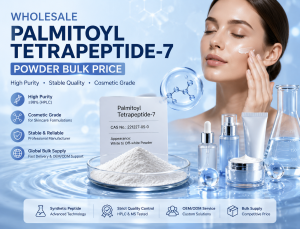
Looking for Palmitoyl Tetrapeptide-7 powder in bulk? Discover cosmetic-grade Palmitoyl Tetrapeptide-7, supplier specifications, applications, quality control, bulk pricing factors, and synthetic peptide manufacturing.
Palmitoyl Tetrapeptide-7 Powder Bulk Price: What Should Cosmetic Manufacturers Know?
Palmitoyl Tetrapeptide-7is a synthetic lipopeptide used in advanced skincare formulations, particularly anti-aging, firming, and skin-conditioning products.
For cosmetic brands, ingredient distributors, laboratories, and contract manufacturers, purchasing Palmitoyl Tetrapeptide-7 in bulk requires more than comparing the lowest price per kilogram. Peptide purity, analytical specifications, manufacturing capability, packaging, batch consistency, quantity, and documentation can all influence the final bulk price.This guide explains what Palmitoyl Tetrapeptide-7 is, how it is used in cosmetics, what buyers should look for when selecting a supplier, and which factors determine the wholesale price of Palmitoyl Tetrapeptide-7 powder.
What Is Palmitoyl Tetrapeptide-7?
Palmitoyl Tetrapeptide-7 is a synthetic cosmetic peptide consisting of a tetrapeptide sequence linked to palmitic acid.It is commonly known as Pal-GQPR and is used as a skin-conditioning ingredient in cosmetic formulations.
The palmitoyl group increases the lipophilic character of the peptide and is an important feature of this class of cosmetic lipopeptides.
Palmitoyl Tetrapeptide-7 has a long history in peptide-based skincare and is particularly associated with formulations designed to address the appearance of wrinkles, loss of firmness, uneven skin texture, and visible signs of skin aging.
Quick Product Overview
| Property | Palmitoyl Tetrapeptide-7 |
|---|---|
| INCI Name | Palmitoyl Tetrapeptide-7 |
| Common Name | Pal-GQPR |
| Ingredient Type | Synthetic lipopeptide |
| Peptide Length | Tetrapeptide |
| Cosmetic Category | Skin-conditioning peptide |
| Common Positioning | Anti-aging and firming skincare |
| Typical Applications | Serums, creams, eye care, masks |
| Supply Form | Depends on supplier specification |
| B2B Availability | Sample, pilot and bulk supply |
Important: The exact assay, appearance, carrier system, storage conditions, and specification should always be confirmed from the supplier’s current product specification and Certificate of Analysis (COA).
Why Is Palmitoyl Tetrapeptide-7 Used in Skincare?
The peptidchem is widely used because of its association with cell-signaling and extracellular-matrix-related cosmetic mechanisms.
Research on cosmetic peptides has investigated Palmitoyl Tetrapeptide-7 in relation to inflammatory signaling and extracellular-matrix preservation. This makes it particularly interesting for formulations targeting the visible effects associated with skin aging.
In finished skincare products, it is commonly positioned for:
- Wrinkle-care formulas
- Firming skincare
- Mature-skin products
- Anti-aging serums
- Eye creams
- Facial creams
- Neck and décolleté products
- Professional skincare formulas
The ingredient should be marketed as a cosmetic skin-conditioning active, rather than as a pharmaceutical treatment.
How Does Palmitoyl Tetrapeptide-7 Work in Cosmetic Formulations?
Palmitoyl Tetrapeptide-7 is generally discussed as a signaling peptide that can interact with biological pathways relevant to skin appearance.
Cosmetic peptide research has focused on its relationship with inflammatory signaling and extracellular-matrix processes.
For formulation developers, the key value is therefore not simply the peptide sequence itself but its role as part of a broader multi-active anti-aging formulation strategy.
A modern peptide serum may combine Palmitoyl Tetrapeptide-7 with:
- Palmitoyl Tripeptide-1
- Hyaluronic acid
- Niacinamide
- Ceramides
- Antioxidants
- Other signal peptides
- Moisturizing ingredients
- Barrier-support ingredients
This allows formulators to address multiple cosmetic skin concerns within one product.
What Is the Relationship Between Palmitoyl Tetrapeptide-7 and Palmitoyl Tripeptide-1?
Palmitoyl Tetrapeptide-7 and Palmitoyl Tripeptide-1 are different peptides, but they are frequently discussed together in advanced anti-aging skincare.
Palmitoyl Tripeptide-1 is commonly known as Pal-GHK, while Palmitoyl Tetrapeptide-7 is commonly known as Pal-GQPR.
Their complementary positioning has contributed to their popularity in peptide-based skincare.
| Ingredient | Common Name | Main Cosmetic Positioning |
| Palmitoyl Tripeptide-1 | Pal-GHK | ECM and collagen-related signaling |
| Palmitoyl Tetrapeptide-7 | Pal-GQPR | Inflammatory signaling and skin conditioning |
The two ingredients are therefore complementary rather than interchangeable.
Is Palmitoyl Tetrapeptide-7 the Same as Matrixyl® 3000?
This distinction is important for B2B purchasing.
Palmitoyl Tetrapeptide-7 is an individual cosmetic peptide ingredient.
Palmitoyl Tripeptide-1 is another individual cosmetic peptide ingredient.
Matrixyl® 3000 is a branded ingredient system associated with a combination of Palmitoyl Tripeptide-1 and Palmitoyl Tetrapeptide-7 in a specific formulation/carrier system.
Therefore, buyers comparing products from different suppliers should examine:
- Actual INCI composition
- Peptide concentration
- Active content
- Carrier ingredients
- Assay method
- HPLC results
- Molecular-weight confirmation
- Storage requirements
- Packaging
- Batch documentation
Do not compare two products solely by their commercial names.
What Are the Cosmetic Benefits of Palmitoyl Tetrapeptide-7?
Palmitoyl Tetrapeptide-7 is commonly selected by cosmetic formulators for products targeting the visible appearance of aging.
1. Anti-wrinkle skincare
It can be incorporated into formulations designed to improve the appearance of fine lines and wrinkles.
2. Firming formulations
It is suitable for skincare concepts focused on firmer-looking and more resilient skin.
3. Mature-skin products
Peptide ingredients are frequently incorporated into premium mature-skin formulations because extracellular-matrix changes are closely associated with visible skin aging.
4. Skin texture
Palmitoyl Tetrapeptide-7 can be used as part of a broader formulation designed to improve overall skin appearance and smoothness.
5. Premium peptide products
Its established use in peptide-based skincare makes it suitable for premium serums, creams, eye products, and professional cosmetic formulations.
What Skincare Products Use Palmitoyl Tetrapeptide-7?
A Palmitoyl Tetrapeptide-7 supplier may supply the ingredient for several cosmetic product categories.
Anti-Aging Serum
Peptide serums are one of the most common applications for high-value cosmetic peptides.
Firming Cream
Palmitoyl Tetrapeptide-7 can be incorporated into facial creams targeting mature and aging skin.
Eye Cream
The peptide can be considered for eye-area formulations targeting the visible appearance of fine lines and skin texture.
Neck Cream
Premium neck and décolleté products can incorporate peptide actives as part of a firming skincare concept.
Facial Mask
Peptide ingredients can also be used in leave-on and mask-type skincare systems.
Professional Skincare
Cosmetic peptides are increasingly used in professional and premium skincare formulations.
Why Buy Palmitoyl Tetrapeptide-7 Powder in Bulk?
For skincare manufacturers and distributors, bulk Palmitoyl Tetrapeptide-7 purchasing can provide advantages when the ingredient is required for commercial production.
Bulk sourcing can support:
- Lower cost per unit at larger quantities
- More predictable production planning
- Consistent raw-material supply
- Reduced purchasing frequency
- Long-term formulation continuity
- Private-label and contract-manufacturing projects
- Distributor inventory management
However, the lowest quoted price is not necessarily the lowest total cost of ownership.
A supplier offering a lower price but inconsistent batches, inadequate documentation, or long lead times can create additional costs during formulation and production.
What Determines Palmitoyl Tetrapeptide-7 Bulk Price?
The wholesale price of Palmitoyl Tetrapeptide-7 can vary significantly depending on several factors.
1. Order Quantity
Larger commercial orders may receive different pricing from laboratory-scale purchases.
2. Purity Specification
Higher purity specifications can require additional purification and analytical testing.
3. Production Scale
Manufacturing economics generally change between R&D, pilot, and commercial-scale production.
4. Packaging
Packaging requirements can influence the final quotation.
5. Analytical Testing
Additional testing requirements can increase production and quality-control costs.
6. Custom Requirements
Special purity, particle-size, packaging, documentation, or formulation requirements may affect pricing.
7. Shipping Destination
International freight, customs documentation, and delivery terms can affect the landed cost.
8. Supply Agreement
Long-term purchasing agreements may receive different commercial terms from one-time orders.
How Can I Get a Palmitoyl Tetrapeptide-7 Bulk Price?
Because cosmetic peptide prices depend on purity, quantity, specification, packaging, and destination, a professional supplier should provide a quotation based on the buyer’s actual requirements.
For an accurate quotation, provide:
Product: Palmitoyl Tetrapeptide-7
Required purity: Your target specification
Quantity: g / kg / commercial batch
Application: Cosmetic / skincare
Packaging: Required package size
Destination: Country or region
Documentation: COA / SDS / technical documents required
This approach allows the supplier to provide a more accurate Palmitoyl Tetrapeptide-7 powder bulk price rather than an unreliable generic price.
What Should I Check Before Choosing a Palmitoyl Tetrapeptide-7 Supplier?
Choosing the right cosmetic peptide supplier is critical for commercial skincare manufacturing.
Quality Control
Ask for analytical documentation such as:
- COA
- HPLC analysis
- Molecular-weight confirmation
- Appearance specification
- Purity specification
- Residual-solvent information where applicable
- Heavy-metal testing where applicable
- Microbiological specifications where applicable
Manufacturing Capability
Confirm whether the company is:
- A direct manufacturer
- A specialized synthetic peptide producer
- A distributor
- A trading company
For long-term B2B supply, direct manufacturing capability can provide greater control over production and quality.
Batch Consistency
Ask whether the supplier can provide consistent specifications across multiple production batches.
Technical Support
A strong supplier should be able to answer questions regarding:
- Solubility
- Recommended processing
- Storage
- Stability
- Compatibility
- Packaging
- Analytical testing
Supply Capacity
For commercial skincare production, confirm whether the supplier can support your expected annual demand.
Why Choose a Synthetic Peptide Manufacturer?
A specialized synthetic peptide manufacturer can provide more than a finished raw material.
Synthetic peptide production can offer:
Controlled synthesis
Peptide sequences and chemical modifications can be produced using controlled synthesis processes.
Purification
Purification procedures can be used to achieve the required specification.
Analytical verification
Analytical methods such as HPLC and mass spectrometry can be used for identity and quality evaluation.
Scalable production
A manufacturer may support the transition from laboratory samples to commercial-scale orders.
Custom peptide synthesis
Specialized peptide manufacturers may also support customized sequences and peptide modifications according to project requirements.
Palmitoyl Tetrapeptide-7 Quality Checklist for B2B Buyers
Before purchasing bulk cosmetic peptide powder, use the following checklist:
| Buyer Requirement | What to Confirm |
| Product identity | Correct INCI name and peptide identity |
| Purity | Supplier specification and COA |
| Testing | HPLC / MS or applicable analytical methods |
| Appearance | White/off-white powder or supplier specification |
| Batch consistency | Lot-to-lot quality |
| Packaging | Suitable for storage and transport |
| Storage | Supplier’s recommended conditions |
| Documentation | COA, SDS, specification sheet |
| Supply | Sample, pilot and bulk availability |
| Customization | Custom synthesis if required |
| Shipping | Export and logistics capability |
| Technical support | Formulation and product information |
How to Store Palmitoyl Tetrapeptide-7 Powder?
Storage requirements should always follow the supplier’s official specification.
For peptide raw materials, buyers should generally pay attention to:
- Temperature
- Humidity
- Light exposure
- Container closure
- Repeated opening
- Storage duration
- Transportation conditions
For commercial manufacturing, the supplier should provide specific storage recommendations on the technical documentation and product label.
Can Palmitoyl Tetrapeptide-7 Be Used With Other Peptides?
Yes. It can be considered as part of a multi-peptide cosmetic formulation.
Potential peptide combinations include:
- Palmitoyl Tripeptide-1
- Palmitoyl Tripeptide-5
- Acetyl Hexapeptide-8
- Palmitoyl Tripeptide-38
- Copper Tripeptide-1
- Other signal peptides
The appropriate combination depends on the formulation objective, regulatory requirements, compatibility, stability, and target consumer positioning.
What Is the Difference Between Cosmetic Peptides and Pharmaceutical Peptides?
This distinction matters when purchasing peptide raw materials.
Cosmetic peptides are developed and supplied for cosmetic applications such as skin conditioning and appearance-related benefits.
Pharmaceutical peptides are developed under substantially different regulatory and manufacturing requirements for therapeutic applications.
A cosmetic peptide supplier should therefore provide documentation and specifications appropriate to the intended cosmetic use.
Why Choose Us as Your Cosmetic Peptide Supplier?
We specialize in the manufacturing of synthetic peptide ingredients for B2B customers developing cosmetic, skincare, and other high-value formulations.
Our focus is on providing reliable peptide raw materials supported by appropriate quality-control and technical documentation.
Our capabilities can support:
- Synthetic cosmetic peptide manufacturing
- Palmitoyl Tetrapeptide-7 supply
- Palmitoyl Tripeptide-1 supply
- Bulk cosmetic peptide ingredients
- High-purity peptide raw materials
- Custom peptide synthesis
- R&D samples
- Pilot-scale supply
- Commercial bulk orders
- Technical documentation
- International B2B supply
Whether you are developing a new anti-aging serum, sourcing raw materials for a private-label skincare line, or purchasing ingredients for commercial manufacturing, selecting a dependable synthetic peptide supplier can help maintain product consistency from R&D through production.📩 Contact us to request a quotation or discuss your specific requirements. Let’s build a strong partnership supply for your anti-aging cosmetics product line.
Also See
What Is Palmitoyl Pentapeptide-4 Powder and Why Is It Used in Advanced Anti-Aging Skincare
How Does Palmitoyl Pentapeptide-4 Support Collagen Synthesis and Wrinkle Reduction Formulas
Why Are Skincare Brands Choosing Palmitoyl Pentapeptide-4 Powder for Premium Peptide Products
FAQs:
Q:1What is Palmitoyl Tetrapeptide-7?
Palmitoyl Tetrapeptide-7 is a synthetic lipidated tetrapeptide, commonly known as Pal-GQPR, used in cosmetic skincare formulations.
Q2:What is Palmitoyl Tetrapeptide-7 used for?
It is commonly used in anti-aging, firming, wrinkle-care, eye-care, and skin-conditioning cosmetic formulations.
Q3:Is Palmitoyl Tetrapeptide-7 synthetic?
Yes. It is a synthetic cosmetic peptide.
Q4:Is Palmitoyl Tetrapeptide-7 a signal peptide?
It is commonly categorized within cosmetic peptide literature as a signaling/lipopeptide associated with skin and extracellular-matrix-related pathways.
Q5:What is Pal-GQPR?
Pal-GQPR is a common designation for Palmitoyl Tetrapeptide-7.
Q6:What is the difference between Pal-GQPR and Pal-GHK?
Pal-GQPR refers to Palmitoyl Tetrapeptide-7, while Pal-GHK refers to Palmitoyl Tripeptide-1. They are different synthetic lipopeptides.
Q7:Can I buy Palmitoyl Tetrapeptide-7 powder in bulk?
Yes. Bulk supply depends on the manufacturer’s available specifications, production capacity, quantity, and commercial terms.
References
Cosmetic Ingredient Review (CIR) — Safety assessment information covering peptide-derived cosmetic ingredients, including Palmitoyl Tetrapeptide-7 and Palmitoyl Tripeptide-
European Commission CosIng — European cosmetic ingredient database and ingredient-name information.
Skin Health and Disease / Oxford Academic — Peer-reviewed review literature discussing cosmetic peptides and anti-aging ingredients.
PubMed / National Library of Medicine — Published clinical and scientific literature concerning peptide-containing cosmetic formulations.
Peer-reviewed cosmetic dermatology literature — Clinical investigations of multi-peptide topical formulations containing Palmitoyl Tripeptide-1 and Palmitoyl Tetrapeptide-7.