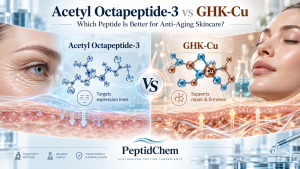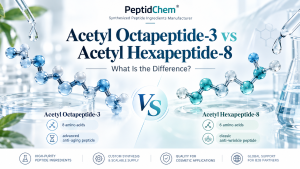






Discover how palmitoyl and acetyl peptides are used in anti-aging skincare. Explore applications, formulation considerations, and how to choose a reliable cosmetic peptide supplier.
What Are Anti-Aging Peptides?
Unlike conventional moisturizing ingredients, cosmetic peptides can be designed for different functional roles, including signal peptides, neurotransmitter-related peptides, carrier peptides, and enzyme-inhibitory peptides.Among the most commercially important categories are palmitoyl Oligopeptide Powder and acetyl peptides.Palmitoyl peptides combine a peptide sequence with a fatty-acid component such as palmitic acid. This modification can increase lipophilicity and may improve compatibility with the skin’s lipid environment. A recent review describes palmitoyl pentapeptide-4 (Pal-KTTKS) as a widely used anti-aging cosmetic ingredient and summarizes clinical evidence involving 93 women aged 35–55 over 12 weeks.Acetyl peptides represent another important group. Acetyl Hexapeptide-8, for example, is widely investigated for cosmetic applications involving the appearance of expression lines and wrinkles. Recent clinical research has continued to investigate formulations containing this peptide.For brands and formulators, understanding the differences between these peptide families is important when selecting cosmetic peptide ingredients for serums, creams, eye products, masks, and other leave-on formulations.
How Do Palmitoyl Peptides Work in Anti-Aging Skincare?
Palmitoyl peptides are generally associated with signal-peptide approaches to cosmetic skin care.
A typical palmitoyl peptide contains:
- A short amino-acid sequence
- A palmitoyl or other lipid component
- A structure designed for cosmetic formulation
- A specific functional target depending on the peptide sequence
The lipid modification is particularly important because peptide chemistry can influence solubility, stability, formulation compatibility, and interaction with the skin surface.
Which Palmitoyl Peptides Are Commonly Used?
Several palmitoyl peptide ingredients have become important in cosmetic formulation, including:
| Peptide | Common Cosmetic Application |
|---|---|
| Palmitoyl Tripeptide-1 | Firming and skin-conditioning formulations |
| Palmitoyl Tetrapeptide-7 | Anti-aging and skin-conditioning formulas |
| Palmitoyl Pentapeptide-4 | Fine-line and skin-smoothing formulations |
| Palmitoyl Tripeptide-38 | Advanced anti-aging and wrinkle-care formulations |
| Palmitoyl Tripeptide-5 | Firming and skin-conditioning applications |
Palmitoyl pentapeptide-4 is one of the better-known examples. A review of cosmetic peptide research reports clinical studies in which formulations containing Pal-KTTKS were associated with improvements in the appearance of fine wrinkles and skin texture.
For B2B formulators, the key consideration is not simply whether a peptide is called “anti-aging,” but whether its sequence, purity, stability, formulation compatibility, and supporting evidence fit the intended finished product.
What Are Acetyl Peptides?
Acetyl peptides are peptides modified with an acetyl group. This chemical modification can influence the properties of the peptide and its suitability for cosmetic formulations.
One of the best-known examples is Acetyl Hexapeptide-8, also known as Argireline in commercial contexts.
It is commonly incorporated into:
- Anti-aging serums
- Eye creams
- Facial creams
- Expression-line care products
- Premium cosmetic formulations
- Multi-peptide skin-care systems
Clinical research has investigated Acetyl Hexapeptide-8 in different delivery systems. In one randomized, double-blind, split-face study involving 52 Korean women, a cross-linked hyaluronic-acid microneedle patch containing Acetyl Hexapeptide-8 showed statistically significant improvements in wrinkle measurements compared with the patch alone.
A newer 2026 study also evaluated a serum containing Acetyl Hexapeptide-8 together with other cosmetic actives in ex-vivo and clinical studies. The study included clinical groups of 50 and 42 participants and reported improvements in measured wrinkle-related outcomes over 12 weeks. Because the formula contained multiple active ingredients, these results should not be interpreted as evidence that Acetyl Hexapeptide-8 alone produced all observed effects.
Palmitoyl Peptides vs. Acetyl Peptides: What Is the Difference?
The simplest way to distinguish them is by their chemical modification and intended functional positioning.
| Feature | Palmitoyl Peptides | Acetyl Peptides |
| Modification | Palmitoyl/lipid group | Acetyl group |
| Typical positioning | Signal and skin-conditioning applications | Expression-line and skin-conditioning applications |
| Representative ingredients | Palmitoyl Tripeptide-1, Palmitoyl Pentapeptide-4 | Acetyl Hexapeptide-8 |
| Typical products | Serums, creams, moisturizers | Serums, eye products, creams |
| Formulation focus | Solubility, lipid compatibility, stability | Stability, concentration, delivery system |
| B2B demand | High in anti-aging active systems | High in wrinkle-focused formulations |
There is no single “best” peptide for every anti-aging formula. The appropriate ingredient depends on the target claim, formulation system, peptide concentration, stability requirements, regulatory market, and available substantiation.
What Are the Main Applications of Cosmetic Anti-Aging Peptides?
1. Anti-Aging Serums
Serums are one of the most suitable delivery formats for peptide-based cosmetic actives because formulators can develop concentrated leave-on systems around peptides, humectants, antioxidants, and other skin-conditioning ingredients.
Common combinations include:
- Peptides + hyaluronic acid
- Peptides + niacinamide
- Peptides + antioxidants
- Multiple signal peptides
- Palmitoyl peptides + acetyl peptides
2. Eye-Care Products
Eye creams and serums frequently use peptides in formulations designed for the appearance of fine lines and uneven texture.
Acetyl Hexapeptide-8 is particularly relevant to products positioned around expression-line appearance.
3. Firming Creams
Palmitoyl peptides are commonly incorporated into moisturizers and firming creams designed to improve the appearance of skin smoothness and firmness.
4. Multi-Peptide Formulations
Advanced cosmetic products may combine several peptide classes rather than relying on a single ingredient.
For example, a formulation may combine:
Signal peptide + acetyl peptide + moisturizing system + antioxidant system
This allows formulators to target several cosmetic concerns within one finished product.
5. Professional and Advanced Delivery Systems
Peptides are also being investigated in advanced delivery formats, including hydrogel systems, microneedle patches, and other technologies designed to improve topical delivery.
Clinical research on an Acetyl Hexapeptide-8-containing microneedle system illustrates how peptide ingredients can be integrated into more advanced cosmetic delivery platforms.
How Should Brands Choose a Cosmetic Peptide Supplier?
Choosing a cosmetic peptide supplier requires more than comparing price per kilogram.
For B2B buyers, evaluate at least these factors:
1. Peptide Identity
The supplier should clearly specify:
- Peptide name
- Sequence where applicable
- INCI name
- CAS number where applicable
- Molecular weight
- Chemical modification
- Product form
2. Purity
High-purity peptide raw materials are important for formulation consistency and quality control.
Ask suppliers for appropriate analytical documentation, such as:
- HPLC analysis
- LC-MS or MS confirmation
- Purity specification
- Batch number
- Certificate of Analysis (CoA)
3. Manufacturing Capability
A manufacturer with in-house or controlled synthesis capabilities can provide better technical communication and greater consistency than a trading company that only resells peptide materials.
4. Batch-to-Batch Consistency
For commercial skincare production, consistent peptide quality is critical because changes in purity, residual solvents, water content, or physical properties can affect formulation development.
5. Custom Synthesis Capability
Brands developing proprietary formulas may require:
- Custom peptide sequences
- Modified peptide structures
- Customized specifications
- Pilot batches
- Scale-up manufacturing
- Technical documentation
This is particularly important when the peptide is being developed as a differentiated cosmetic active rather than a standard commodity ingredient.
Why Work With a Synthesized Peptide Ingredient Manufacturer?
Our company focuses primarily on the manufacture of synthesized peptide ingredients for cosmetic and formulation applications.
Rather than positioning peptides only as finished skincare products, our business model is centered on supplying peptide raw materials to B2B customers that need reliable ingredient sourcing.
Our Core Manufacturing Focus
Synthesized peptide ingredients
Our capabilities can support customers looking for:
- Cosmetic-grade peptide raw materials
- Palmitoyl peptide ingredients
- Acetyl peptide ingredients
- Custom synthesized peptides
- Bulk peptide ingredients
- Peptide formulation development materials
- Technical documentation
- B2B ingredient sourcing
- Scalable peptide manufacturing
Why B2B Buyers Need a Specialized Peptide Manufacturer
A specialized manufacturer can help customers move from:
Peptide concept → laboratory sample → formulation development → pilot production → commercial-scale supply
This is especially valuable for skincare brands, cosmetic manufacturers, ingredient distributors, laboratories, and R&D teams developing peptide-based formulations.
If you are sourcing cosmetic peptides in bulk or developing a new peptide-based skincare formula, our synthesized peptide ingredient manufacturing capability can provide a direct B2B supply route.
What Quality Documents Should a Cosmetic Peptide Supplier Provide?
Before purchasing cosmetic peptide raw materials, buyers should request appropriate documentation based on the destination market and intended application.
Typical technical documents may include:
| Document | Purpose |
| Certificate of Analysis (CoA) | Confirms batch specifications |
| HPLC data | Supports purity assessment |
| LC-MS/MS or MS data | Supports molecular identity |
| Specification sheet | Defines product quality parameters |
| SDS | Supports safe handling and transportation |
| Residual solvent data | Supports quality evaluation |
| Heavy-metal testing | Supports raw-material quality control |
| Microbiological testing | Relevant where applicable |
| Stability information | Supports formulation and storage decisions |
| Regulatory documentation | Supports market-specific compliance |
The exact documentation required depends on the ingredient, formulation, destination country, and customer’s regulatory requirements.
What Does the Research Say About Cosmetic Peptide Performance?
The evidence base is growing, but peptide claims should be interpreted carefully.
A review published in Current Approaches in Cosmeceuticals summarizes research on palmitoyl peptides and reports clinical investigations involving Pal-KTTKS-containing formulations.
For Acetyl Hexapeptide-8, a randomized controlled study involving 52 Korean women found that a microneedle patch containing the peptide showed greater wrinkle improvement than the patch alone, although the delivery platform itself was also part of the intervention.
A 2026 clinical and ex-vivo study investigated Acetyl Hexapeptide-8 in a multi-active serum and reported improvements in several wrinkle-related outcomes over 12 weeks. Again, because the formula contained multiple actives, the findings should be considered evidence for the finished formulation, rather than attributed exclusively to one peptide.
This distinction is important for responsible B2B marketing: ingredient research, formulation research, and finished-product clinical evidence are not interchangeable.
Are Anti-Aging Peptides Safe for Cosmetic Formulations?
Safety depends on the specific peptide, purity, concentration, formulation, route of use, and applicable regulatory requirements.
For example, the Cosmetic Ingredient Review Expert Panel recently assessed Acetyl Hexapeptide-8 Amide and concluded that it is safe in cosmetics at concentrations up to 0.005% under the practices of use evaluated by the Panel; the available data were considered insufficient to determine safety at concentrations above 0.005%.
Therefore, manufacturers should not automatically apply one peptide’s safety data or use level to another peptide.
Always formulate according to the supplier’s specification, available safety data, applicable cosmetic regulations, and the requirements of the target market.
What Claims Can Cosmetic Peptide Products Make?
This is an important issue for international brands.
In the United States, FDA explains that cosmetic claims must be truthful and not misleading. Products marketed with claims intended to affect the structure or function of the body may fall under drug regulation rather than ordinary cosmetic regulation.
For example, cosmetic marketing is generally safer when it focuses on appearance-related language such as:
- “Helps improve the appearance of fine lines”
- “Supports a smoother-looking complexion”
- “Helps skin appear firmer”
- “Skin-conditioning peptide”
- “Designed for anti-aging skincare formulations”
Manufacturers should be cautious with unqualified claims such as “removes wrinkles,” “stimulates collagen production in the skin,” or other claims that imply modification of skin structure or biological function. FDA specifically notes that some wrinkle and anti-aging claims can cause a cosmetic product to be regulated as a drug.
For global products, brands should also review the rules applicable to the European Union, United States, China, Japan, and other target markets before publishing final claims.
How Can Brands Buy Cosmetic Peptides in Bulk?
When sourcing bulk cosmetic peptide ingredients, the purchasing process should begin with technical requirements rather than price alone.
Step 1: Define the Peptide
Specify:
- Peptide name
- Sequence
- Modification
- Purity requirement
- Intended cosmetic application
Step 2: Request a Sample
Evaluate the material through your own laboratory or formulation team.
Step 3: Review Analytical Documentation
Compare the sample with:
- CoA
- HPLC
- MS data
- Specification sheet
- SDS
Step 4: Conduct Formulation Testing
Evaluate:
- Solubility
- pH compatibility
- Temperature stability
- Compatibility with other actives
- Appearance
- Odor
- Storage stability
Step 5: Confirm Commercial Supply
Once the ingredient passes technical evaluation, discuss:
- MOQ
- Packaging
- Lead time
- Production capacity
- Batch specifications
- Shipping requirements
- Long-term supply agreements
For brands that need repeated supply, establishing specifications before commercial purchasing can help minimize batch-to-batch variability.
Why Are Synthesized Peptide Ingredients Important for the Future of Skincare?
The development of cosmetic peptides is moving toward increasingly specific structures and functions.
Instead of treating “peptides” as one ingredient category, formulators can select different sequences and modifications for different product concepts.
This creates opportunities for:
- Targeted anti-aging formulations
- Multi-peptide systems
- Customized peptide sequences
- Advanced delivery technologies
- Premium cosmetic actives
- Evidence-based formulation development
- Proprietary skincare concepts
For ingredient manufacturers, this means that synthesis capability, analytical control, scalability, and technical support are becoming increasingly important.
Our focus on synthesized peptide ingredients allows us to support B2B customers seeking peptide raw materials for the development of next-generation cosmetic formulations.📩 Contact us to request a quotation or discuss your specific requirements. Let’s build a strong partnership supply for your anti-aging cosmetics product line.
Also See
Inside Cosmetic Peptide Manufacturing: Production Process, Quality Control, and Industry Standards
Why Are Skincare Brands Choosing Palmitoyl Tetrapeptide-7 Powder for Premium Anti-Aging Products
FAQs:
Q1:What are the best anti-aging peptides?
There is no single best peptide for every formulation. Palmitoyl peptides are commonly selected for signal-peptide and skin-conditioning applications, while acetyl peptides such as Acetyl Hexapeptide-8 are widely investigated for expression-line and wrinkle-appearance applications.
Q2:What is the difference between palmitoyl peptides and acetyl peptides?
Palmitoyl peptides contain a palmitoyl or lipid modification, while acetyl peptides contain an acetyl modification. These chemical changes affect the physicochemical properties and formulation behavior of the peptide.
Q3:Is Palmitoyl Tripeptide-1 suitable for skincare?
Palmitoyl Tripeptide-1 is widely used as a cosmetic skin-conditioning peptide and is commonly incorporated into anti-aging formulations.
Q4:What is Acetyl Hexapeptide-8 used for?
Acetyl Hexapeptide-8 is used in cosmetic formulations, particularly products positioned around the appearance of expression lines and wrinkles. Clinical studies have investigated its use in topical and advanced delivery systems.
Q5:Can palmitoyl and acetyl peptides be used together?
They can be incorporated into the same multi-peptide formulation when their individual specifications, concentrations, pH requirements, stability, and compatibility have been evaluated.
Q6:How do I choose a cosmetic peptide supplier?
Look for a manufacturer that can demonstrate peptide identity, purity, analytical testing, batch consistency, technical documentation, manufacturing capacity, and appropriate regulatory support.
Q7:Can I buy synthesized peptide ingredients in bulk?
Yes. B2B cosmetic ingredient manufacturers can supply peptide raw materials in different quantities depending on the peptide, specification, production scale, and commercial requirements.
References
Snyder, P. W., Fiume, M. M., Heldreth, B., et al. (2025). Safety Assessment of Acetyl Hexapeptide-8 Amide as Used in Cosmetics. International Journal of Toxicology.
Zhu, M., He, X., Zhu, Z., et al. (2026). The effect of a serum containing acetyl hexapeptide-8, dipeptide diaminobutyroyl benzylamide diacetate and gluconolactone on skin biomarkers, wrinkles and skin texture: Ex vivo and clinical studies. International Journal of Cosmetic Science. DOI: 10.1111/ics.70087.
Park, K. Y., et al. Anti-Wrinkle Efficacy of Cross-Linked Hyaluronic Acid-Based Microneedle Patch with Acetyl Hexapeptide-8 and Epidermal Growth Factor on Korean Skin. Annals of Dermatology.
Current Approaches in Cosmeceuticals: Peptides, Biotics and Marine Biopolymers. Review of cosmetic peptide technologies and applications.
U.S. Food and Drug Administration. Cosmetics Labeling Claims. FDA guidance concerning cosmetic claims and the distinction between cosmetics and drugs.
U.S. Food and Drug Administration. Wrinkle Treatments and Other Anti-aging Products. Guidance concerning anti-aging and wrinkle-related cosmetic claims.
U.S. Food and Drug Administration. “Cosmeceutical”. Explanation of the regulatory status of the term “cosmeceutical.”