



Discover how cosmetic brands use D-Panthenol Powder in clean beauty formulations. Learn benefits, applications, formulation tips, and sourcing from a trusted cosmetic peptide ingredient supplier.
How Can Cosmetic Brands Use D-Panthenol Powder in Clean Beauty Products?
The clean beauty market is rapidly shifting toward multifunctional, safe, and scientifically supported cosmetic ingredients. Consumers increasingly demand formulations that provide hydration, skin barrier support, and visible skin improvement without unnecessary additives.
Among these functional ingredients, D-Panthenol Powder (Dexpanthenol / Pro-Vitamin B5) has become a widely used active ingredient in skincare, haircare, and personal care formulations.
For cosmetic brands developing premium clean beauty products, sourcing high-quality D-Panthenol Powder from a reliable cosmetic ingredient manufacturer or peptide ingredient supplier can improve product performance, stability, and market competitiveness.
What Is D-Panthenol Powder?
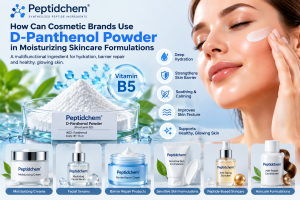
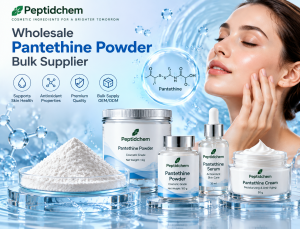
D-Panthenol Powder is the stable powder form of Dexpanthenol, a derivative of Vitamin B5 (pantothenic acid). It is widely recognized as a multifunctional cosmetic active because it works as:
- A humectant to attract and retain moisture
- A skin-conditioning agent
- A soothing ingredient for sensitive skin formulations
- A hair-conditioning ingredient
According to the Cosmetic Ingredient Review (CIR) Expert Panel, panthenol is considered safe for use in cosmetic formulations and functions as a skin-conditioning agent, humectant, and hair-conditioning ingredient.
Why Is D-Panthenol Powder Important for Clean Beauty Brands?
Modern clean beauty consumers look for products that combine:
- Safety
- Transparency
- Skin compatibility
- Functional performance
- Scientifically supported ingredients
D-Panthenol fits these requirements because it provides multiple benefits in a single ingredient.
Key benefits include:
1. Deep Hydration Support
D-Panthenol acts as a humectant by attracting water molecules and improving skin moisture balance.
Cosmetic brands commonly incorporate it into:
- Hydrating serums
- Facial moisturizers
- Barrier creams
- Sleeping masks
- Sensitive skin products
2. Skin Barrier Support
Healthy skin requires an effective barrier to reduce moisture loss.
D-Panthenol is commonly used in barrier-focused formulations because it supports skin conditioning and improves the sensory feel of skincare products.
Popular product categories include:
- Repair creams
- Post-treatment skincare
- Sensitive skin products
- Baby care products
3. Sensitive Skin Compatibility
Clean beauty brands increasingly develop products for consumers with sensitive skin.
D-Panthenol is valued because it can be combined with other gentle actives, including:
- Hyaluronic acid
- Ceramides
- Peptides
- Niacinamide
How Can Cosmetic Brands Formulate D-Panthenol Powder?
D-Panthenol Powder can be incorporated into multiple cosmetic categories.
| Product Category | Application Benefits |
|---|---|
| Facial Serum | Hydration and skin conditioning |
| Moisturizer | Moisture retention and softness |
| Anti-aging Cream | Supports active ingredient systems |
| Sunscreen Products | Improves skin feel |
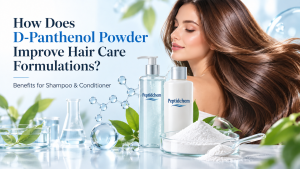
| Hair Conditioner | Hair conditioning and smoothness |
| Shampoo | Moisturizing support |
| Body Lotion | Hydration enhancement |
| Repair Cream | Barrier-focused formulations |
What Are the Recommended Formulation Considerations?
Professional formulators should consider:
Solubility
D-Panthenol Powder is water soluble and is generally incorporated into the aqueous phase of cosmetic formulations.
Processing Temperature
Manufacturers should avoid unnecessary prolonged exposure to high temperatures during processing.
Compatibility
D-Panthenol is compatible with many cosmetic actives, including:
- Peptides
- Botanical extracts
- Hyaluronic acid
- Ceramides
- Vitamins
Technical formulation guidance commonly recommends adding panthenol into water-based systems and controlling pH conditions for optimal stability.
Why Should Brands Source D-Panthenol Powder From a Professional Cosmetic Ingredient Supplier?
A reliable cosmetic ingredient manufacturer should provide:
Quality Documentation
Professional suppliers should provide:
- Certificate of Analysis (COA)
- Safety Data Sheet (SDS)
- Specification sheet
- Batch testing results
- Purity information
Manufacturing Capability
Brands should evaluate:
- Production consistency
- Quality control systems
- Regulatory compliance
- Bulk supply capability
Custom Ingredient Solutions
For advanced skincare brands, suppliers offering:
- Synthesized peptides
- Anti-aging actives
- Functional cosmetic ingredients
can support complete active ingredient development.
How Does D-Panthenol Compare With Other Cosmetic Actives?
Yes.
Modern skincare formulations increasingly combine peptides with supportive ingredients such as D-Panthenol.
Example formulation strategy:
Cosmetic Peptides
↓
Support targeted skin functions
D-Panthenol
↓
Provides hydration and conditioning benefits
Together they create multifunctional formulations targeting:
- Skin aging
- Moisture loss
- Skin texture
- Barrier improvement
For cosmetic brands developing advanced anti-aging products, sourcing both peptide ingredients and complementary actives from one experienced supplier can simplify formulation development.
Clean Beauty Product Development Opportunities
Brands can create:
Hydrating Skincare Line
Ingredients:
- D-Panthenol
- Hyaluronic acid
- Peptides
Products:
- Hydrating serum
- Moisture cream
- Face mist
Anti-Aging Skincare Line
Ingredients:
- Peptide complexes
- D-Panthenol
- Antioxidants
Products:
- Firming serum
- Wrinkle cream
- Premium night cream
Sensitive Skin Collection
Ingredients:
- D-Panthenol
- Ceramides
- Gentle botanical extracts
Products:
- Barrier repair cream
- Calming lotion
Why Choose Our Cosmetic Ingredient Manufacturing Services?
We specialize in synthesized peptide ingredients and advanced cosmetic active ingredients for global skincare brands.
Our capabilities include:
- Cosmetic peptide ingredient manufacturing
- Customized active ingredient solutions
- Bulk ingredient supply
- Technical documentation support
- OEM/ODM ingredient partnerships
📩 Contact us to request a quotation or discuss your specific requirements. Let’s build a strong partnership supply for your anti-aging cosmetics product line and we also help cosmetic brands develop innovative skincare products based on scientifically supported ingredients.
Also See
What Is Acetyl Octapeptide-3 Powder and Why Is It Used in Skincare Products
Acetyl Octapeptide-3 vs Acetyl Hexapeptide-8: What Is the Difference
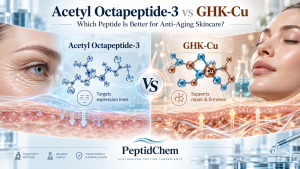
Acetyl Octapeptide-3 vs GHK-Cu: Which Peptide Is Better for Anti-Aging Skincare
FAQs:
Q1: Is D-Panthenol Powder safe for cosmetic products?
Yes. The Cosmetic Ingredient Review (CIR) Expert Panel evaluated panthenol and related ingredients and concluded they are safe for use in cosmetics under current practices of use.
Q2: What is the INCI name of D-Panthenol?
The commonly used cosmetic INCI name is:
Panthenol
Q3: Is D-Panthenol the same as Vitamin B5?
D-Panthenol is a provitamin form of Vitamin B5. After application, it can be converted into pantothenic acid.
Q4: Can D-Panthenol Powder be used with peptides?
Yes. D-Panthenol is frequently used with peptide-based cosmetic formulations because it provides complementary hydration and conditioning benefits.
Q5: What industries use D-Panthenol Powder?
Applications include:
- Skincare
- Haircare
- Personal care
- Dermatological cosmetics
- Clean beauty products
References
Cosmetic Ingredient Review (CIR). Safety Assessment of Panthenol, Pantothenic Acid, and Derivatives as Used in Cosmetics. International Journal of Toxicology.
United States Pharmacopeia (USP). Panthenol Monograph. USP-NF Standards.
Pro-Vitamin B5 (Panthenol) Cosmetic Ingredient Technical Information.