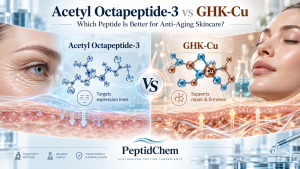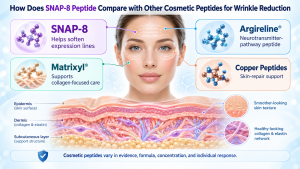






Discover the differences between Acetyl Octapeptide-3 (SNAP-8) and Acetyl Hexapeptide-8 (Argireline®), including structure, mechanism, applications, and formulation advantages. PeptidChem manufactures high-quality synthesized cosmetic peptides for global skincare brands.
Acetyl Octapeptide-3 vs Acetyl Hexapeptide-8: Complete Comparison Guide for Cosmetic Formulators
The demand for advanced anti-aging cosmetic ingredients has increased rapidly as skincare brands seek alternatives to invasive procedures. Among the most researched neurotransmitter-inhibiting cosmetic peptides are:
Both peptides are synthetic biomimetic peptides designed to influence pathways associated with facial expression lines. They share similarities because both are derived from sequences related to SNAP-25, a protein involved in the SNARE complex responsible for neurotransmitter release.
What Is Acetyl Hexapeptide-8?
Acetyl Hexapeptide-8, commonly known as Argireline®, is a synthetic six-amino-acid peptide used in cosmetic anti-aging formulations.
Its sequence is:
Ac-Glu-Glu-Met-Gln-Arg-Arg-NH₂
The peptide was designed as a biomimetic fragment of SNAP-25, a component of the SNARE protein complex involved in neurotransmitter release.
INCI Name:
Acetyl Hexapeptide-8
Common Applications:
- Anti-wrinkle creams
- Facial serums
- Eye contour products
- Expression line treatments
- Premium skincare formulations
Cosmetic Function:
Acetyl Hexapeptide-8 is classified as a peptidchem because it is studied for its ability to reduce the appearance of expression wrinkles by influencing facial muscle contraction pathways
What Is Acetyl Octapeptide-3?
Acetyl Octapeptide-3, also known as SNAP-8, is an eight-amino-acid synthetic peptide developed as an extended version of Acetyl Hexapeptide-8.
It contains two additional amino acids compared with the hexapeptide structure.
INCI Name:
Acetyl Octapeptide-3
Peptide Classification:
- Synthetic biomimetic peptide
- Neurotransmitter-inhibiting cosmetic peptide
- Anti-expression wrinkle ingredient
SNAP-8 follows the same design concept as Acetyl Hexapeptide-8 by targeting interactions associated with the SNARE complex.
What Is the Main Difference Between Acetyl Octapeptide-3 and Acetyl Hexapeptide-8?
The primary difference is their amino acid chain length and molecular structure.
| Feature | Acetyl Hexapeptide-8 | Acetyl Octapeptide-3 |
|---|---|---|
| Peptide length | 6 amino acids | 8 amino acids |
| Common name | Argireline® | SNAP-8 |
| Peptide category | Neurotransmitter-inhibiting peptide | Neurotransmitter-inhibiting peptide |
| Structural origin | SNAP-25 related sequence | Extended SNAP-25 related sequence |
| Cosmetic use | Anti-expression wrinkle formulations | Advanced anti-aging formulations |
| Molecular size | Smaller | Larger |
| Development concept | Original hexapeptide design | Extended peptide design |
Does Acetyl Octapeptide-3 Work Better Than Acetyl Hexapeptide-8?
The answer depends on the formulation objective.
Acetyl Octapeptide-3 was developed by extending the peptide sequence of Acetyl Hexapeptide-8, with the intention of improving interaction with the SNARE-related pathway.
However, direct independent clinical comparisons proving that SNAP-8 consistently outperforms Acetyl Hexapeptide-8 are limited. Cosmetic performance depends strongly on:
- peptide purity
- formulation system
- delivery technology
- concentration
- stability
- skin penetration properties
Therefore, ingredient selection should be based on formulation goals rather than peptide length alone.
How Do These Cosmetic Peptides Work?
Mechanism of Action
Both peptides belong to the category of neuropeptides.
The theoretical mechanism involves interaction with the SNARE complex, which regulates neurotransmitter vesicle release.
The SNARE complex includes:
- SNAP-25
- Syntaxin
- VAMP/Synaptobrevin
By influencing this pathway, these peptides are studied for their potential role in reducing repetitive facial movement-related wrinkle appearance.
Which Peptide Should Cosmetic Manufacturers Choose?
Choose:
Acetyl Hexapeptide-8
Suitable for:
✔ Facial serums
✔ Eye creams
✔ Daily anti-wrinkle products
✔ Established peptide formulations
For Premium or Innovative Anti-Aging Lines:
Choose:
Acetyl Octapeptide-3
Suitable for:
✔ Advanced peptide blends
✔ Luxury skincare formulations
✔ Research-driven cosmetic products
Acetyl Octapeptide-3 vs Acetyl Hexapeptide-8: Formulation Considerations
| Parameter | Acetyl Hexapeptide-8 | Acetyl Octapeptide-3 |
|---|---|---|
| Product positioning | Established cosmetic active | Advanced peptide active |
| Formulation compatibility | Widely used | Requires optimized formulation |
| Stability considerations | Peptide stability management required | Peptide stability management required |
| Suitable product formats | Serum, cream, eye products | Serum, luxury anti-aging products |
| Manufacturer requirements | High purity synthesis | High purity synthesis |
Why Choose PeptidChem as Your Cosmetic Peptide Supplier?
PeptidChem specializes in the research, synthesis, and supply of cosmetic peptide ingredients for global skincare manufacturers.
Our capabilities include:
High-Quality Synthetic Peptide Production
We manufacture:
- Acetyl Hexapeptide-8
- Acetyl Octapeptide-3
- Anti-aging peptides
- Signal peptides
- Carrier peptides
- Customized cosmetic peptides
Quality Advantages
PeptidChem focuses on:
✔ Advanced peptide synthesis technology
✔ High purity cosmetic-grade peptides
✔ Batch-to-batch consistency
✔ Customized peptide solutions
✔ Global B2B supply support
For cosmetic brands searching for a reliable Acetyl Octapeptide-3 supplier or Acetyl Hexapeptide-8 manufacturer, PeptidChem provides scalable peptide ingredient solutions.
Acetyl Octapeptide-3 and Acetyl Hexapeptide-8 Buying Guide
Cosmetic manufacturers should evaluate:
1. Purity Level
Higher purity improves:
- formulation reliability
- batch consistency
- regulatory documentation
2. Quality Documentation
Request:
- COA (Certificate of Analysis)
- HPLC purity report
- MS confirmation
- Stability data
3. Manufacturing Capability
A professional peptide supplier should provide:
- consistent synthesis capability
- technical support
- formulation guidance
Conclusion
PeptidChem specializes in the research, synthesis, and supply of high-quality cosmetic peptide ingredients, including Acetyl Hexapeptide-8 powder and Acetyl Octapeptide-3 powder. With professional peptide synthesis capabilities and B2B supply solutions, PeptidChem supports skincare brands, cosmetic manufacturers, and ingredient distributors in developing innovative anti-aging products.📩 Contact us to request a quotation or discuss your specific requirements. Let’s build a strong partnership supply for your anti-aging cosmetics product line.
Also See
Acetyl Octapeptide-3 (SNAP-8): A Next-Generation Peptide Ingredient for Wrinkle Reduction Formulas
Palmitoyl Pentapeptide-4 (Matrixyl): Why It Remains a Leading Anti-Aging Peptide Ingredient
Acetyl Tetrapeptide-5 and Acetyl Dipeptide-1 Cetyl: Functional Peptides for Eye Care Formulations
FAQs:
Q1: Are Acetyl Octapeptide-3 and Acetyl Hexapeptide-8 the same ingredient?
No. Both are synthetic peptides related to SNAP-25 research, but they have different amino acid chain lengths and chemical structures.
Q2: Which peptide is more commonly used in cosmetics?
Acetyl Hexapeptide-8 has wider commercial recognition because of its long history in cosmetic formulations.
Q3: Is SNAP-8 another name for Acetyl Octapeptide-3?
Yes. SNAP-8 is a common commercial name associated with Acetyl Octapeptide-3.
Q4: Can Acetyl Hexapeptide-8 and Acetyl Octapeptide-3 be combined?
Yes. Cosmetic formulators may combine different peptides when designing multi-functional anti-aging products.
Q5: Where can I buy Acetyl Octapeptide-3 or Acetyl Hexapeptide-8 in bulk?
PeptidChem supplies synthesized cosmetic peptide ingredients for skincare manufacturers, distributors, and formulation companies.
References
Blanes-Mira C. et al. “A synthetic hexapeptide derived from SNAP-25 inhibits neurotransmitter release.” Journal of Biological Chemistry.
Wang Y. et al. Cosmetic peptide research related to skin aging and wrinkle appearance.
Journal of Cosmetic Dermatology. “An octapeptide as a topical anti-aging cosmetic ingredient.
Cosmetic peptide mechanism studies regarding SNAP-25 and SNARE complex modulation.