





Learn how skincare brands evaluate cosmetic peptide suppliers by purity, COA, analytical testing, batch traceability, manufacturing controls, and documentation.
Why Supplier Evaluation Matters for Cosmetic Peptides
For skincare brands, selecting a cosmetic peptidchem supplier is more than comparing price per kilogram.
Peptides are specialized cosmetic ingredients, and their value depends on more than a specification sheet. Brands and formulators need confidence in identity, purity, analytical testing, batch consistency, documentation, manufacturing controls, and traceability.A reliable peptide supplier should therefore be able to demonstrate how a peptide is synthesized, purified, analyzed, released, packaged, stored, and traced from production batch to customer delivery.This is particularly important for brands developing peptide serums, eye-care products, anti-aging formulations, firming creams, moisturizers, and other advanced skincare products.The U.S. FDA’s cosmetic GMP guidance, for example, emphasizes appropriate controls for raw materials, including identification, lot identification, testing, laboratory controls, manufacturing records, and batch traceability.So, how should a skincare brand evaluate a cosmetic peptide supplier?
The answer starts with five questions:
- Is the peptide what the supplier says it is?
- Is the stated purity supported by appropriate analytical testing?
- Does the COA contain meaningful batch-specific information?
- Can every production lot be traced?
- Can the supplier consistently manufacture the same quality specification?
What Should Skincare Brands Look for in a Cosmetic Peptide Supplier?
A practical supplier qualification process can be divided into six areas:
| Evaluation Area | What Brands Should Check |
|---|---|
| Peptide identity | Chemical name, sequence, molecular information, analytical confirmation |
| Purity | HPLC or other appropriate quantitative purity method |
| Molecular confirmation | LC-MS/MS or MS where appropriate |
| COA | Lot number, specifications, actual results, test methods, release information |
| Manufacturing quality | Process controls, quality system, batch records |
| Traceability | Raw materials → synthesis → purification → testing → packaging → shipment |
A supplier that can answer these questions clearly is easier to qualify for long-term B2B cooperation.
How Do You Evaluate the Purity of a Cosmetic Peptide?
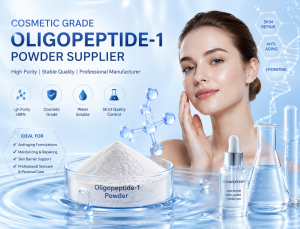
Cosmetic Grade Oligopeptide-1 Powder Supplier, purity is a key quality attribute because the manufacturing process can generate related substances, truncated sequences, deletion sequences, residual reagents, solvents, salts, or other process-related impurities.
However, a statement such as “≥98% purity” should not be evaluated in isolation.
A professional buyer should ask:
- What analytical method is used?
- Is the purity result batch-specific?
- Is the chromatogram available?
- What is the specification limit?
- Is the test method appropriate for the peptide?
- How is peptide identity confirmed?
- Are relevant residual solvents or other impurities controlled?
For analytical procedures, ICH Q2(R2) describes important validation characteristics including accuracy, precision, specificity, and appropriate evaluation of quantitative procedures. Although ICH Q2 is a pharmaceutical analytical guideline rather than a universal cosmetic-peptide regulation, its analytical principles provide useful technical context when assessing the robustness of quantitative testing.
What does high-purity peptide mean?
In a supplier qualification context, high purity generally means that the principal peptide component represents the specified proportion of the tested material according to a defined analytical method.
That distinction matters.
“98% purity” without a defined method is less informative than “≥98% by a specified HPLC method with batch-specific results.”
For this reason, skincare brands should evaluate both the numerical purity result and the analytical method behind it.
Which Tests Should a Cosmetic Peptide Supplier Provide?
Testing should be selected according to the peptide’s chemistry, intended application, customer specification, and applicable requirements.
For synthesized cosmetic peptide ingredients, a supplier’s quality package may include:
HPLC Analysis
HPLC is commonly used to evaluate peptide purity and chromatographic profile.
A buyer should look for:
- Specification
- Actual batch result
- Analytical method
- Retention time information where relevant
- Chromatogram availability
- Test date or release information
Mass Spectrometry
Mass spectrometry can provide molecular-weight information that supports peptide identity.
For synthesized peptides, MS testing can help answer an important question:
Does the measured molecular mass correspond to the intended peptide?
Appearance
A COA may specify physical characteristics such as:
- Color
- Physical form
- Appearance
- Clarity or visual characteristics where applicable
Appearance alone, however, should never replace analytical identification.
Water or Moisture
Depending on the material specification and formulation requirements, water content or loss-on-drying testing may be relevant.
Residual Solvents
Peptide synthesis and purification can involve organic solvents. Appropriate controls for residual solvents may therefore form part of a supplier’s quality specification when relevant to the manufacturing process and intended use.
Microbiological Quality
Microbial specifications may be relevant depending on the peptide material, manufacturing process, packaging, intended use, and customer requirements.
The FDA notes that cosmetic products must not contain harmful microorganisms and that raw materials should be handled and tested as appropriate to prevent contamination.
Elemental or Other Impurity Testing
Depending on the synthesis route and risk assessment, customers may request additional testing for specific impurities or elemental contaminants.
What Should Be Included on a Cosmetic Peptide COA?
A Certificate of Analysis (COA) is one of the first documents a skincare brand will request when qualifying a peptide supplier.
A useful COA should clearly connect the analytical results to a specific production lot.
Recommended COA information
| COA Item | Why It Matters |
| Product name | Confirms the material being supplied |
| Product code | Prevents material mix-ups |
| Batch/Lot number | Links the COA to a specific production batch |
| Manufacturing date | Supports batch history |
| Retest/expiry information | Supports inventory management where applicable |
| Specification | Defines acceptance criteria |
| Test result | Shows actual batch performance |
| Test method | Explains how the result was generated |
| Appearance | Confirms physical characteristics |
| Purity | Provides quantitative quality information |
| Identity | Supports confirmation of the intended peptide |
| Molecular weight/MS | Supports molecular identity where applicable |
| Microbial results | Supports microbiological quality where specified |
| Residual solvent results | Supports process impurity control where applicable |
| Release status | Demonstrates quality-control disposition |
| Authorized approval | Provides formal quality release |
A strong COA should distinguish between specification and actual result.
For example:
Purity: ≥98.0%
Result: 99.1%
is substantially more useful to a buyer than simply stating:
Purity: ≥98%.
The FDA’s cosmetic GMP guidance specifically emphasizes testing raw materials, identifying materials by lot, controlling materials that fail specifications, and maintaining laboratory and production records.
Why Is Batch-to-Batch Consistency Important?
A skincare brand may receive an excellent peptide sample during product development.
But commercial manufacturing requires something more:
Can the supplier reproduce the same specification across multiple production batches?
This is where batch consistency becomes important.
Brands should evaluate:
- Multiple COAs from different lots
- Historical purity results
- Identity confirmation
- Appearance consistency
- Impurity profile where applicable
- Microbiological results where applicable
- Packaging consistency
- Storage and shipping controls
- Customer complaint and deviation handling
A supplier should ideally maintain a controlled production and quality system capable of identifying the raw materials, processing history, analytical results, and release status associated with each batch.
FDA GMP guidance similarly emphasizes records covering the kinds, lots, and quantities of materials used, processing activities, sampling, testing, batch identification, and distribution.
What Does Traceability Mean for Cosmetic Peptide Ingredients?
Traceability is especially important for B2B cosmetic ingredient procurement.
A robust traceability system should allow a supplier to connect:
Raw Material → Synthesis → Purification → Intermediate → Final Peptide → QC Testing → Packaging → Shipment
This means that if a customer asks about a specific batch, the supplier should be able to identify the relevant production and quality records.
What should a traceability system include?
A professional cosmetic peptide manufacturer should be able to manage information such as:
- Raw-material lot numbers
- Production batch numbers
- Manufacturing dates
- Processing records
- QC sampling records
- Analytical results
- Packaging records
- Storage conditions
- Shipment information
This is not merely administrative paperwork.
Traceability helps manufacturers investigate deviations, manage customer complaints, identify affected batches, and support controlled product release.
FDA guidance for cosmetic manufacturing also highlights lot identification and records covering raw materials, manufacturing, laboratory controls, and distribution.
How Should Buyers Evaluate a Peptide Manufacturer’s Testing Capability?
When qualifying a cosmetic peptide supplier, buyers should ask for a representative quality package.
A useful supplier assessment may request:
- Product specification
- Representative COA
- Batch-specific COA
- HPLC chromatogram
- MS or identity documentation where applicable
- Microbiological specifications where relevant
- Residual solvent information where relevant
- Safety or technical documentation
- Storage conditions
- Shelf-life or retest information
- Manufacturing and traceability information
- Quality-system documentation
For analytical methods, ICH Q2(R2) highlights the importance of demonstrating characteristics such as specificity, accuracy, and precision for appropriate quantitative analytical procedures.
This gives buyers a useful framework for asking a deeper question:
Is the supplier’s test result simply reported, or is the underlying analytical method appropriately controlled?
Should Skincare Brands Rely Only on the Supplier’s COA?
A COA is important, but purchasing decisions should consider the supplier’s broader quality system.
For example, FDA’s GMP guidance for APIs states that supplier qualification should evaluate whether a supplier can consistently provide materials meeting specifications and recommends periodic comparison of supplier COAs with independent testing.
Although that guidance applies to pharmaceutical APIs rather than cosmetic ingredients, the principle is useful for B2B ingredient qualification:
Supplier documents should be supported by a demonstrated quality system.
For a new cosmetic peptide supplier, a buyer may therefore consider:
- Initial sample testing
- Independent laboratory confirmation
- Comparison of supplier and customer test results
- Periodic verification
- Review of multiple production lots
- Supplier quality assessment
The appropriate level of verification depends on the customer’s risk assessment and quality requirements.
What Manufacturing Information Should a Cosmetic Peptide Supplier Provide?
For skincare brands, there can be a meaningful difference between a company that manufactures synthesized peptide ingredients and a company that simply resells finished materials.
When evaluating a peptide manufacturer, buyers may ask:
Does the supplier manufacture synthesized peptides in-house?
This helps clarify control over:
- Synthesis
- Purification
- Quality testing
- Batch release
- Packaging
- Technical support
Can the supplier provide customized specifications?
Different brands may have different requirements for:
- Purity
- Packaging
- Batch size
- Documentation
- Analytical testing
- Delivery format
- Technical specifications
Can the supplier support commercial-scale supply?
A supplier should be able to explain:
- Minimum order quantities
- Standard production lead time
- Packaging options
- Batch availability
- Quality documentation
- Export documentation
- Long-term supply capability
For B2B buyers, this information can be as important as the initial sample price.
How Do You Compare Two Cosmetic Peptide Suppliers?
A practical supplier comparison can use a weighted evaluation model.
| Evaluation Factor | Key Question |
| Purity | Does the material meet the required specification? |
| Identity | Is the peptide identity adequately confirmed? |
| Analytical testing | Are methods appropriate and controlled? |
| COA | Does the COA provide actual batch results? |
| Traceability | Can the production history be reconstructed? |
| Batch consistency | Are multiple lots consistent? |
| Documentation | Can the supplier provide the required technical package? |
| Manufacturing | Is the supplier an actual manufacturer or reseller? |
| Customization | Can specifications and packaging be adapted? |
| Supply capacity | Can the supplier support commercial demand? |
| Quality response | How are deviations and complaints handled? |
| Price | Is the total value competitive? |
The best supplier is not necessarily the cheapest supplier.
For high-value skincare formulations, a slightly higher ingredient price may be economically preferable if it reduces:
- Batch failures
- Reformulation
- Incoming-material rejection
- Delayed production
- Documentation problems
- Quality investigations
- Supply interruptions
What Questions Should You Ask a Cosmetic Peptide Manufacturer Before Ordering?
Before placing a commercial order, skincare brands can ask:
Product Quality
Q: What purity specification do you guarantee?
Q: Which analytical method is used for purity testing?
Q: How is peptide identity confirmed?
Q: Can you provide HPLC and MS data where applicable?
COA and Documentation
Q: Is the COA batch-specific?
Q: Does the COA show actual test results rather than specifications only?
Q: Can you provide representative analytical data?
Manufacturing
Q: Are the peptides synthesized and purified under your own manufacturing control?
Q: What quality controls are performed during production?
Q: How do you manage deviations and out-of-specification results?
Traceability
Q: Can every finished lot be traced to its production records?
Q: How are raw-material and batch numbers controlled?
Commercial Supply
Q: What is the minimum order quantity?
Q: What packaging formats are available?
Q: Can you support customized specifications?
Q: What is the typical production lead time?
These questions can quickly separate a documentation-focused manufacturer from a supplier that mainly competes on price.
Why Synthesized Peptide Manufacturing Experience Matters
Synthesized peptide ingredients require controlled chemistry, purification, analytical characterization, and batch management.
A specialized supplier should understand that peptide quality is not determined at the synthesis step alone.
The overall quality chain can be viewed as:
Synthesis → Cleavage/Processing → Purification → Characterization → Quality Control → Batch Release → Packaging → Traceability
Each stage can influence the final material.
For skincare brands, working directly with a manufacturer specializing in synthesized peptide ingredients can provide a clearer technical communication channel between formulation development and raw-material production.
This can be especially useful when a brand requires:
- High-purity peptide ingredients
- Specific peptide sequences
- Customized specifications
- Bulk peptide supply
- Batch-specific COAs
- Analytical documentation
- Long-term supply agreements
- Private-label or formulation development support
What Should a Good Cosmetic Peptide Supplier’s Quality Package Look Like?
A buyer can think of supplier documentation as a three-level system.
Level 1: Basic Commercial Documentation
- Product specification
- COA
- SDS
- Product information
Level 2: Technical Quality Documentation
- HPLC data
- MS/identity data
- Analytical methods
- Batch information
- Stability or storage information where applicable
- Microbiological information where relevant
Level 3: Supplier Qualification Evidence
- Manufacturing information
- Quality-system documentation
- Traceability procedures
- Batch records or appropriate summaries
- Supplier audit information where applicable
- Change-control information
- Deviation/OOS management
- Ongoing quality monitoring
The exact documentation package will vary by supplier, peptide, market, and customer requirements.
How Can Brands Reduce Cosmetic Peptide Supply-Chain Risk?
The most effective approach is to qualify the supplier before commercial procurement.
A simple process is:
Step 1: Define the peptide specification
Establish the required:
- Peptide identity
- Purity
- Physical form
- Packaging
- Storage requirements
- Testing requirements
Step 2: Request documentation
Obtain:
- Specification
- COA
- SDS
- Analytical data
- Manufacturing information
Step 3: Evaluate the sample
Where appropriate, perform internal or third-party testing.
Step 4: Compare multiple lots
Do not rely entirely on one development sample.
Step 5: Evaluate traceability
Confirm that the supplier can connect the finished lot with its manufacturing and QC history.
Step 6: Approve the supplier
Document the supplier qualification decision and agreed specifications.
Step 7: Monitor ongoing performance
Review:
- Batch consistency
- COA reliability
- Delivery performance
- Complaints
- Deviations
- Changes to specifications or manufacturing
This creates a more robust supplier-management process.
Why Choose a Synthesized Peptide Ingredient Manufacturer?
For skincare brands seeking a long-term cosmetic peptide supplier, manufacturing capability, analytical quality, documentation, and traceability should be evaluated together.
Our focus is the manufacture of synthesized peptide ingredients for cosmetic and skincare applications, with attention to purity, analytical characterization, batch control, and documentation.
For B2B customers, the objective is not simply to supply a peptide sample. It is to provide a reproducible raw material that can be evaluated, qualified, purchased, and incorporated into commercial formulation development.
Depending on customer requirements, a peptide ingredient supplier may support:
- High-purity synthesized peptide ingredients
- Cosmetic-grade peptide raw materials
- Batch-specific COAs
- Analytical testing documentation
- Peptide identity characterization
- Bulk supply
- Customized specifications
- Technical documentation for formulation teams
- Long-term B2B supply
Looking for a cosmetic peptide supplier for your next skincare formulation?
Request the product specification, COA, analytical documentation, MOQ, packaging options, and commercial quotation before making a supplier decision.
Conclusion:
Choosing a reliable cosmetic peptide supplier requires more than comparing price. Skincare brands should evaluate peptide purity, identity, analytical testing, batch-specific COAs, manufacturing quality, and full traceability. For synthesized peptide ingredients, a supplier that provides consistent quality, transparent documentation, and reliable batch control can help brands reduce supply-chain risk and build stronger, long-term product development partnerships.📩 Contact us to request a quotation or discuss your specific requirements. Let’s build a strong partnership supply for your anti-aging cosmetics product line.
Also See
Acetyl Octapeptide-3 (SNAP-8): A Next-Generation Peptide Ingredient for Wrinkle Reduction Formulas
Palmitoyl Tetrapeptide-7 and Palmitoyl Tripeptide-1: Key Peptides for Advanced Skincare Products
Acetyl Tetrapeptide-5 and Acetyl Dipeptide-1 Cetyl: Functional Peptides for Eye Care Formulations
FAQs:
Q1:What is a cosmetic peptide supplier?
A cosmetic peptide supplier provides peptide raw materials used by skincare and personal-care manufacturers. A specialized supplier may manufacture synthesized peptide ingredients and provide specifications, COAs, analytical data, and technical documentation.
Q2:What purity should cosmetic peptides have?
There is no single universal purity specification for every cosmetic peptide. The appropriate specification depends on the peptide, analytical method, intended application, and customer quality requirements. Buyers should evaluate the purity specification together with the analytical method and batch-specific result.
Q3:What is a COA for cosmetic peptides?
A Certificate of Analysis is a quality document associated with a particular material or batch. It typically provides specifications and test results for attributes such as identity, purity, appearance, and other applicable quality parameters.
Q4:Why is batch traceability important?
Batch traceability allows a supplier and customer to connect a finished peptide lot with its manufacturing, testing, packaging, and distribution history. This supports quality investigations, complaint handling, and supply-chain control.
Q5:Should I request an HPLC chromatogram from a peptide supplier?
For synthesized peptides, requesting relevant chromatographic evidence can be useful during supplier qualification because HPLC can provide information about chromatographic purity and related peaks. The exact testing approach should be appropriate for the peptide and specification.
Q6:Is MS testing important for synthesized peptide ingredients?
Mass spectrometry can provide molecular-weight information that supports peptide identity. Whether it is required for every batch should be determined according to the supplier’s quality specification, analytical strategy, customer requirements, and risk assessment.
Q7:Should skincare brands test peptide samples independently?
Independent testing can be useful, particularly when qualifying a new supplier or validating supplier analytical results. The appropriate frequency depends on the ingredient risk, supplier history, customer quality system, and applicable requirements.
References
U.S. Food and Drug Administration (FDA) — Good Manufacturing Practice Guidelines/Inspection Checklist for Cosmetics. The guidance discusses raw-material identification, lot control, testing, laboratory controls, manufacturing records, and distribution records.
U.S. Food and Drug Administration (FDA) — Cosmetic Ingredient Suppliers: Fact Sheet. Provides regulatory context for suppliers of cosmetic ingredients and raw materials.
U.S. Food and Drug Administration (FDA) — Product Testing of Cosmetics. Explains cosmetic safety responsibilities, available ingredient safety information, and the role of scientifically sound testing.
ICH Q2(R2) — Validation of Analytical Procedures. Provides internationally recognized principles concerning analytical validation characteristics including accuracy and precision.
FDA — Q7A Good Manufacturing Practice Guidance for Active Pharmaceutical Ingredients. Although directed toward APIs rather than cosmetic ingredients, it provides useful principles for supplier qualification, COA reliability, identity testing, and periodic verification.
FDA — Modernization of Cosmetics Regulation Act of 2022 (MoCRA). Provides current U.S. regulatory context concerning cosmetic safety substantiation and cosmetic manufacturing requirements.